
In this update10
Full notes
Full LithoBreak update
Read the full published notes in a cleaner layout. The original post stays linked below.
What changed
- Maps
- Gameplay
- UI and audio
- Performance
LithoBreak changes
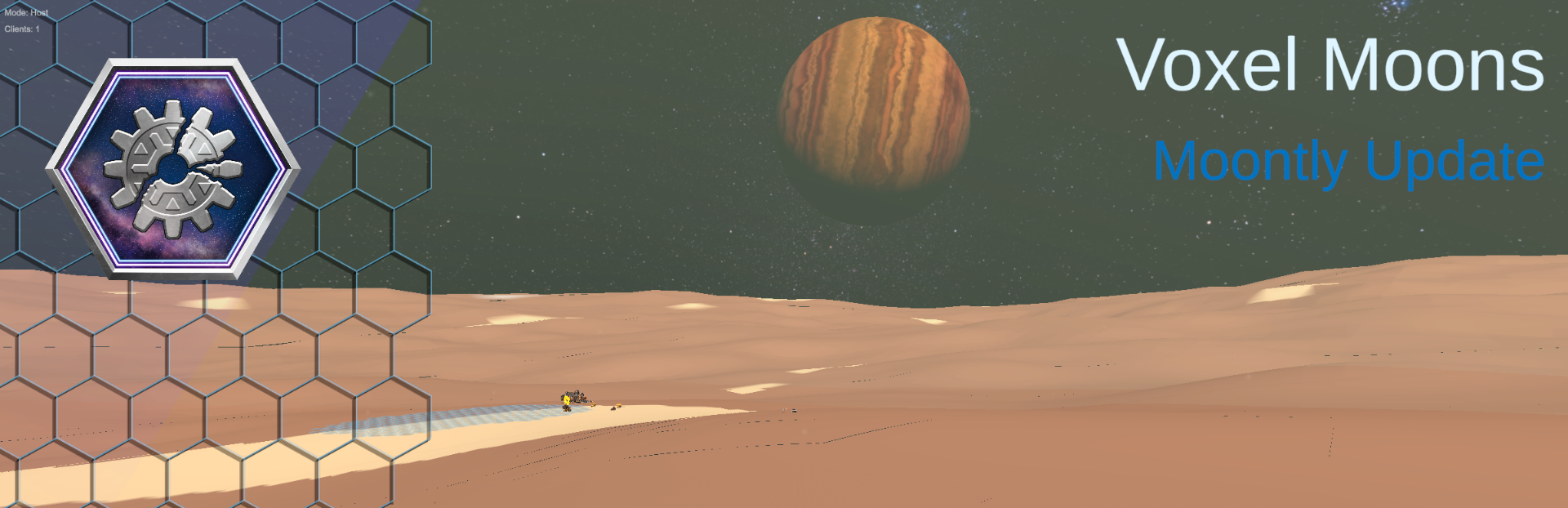
🌕 Moonthly Update — The Voxel Moons Preview
Another full moon, another moonthly LithoBreak update.
This one is different.
The old moon terrain is gone.
In its place: an in-progress preview of LithoBreak’s new voxel moon system.
This has been years in the making.
Why Voxel Moons?
We have wanted mineable, real-scale voxel moons for a long time.
The problem wasn’t desire; it was figuring out how to do it right.
As far as we can tell, no one has implemented voxel moons at this scale using a Body-Centered Cubic (BCC) grid. Most voxel guides, engines, and tutorials assume cubic grids. Almost everything online points you toward marching cubes on cube voxels.
That works, but it wasn’t what we wanted.
Exploration First
The vision for LithoBreak leans heavily into exploration.
Real terrain has strange formations, unexpected slopes, ridgelines, bowls, impact scars — places that feel like no one has stood there before.
Empedocles alone is roughly 90,000,000 square kilometers of surface area.
There are multiple moons in the Aristarchus system.
When you choose a direction and walk for kilometers, it should feel plausible that no one has been there.
Voxel moons let us do that.
Steam post imageImage with the character circled in red
Steam post imageZoomed out Image with the mining equipment circled in red
Living Off the Land
We also wanted the terrain to be:
Mineable
Physically meaningful
Volume-consistent
The regolith that goes into your rover is the same volume removed from the moon surface.
Surface coloration hints at what ores and chemical materials are present beneath.
You’re not harvesting from an abstract resource node.
You’re carving into the moon.
Why BCC Instead of Cubes?
Both cubic voxels and BCC voxels:
Tile infinitely
Can be smoothed
Can scale to realistic sizes
Have tradeoffs
But the way they connect differs.
A cubic grid has:
6 direct face-sharing neighbors
8 corner-sharing neighbors
A BCC grid has:
14 nearly equal-distance face-sharing neighbors
In practice, that means BCC can smooth more naturally in all directions, behaving more uniformly when up isn't a static vector direction. Moons are spheres, so 'up' is relative.
So, we chose the road less traveled. It took longer as the guides are almost exclusively cubic.
But we are Tau Ceti Labs. We are here to experiment.
Steam post imageImage of non-smoothed BCC grid mesh
How It Works
Each moon has its own:
Generation algorithm
Material distributions
Surface characteristics
Terrain is generated in two different ways for rendering and simulation. When mining the surface, both visuals and physics colliders update to reflect the edits.
1️⃣ Visual Terrain (LOD-Based Rendering)
Visually, the moon is broken into rendering chunks at multiple Levels of Detail (LODs).
We use 21 LOD levels, allowing us to render a distant orbiting moon with a few dozen triangles all the way to representing single 0.5 cubic meter voxel directly below your boots. Everything in between is covered by the rendering system increasing or decreasing the visual fidelity in real time, 1000 km orbits to hills 10 km away.
This is what makes real-scale moons even remotely feasible.
2️⃣ Physics Terrain (Colliders)
Visual meshes are only half the story.
We also generate terrain specifically for:
Character collision
Mining sites
Rover traversal (soon)
For the local player, only 1:1 voxel terrain immediately surrounding them is generated. This is the highest detail the terrain gets, and this is intentionally kept small and locally computed so that it can generate rapidly. As you move, old terrain is removed from memory and new terrain is generated ahead.
You can walk for kilometers and always have something solid beneath your boots.
The same is similar for mining site terrains, only the generated terrain is much larger and the position is fixed. This is to facilitate rover physics and equipment placement with true 1:1 voxel terrain.
Steam post imageSimulation of terrain being mined
What You Can See Today
Currently you can explore in first-person and use a third-person mining console.
You can see distant hills and begin to see curvature — but not dramatically yet. Game render distance is currently hard-locked to about 50 km given floating point precision. That might sound large, but our real-scale Empedocles moon is 2700 km radius, which itself is small compared to the distances of other orbiting bodies.
But wait, how do we render those distant orbitals then?
We squish everything down dramatically. As long as the distance pulled in is proportional to the scale and we track the camera movement, it looks the same in game. We will be doing the same process to the visual LOD system over the coming moons, where voxel by voxel the meshes warp to keep within that rendering distance.
Performance Reality
Let’s be transparent at this early stage.
It can hit ~60 FPS in development mode
Loading hitches can be severe
Visual terrain does not stream in fast enough yet
Running across the surface can cause LOD drops underfoot
Catch-up time can take tens of seconds
Optimization will come in time, but optimizing too early is simply extra work. Multi-threaded mesh generation and smarter streaming are still being implemented to make it playable, but polish will come later.
This build is a preview, not a finished terrain system.
What This Unlocks
With terrain generation and editing working:
True ore veins become possible
Multiple mining sites across a single moon
Vehicles for meaningful traversal
Console-based site switching
Persistent carved terrain
This is the foundation for Stage 3 and beyond.
Roadmap
Procedural Terrain has been pulled forward into Stage 2. We made this change because if we were going to do it, it needed to come sooner so it could be part of the LithoBreak foundation.
The old terrain is gone; this preview is the new baseline.
Full Moon Cadence
Main branch updates continue landing each full moon.
This one isn’t flashy polish, it’s infrastructure. The kind that makes the rest of the game possible.
Next up:
Vehicle Preview
Metals
Thanks for sticking with us while we build something ambitious.
— Tau Ceti Labs 🌕
Source
Changelog.gg summarizes and formats this update. How we read updates.