
Full notes
Full Zooconomy update
Read the full published notes in a cleaner layout. The original post stays linked below.
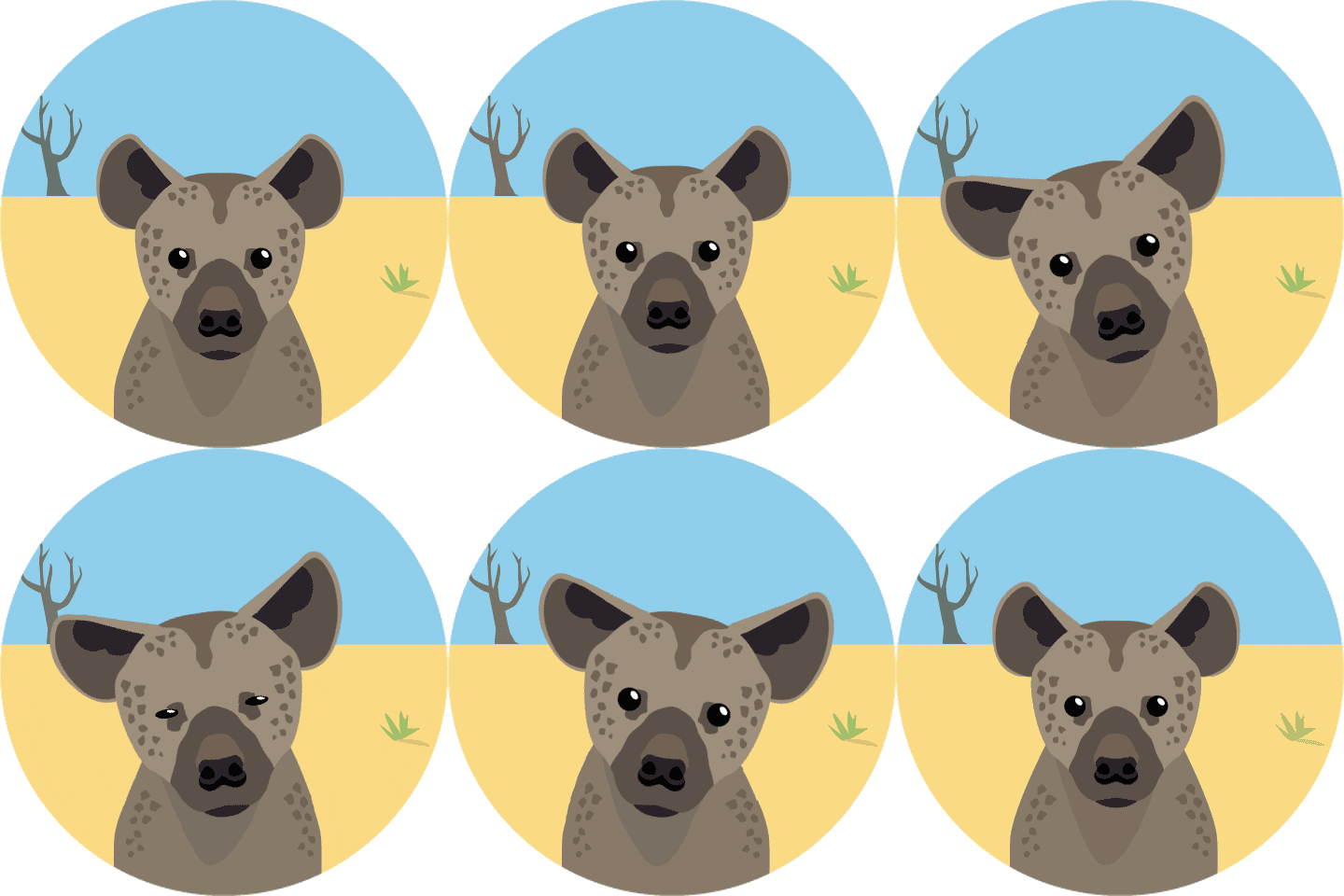
And now something spotted, but quite dangerous - we will get acquainted with the spotted hyena.
Spotted Hyena
The spotted hyena has a strong and well developed neck and forequarters, but relatively underdeveloped hindquarters. The rump is rounded rather than angular, which prevents attackers coming from behind from getting a firm grip on it. The head is wide and flat with a blunt muzzle and broad rhinarium. In contrast to the striped hyena, the ears of the spotted hyena are rounded rather than pointed. Each foot has four digits, which are webbed and armed with short, stout and blunt claws. The paw-pads are broad and very flat, with the whole undersurface of the foot around them being naked. The tail is relatively short, being 300–350 mm (12–14 in) long, and resembles a pompom in appearance. Unusually among hyaenids, and mammals in general, the female spotted hyena is considerably larger than the male. Both sexes have a pair of anal glands which open into the rectum just inside the anal opening. These glands produce a white, creamy secretion which is pasted onto grass stalks by everting the rectum. The odour of this secretion is very strong, smelling of boiling cheap soap or burning, and can be detected by humans several metres downwind. The spotted hyena has a proportionately large heart, constituting close to 1% of its body weight, thus giving it great endurance in long chases. In contrast, a lion's heart makes up only 0.45–0.57 percent of its body weight. The now extinct Eurasian populations were distinguished from the modern African populations by their shorter distal extremities and longer humerus and femur.
Fur colour varies greatly and changes with age. Unlike the fur of the striped and brown hyena, that of the spotted hyena consists of spots rather than stripes and is much shorter, lacking the well defined spinal mane of the former two species. The base colour generally is a pale greyish-brown or yellowish-grey on which an irregular pattern of roundish spots is superimposed on the back and hind quarters. The spots, which are of variable distinction, may be reddish, deep brown or almost blackish. The spots vary in size, even on single individuals, but are commonly 20 mm (0.79 in) in diameter. A less distinct spot pattern is present on the legs and belly but not on the throat and chest. Some research groups often use the spot patterns to help identify individual hyenas. A set of five, pale and barely distinct bands replace the spots on the back and sides of the neck. A broad, medial band is present on the back of the neck, and is lengthened into a forward facing crest. The crest is mostly reddish-brown in colour. The crown and upper part of the face is brownish, save for a white band above both eyes, though the front of the eyes, the area around the rhinarium, the lips and the back portion of the chin are all blackish. The limbs are spotted, though the feet vary in colour, from light brown to blackish. The fur is relatively sparse and consists of two hair types; moderately fine underfur (measuring 15–20 mm (0.59–0.79 in)) and long, stout bristle hairs (30–40 mm (1.2–1.6 in)). European Paleolithic rock art depicting the species indicates that the Eurasian populations retained the spots of their modern-day African counterparts.
Spotted hyenas are social animals that live in large communities (referred to as "clans") which can consist of at most 80 individuals. Group-size varies geographically; in the Serengeti, where prey is migratory, clans are smaller than those in the
Source
Changelog.gg summarizes and formats this update. How we read updates.