
Full notes
Full Zooconomy update
Read the full published notes in a cleaner layout. The original post stays linked below.
What changed
- Events
Zooconomy changes
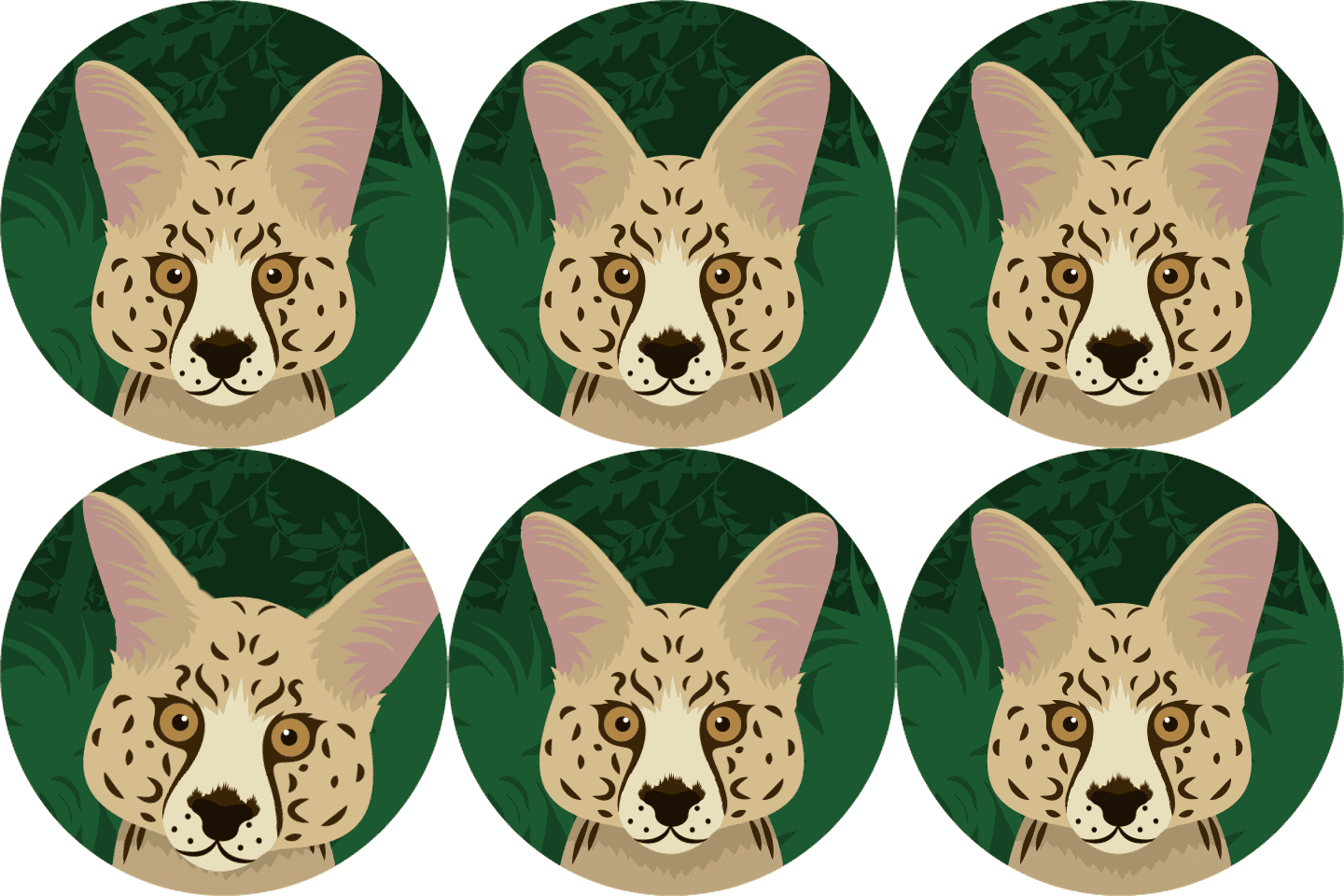
The time has come for cats, so we are going to Africa for the eared representative - Serval.
Serval
The serval is a slender, medium-sized cat; it stands 54 to 62 cm (21–24 in) at the shoulder and weighs 8 to 18 kg (18–40 lb), but females tend to be lighter. The head-and-body length is typically between 67 and 100 cm (26–39 in). Males tend to be sturdier than females. Prominent characteristics include the small head, large ears, spotted and striped coat, long legs and a black-tipped tail that is around 30 cm (12 in) long. The serval has the longest legs of any cat relative to its body size, largely due to the greatly elongated metatarsal bones in the feet. The toes are elongated as well, and unusually mobile.
The coat is basically golden-yellow to buff, and extensively marked with black spots and stripes. The spots show great variation in size. Facial features include the whitish chin, spots and streaks on the cheeks and the forehead, brownish or greenish eyes, white whiskers on the snout and near the ears, which are black on the back with a white horizontal band in the middle; Three to four black stripes run from the back of the head onto the shoulders, and then break into rows of spots. The white underbelly has dense and fluffy basal fur, and the soft guard hairs (the layer of fur protecting the basal fur) are 5–10 cm (2.0–3.9 in) long. Guard hairs are up to 3 cm (1.2 in) long on the neck, back and the flanks, and are merely 1 cm (0.39 in) long on the face. The serval has a good sense of smell, hearing and vision.
The serval is similar to the sympatric caracal, but has a narrower spoor, a rounder skull, and lacks its prominent ear tufts. The closely set ears can rotate up to 180 degrees independently of each other and help in locating prey efficiently. The serval is active in the day as well as at night; activity might peak in early morning, around twilight and at midnight. Servals might be active for a longer time on cool or rainy days. During the hot midday, they rest or groom themselves in the shade of bushes and grasses. Servals remain cautious of their vicinity, though they may be less alert when no large carnivores or prey animals are around. Servals walk as much as 2 to 4 kilometres (1+1⁄4 to 2+1⁄2 miles) every night. Servals will often use special trails to reach certain hunting areas. A solitary animal, there is little social interaction among servals except in the mating season, when pairs of opposite sexes may stay together. The only long-lasting bond appears to be of the mother and her cubs, which leave their mother only when they are a year old.
Both males and females establish home ranges, and are most active only in certain regions ('core areas') within them. The area of these ranges can vary from 10 to 32 square kilometres (4 to 12 square miles); prey density, availability of cover and human interference could be significant factors in determining their size. Home ranges might overlap extensively, but occupants show minimal interaction. Aggressive encounters are rare, as servals appear to mutually avoid one another rather than fight and defend their ranges. On occasions where two adult servals meet in conflict over territory, a ritualistic display may ensue, in which one will place a paw on the other’s chest while observing their rival closely; this interaction rarely escalates into a fight.
Agonistic behaviour
Source
Changelog.gg summarizes and formats this update. How we read updates.