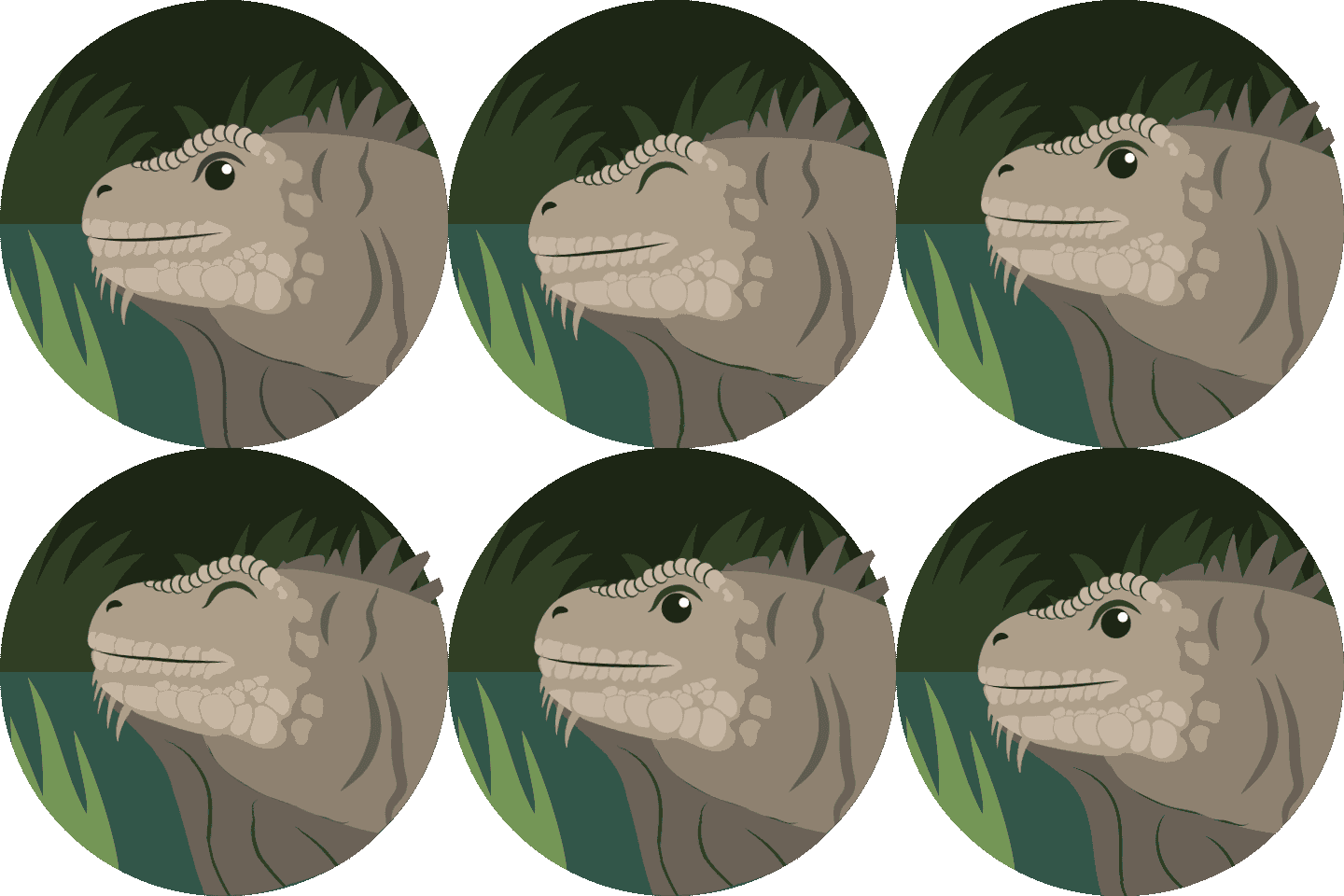
Let's travel to the Caribbean to meet threatened animal - Lesser Antillean Iguana.
In this update2
Full notes
Full Zooconomy update
Read the full published notes in a cleaner layout. The original post stays linked below.
What changed
0 fixes1 addition2 changes0 removals
Events
Gameplay
changedLesser Antillean IguanaThe Lesser Antillean iguana varies in color between different island populations, but the base color tends to be gray, with green splotching on the underside. They have large pale, ivory colored scales on their heads. The jowls of males are pink and the scales around the eyes are blue. Males also have femoral pores along each inner thigh that exude pheromones during breeding season. Males are larger than females and are 40 cm (15.5 in) long, with an 80 cm (31.5 in) tail when full-grown. Females are two-thirds this size. Lesser Antillean iguanas are primarily herbivores, feeding on leaves, flowers, fruit, and growing shoots of upwards of 100 different species of plant.
changedLesser Antillean IguanaLesser Antilean iguanas are solitary animals and only interact to mate and compete over mates. Lesser Antilean iguana males have hierarchy where dominance is signaled by their coloration; the darker grey the scales, the more dominant the individual and the more likely it is for a female to be receptive to them. During the maring season, they will establish a territory and display to females by strutting and engaging in 'head pushing' behavior with rival males. If interested, a female will approach so he can mount and mate. The mother will then search for a sandy area to dig a tunnel where she will lay her clutch of eggs, which hatch after 3 months and are immediately independent. The young will reach sexual maturity at between 3 and 5 years-old.
addedConservationThe species' greatest threat is from its own relative. The green iguana has been introduced to the Lesser Antilles as an invasive species and directly competes with the Lesser Antillean iguana for food and resources. In addition, the green iguana has been interbreeding with the Lesser Antillean iguana and this hybridization has been the number one reason for the latter species' decline on numerous islands (Basse Terre and Grande Terre (Guadeloupe), St. Barthélemy, Martinique) or complete disappearance (e.g., Les Iles des Saintes). Also on St. Eustatius hybridization has been observed. After a group of green iguanas washed ashore after hurricane Luis in 1995 on the island of Anguilla, the endemic Lesser Antillean iguana population was gone within twenty years. Recently, non-native iguanas also arrived on Dominica, the last major stronghold of the species. These iguanas were translocated together with hurricane-aid supplies during the aftermath of Hurricane Maria in 2017.
Zooconomy changes
changedThe Lesser Antillean iguana varies in color between different island populations, but the base color tends to be gray, with green splotching on the underside. They have large pale, ivory colored scales on their heads. The jowls of males are pink and the scales around the eyes are blue. Males also have femoral pores along each inner thigh that exude pheromones during breeding season. Males are larger than females and are 40 cm (15.5 in) long, with an 80 cm (31.5 in) tail when full-grown. Females are two-thirds this size. Lesser Antillean iguanas are primarily herbivores, feeding on leaves, flowers, fruit, and growing shoots of upwards of 100 different species of plant.
changedLesser Antilean iguanas are solitary animals and only interact to mate and compete over mates. Lesser Antilean iguana males have hierarchy where dominance is signaled by their coloration; the darker grey the scales, the more dominant the individual and the more likely it is for a female to be receptive to them. During the maring season, they will establish a territory and display to females by strutting and engaging in 'head pushing' behavior with rival males. If interested, a female will approach so he can mount and mate. The mother will then search for a sandy area to dig a tunnel where she will lay her clutch of eggs, which hatch after 3 months and are immediately independent. The young will reach sexual maturity at between 3 and 5 years-old.
addedThe species' greatest threat is from its own relative. The green iguana has been introduced to the Lesser Antilles as an invasive species and directly competes with the Lesser Antillean iguana for food and resources. In addition, the green iguana has been interbreeding with the Lesser Antillean iguana and this hybridization has been the number one reason for the latter species' decline on numerous islands (Basse Terre and Grande Terre (Guadeloupe), St. Barthélemy, Martinique) or complete disappearance (e.g., Les Iles des Saintes). Also on St. Eustatius hybridization has been observed. After a group of green iguanas washed ashore after hurricane Luis in 1995 on the island of Anguilla, the endemic Lesser Antillean iguana population was gone within twenty years. Recently, non-native iguanas also arrived on Dominica, the last major stronghold of the species. These iguanas were translocated together with hurricane-aid supplies during the aftermath of Hurricane Maria in 2017.
Let's travel to the Caribbean to meet threatened animal - Lesser Antillean Iguana.
Lesser Antillean Iguana
The Lesser Antilles iguana has a more blocky, shortened face than the green iguana and lacks the distinctive stripe pattern present along the green iguana's tail. The feature that most easily distinguishes these two species is the large, round scale that the green iguana has below each ear hole but which the Lesser Antillean iguana lacks.
The Lesser Antillean iguana varies in color between different island populations, but the base color tends to be gray, with green splotching on the underside. They have large pale, ivory colored scales on their heads. The jowls of males are pink and the scales around the eyes are blue. Males also have femoral pores along each inner thigh that exude pheromones during breeding season. Males are larger than females and are 40 cm (15.5 in) long, with an 80 cm (31.5 in) tail when full-grown. Females are two-thirds this size. Lesser Antillean iguanas are primarily herbivores, feeding on leaves, flowers, fruit, and growing shoots of upwards of 100 different species of plant.
Lesser Antilean iguanas are solitary animals and only interact to mate and compete over mates. Lesser Antilean iguana males have hierarchy where dominance is signaled by their coloration; the darker grey the scales, the more dominant the individual and the more likely it is for a female to be receptive to them. During the maring season, they will establish a territory and display to females by strutting and engaging in 'head pushing' behavior with rival males. If interested, a female will approach so he can mount and mate. The mother will then search for a sandy area to dig a tunnel where she will lay her clutch of eggs, which hatch after 3 months and are immediately independent. The young will reach sexual maturity at between 3 and 5 years-old.
Distribution
The Lesser Antillean iguana is found in scrub woodlands, rainforests, and mangroves throughout the Lesser Antilles on Saint Barth, Anguilla, St. Eustatius, Guadeloupe, Dominica, and Martinique. Since European settlement the species has disappeared from Sint Maarten, Saint Kitts, Nevis, Barbuda, Antigua, Marie Galante, and Îles des Saintes.
Conservation
The Lesser Antillean iguana is a critically endangered species and is found on the IUCN Red List. The Lesser Antillean iguana is legally protected from hunting throughout its range, but enforcement of these regulations is extremely difficult and therefore limited. Other threats include habitat loss to agriculture and development and the introduction of feral predators such as dogs, cats, and mongooses.
The species' greatest threat is from its own relative. The green iguana has been introduced to the Lesser Antilles as an invasive species and directly competes with the Lesser Antillean iguana for food and resources. In addition, the green iguana has been interbreeding with the Lesser Antillean iguana and this hybridization has been the number one reason for the latter species' decline on numerous islands (Basse Terre and Grande Terre (Guadeloupe), St. Barthélemy, Martinique) or complete disappearance (e.g., Les Iles des Saintes). Also on St. Eustatius hybridization has been observed. After a group of green iguanas washed ashore after hurricane Luis in 1995 on the island of Anguilla, the endemic Lesser Antillean iguana population was gone within twenty years. Recently, non-native iguanas also arrived on Dominica, the last major stronghold of the species. These iguanas were translocated together with hurricane-aid supplies during the aftermath of Hurricane Maria in 2017.
Captive Lesser Antillean iguanas are currently kept at the Durrell Wildlife Conservation Trust, the Chester