
Full notes
Full Zooconomy update
Read the full published notes in a cleaner layout. The original post stays linked below.
What changed
- Store
- Maps
Zooconomy changes
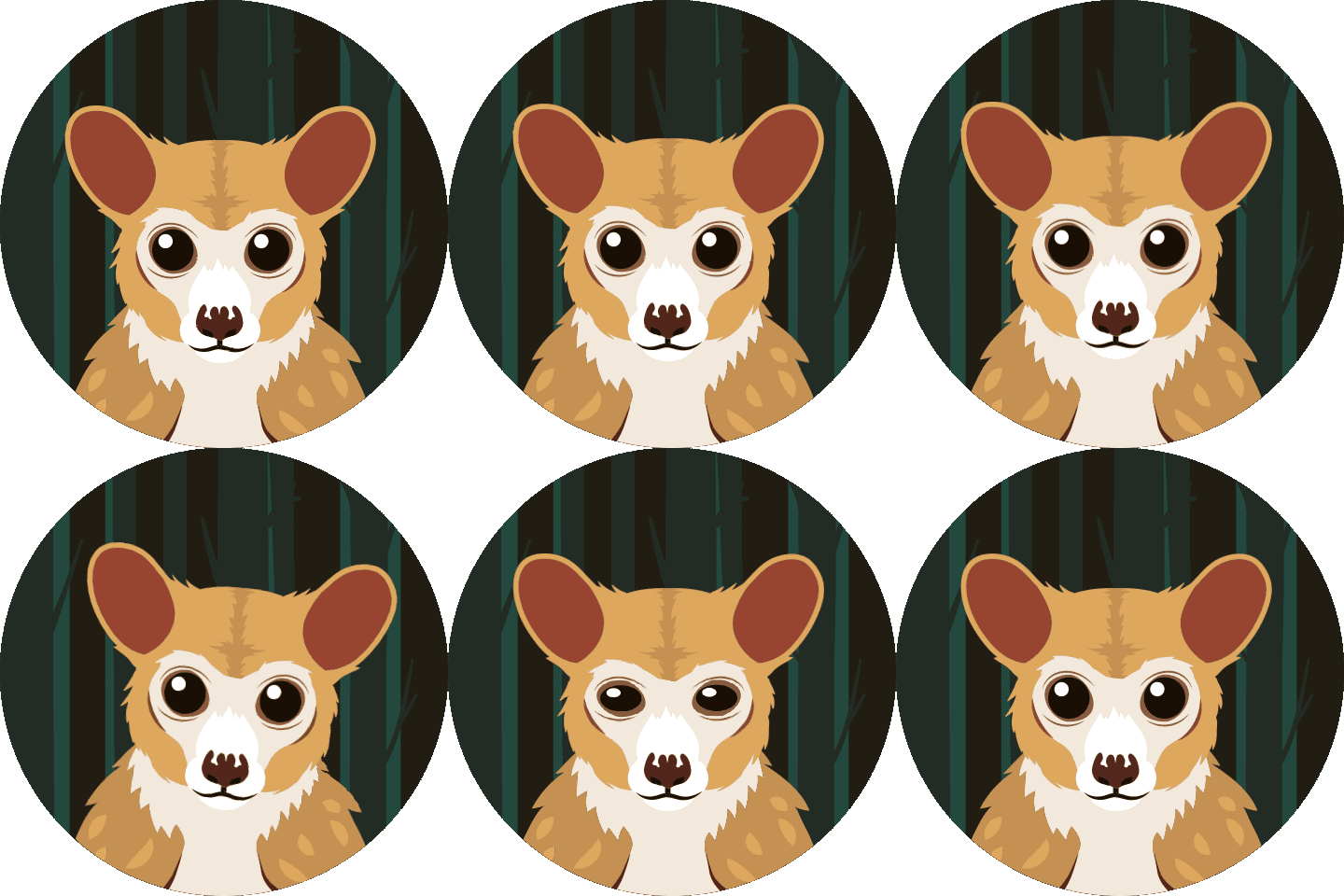
As days getting shorter let's meet a cute nocturnal animal - Brown greater galago.
Brown greater galago
This species has a rounded head with a short, wide snout, very large ears that can be moved independently and relatively large forward binocular eyes. They possess flat thickened skin pads at the ends of their fingers and toes for grasping limbs. The fingers are long and toes are flattened with flattened nails.
The thick fur is highly variable in color, depending on the subspecies: O. c. crassicaudatus exhibits dorsal pelage ranging from buff to gray extending to the face, flanks and limbs. The ventral fur is cream colored, and the tail has a darker tip. The hands and feet are darkened except on the digits. O. c. kirkii exhibits fur ranging from brown to grey on the dorsal surfaces. Ventrally, the fur is cream to yellow colored. The tail is usually light brown in this subspecies and the feet and hands lack darkening pattern.
The brown greater galago has a head-and-body length of 26 to 47 cm (32 cm on average), a tail length of 29 to 55 cm, and a weight of 0.5 to 2 kg. The brown greater galago exhibits sexual size dimorphism with males being larger than the females. This is due to bimaturism, a longer period of growth in the male, on average 84.5 more days. While males and females galagos grow at the same rate, this longer growth period results in males averaging 16% more body mass than females. On average females weigh 1.2 kg (2.6 lb), and males 1.5 kg (3.3 lb).
The brown greater galago is a nocturnal, arboreal animal. During the day, it rests 5 to 12 meters above the ground in a dense tangle of creepers or in the hollow of a tree, rarely on an exposed branch. Female galagos will make nests, leafy platforms with foliage above to shelter their young. An individual galago may have several sleeping sites throughout its home range. At night, it emerges to forage for food. It moves quadrupedally through the trees or bush. This species is capable of short jumps from tree to tree when necessary. Its diet consists of fruit (like berries, figs), seeds, acacia gum, flowers, insects, slugs, and even reptiles, small birds and mammals. An individual galago on average spends 50% of its time each night traveling and only about 20% of its time foraging. It will often follow the same patrol pathway every night. Galago lifespan in captivity is 18 years or more. It is likely that life expectancy in the wild is lower.
This species is solitary, living in a home range of a few hectares; however, there is some overlap with other individuals. Males have territories that overlap with a few females and females may have home ranges that overlap, but male territories generally do not overlap. Males tend to have a larger territory than females. The territory is marked by urine and a scent produced in a gland in the chest. Social interaction generally occurs at sites of range overlap, sites of large gum resources or prime sleeping trees. Social play is also exhibited by juveniles, sub adults and adult females with juveniles. Social grooming is absent in the greater galagos compared to other primate species. It is instead filled with a behavior known as reciprocal licking to clean each other's fur.
Vocal communication is very important in galago species with significant research systematically identifying types of calls including: raucous cry call, alarm call, contact rejection calls, distress call, infant call, mother call,
Source
Changelog.gg summarizes and formats this update. How we read updates.