
Full notes
Full Zooconomy update
Read the full published notes in a cleaner layout. The original post stays linked below.
What changed
- Events
Zooconomy changes
Let's meet someone 'giant' with long tongue and specific diet - Giant anteater.
Giant anteater
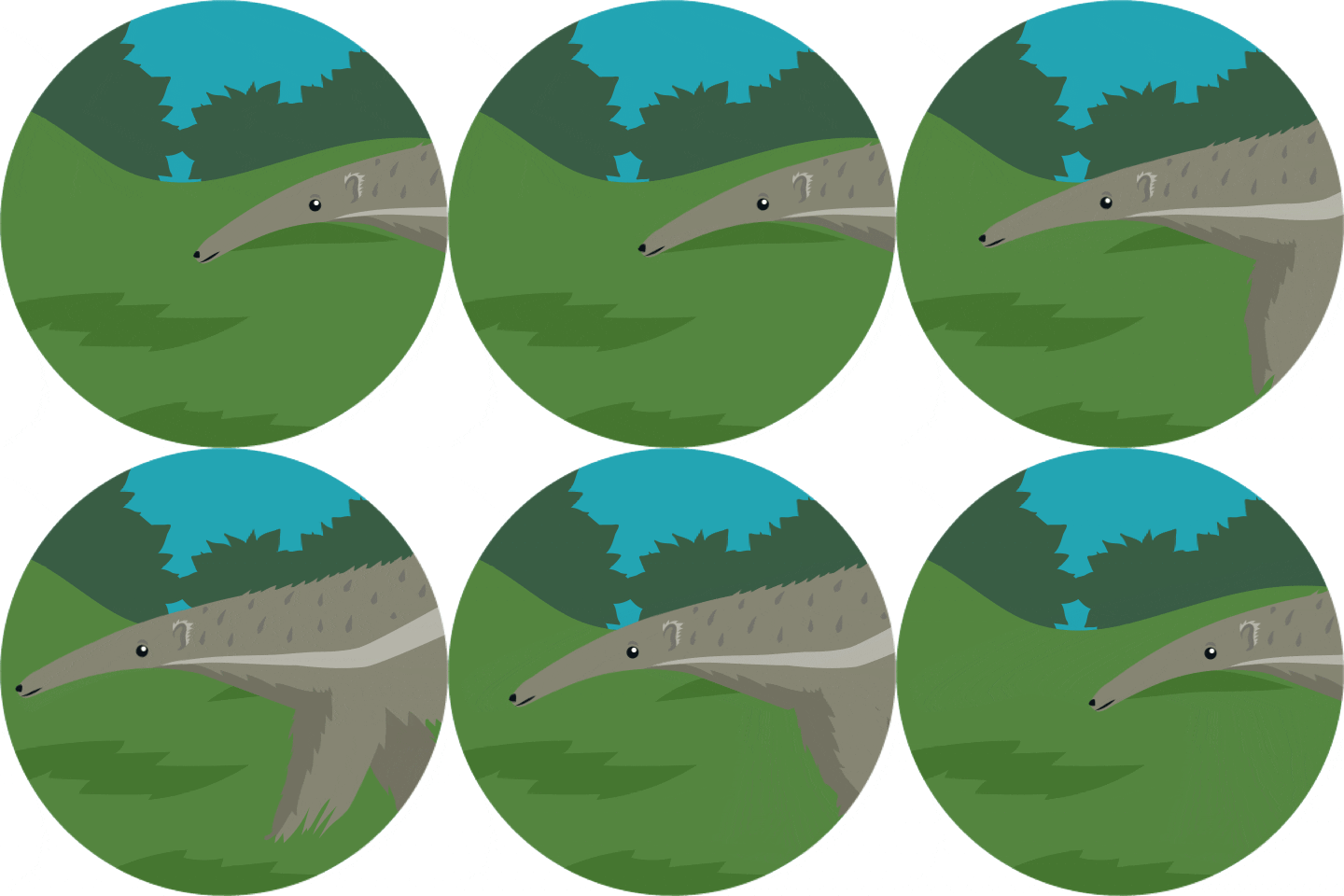
The giant anteater can be identified by its large size, elongated muzzle, and long bushy tail. It has a total body length of 182 to 217 cm (5 ft 11+1⁄2 in to 7 ft 1+1⁄2 in). Males weigh 33 to 50 kg (73 to 110 lb) and females weigh 27 to 47 kg (60 to 104 lb), making the giant anteater the biggest extant species in its suborder. The head of the giant anteater, at 30 cm (12 in) long, is particularly elongated, even when compared to other anteaters. Its tubular snout, which ends in its tiny mouth opening and nostrils, takes up most of its head. Its eyes and ears are relatively small. It has poor eyesight, but its sense of smell is 40 times more sensitive than that of humans.
Even for an anteater, the neck is especially thick compared to the back of the head, and a small hump is found at the back of the neck. The coat is mostly greyish, brown or black and salted with white. The forelimbs are white, with black bands around the wrists, while the hindlimbs are dark. Thick black bands with white outlines stretch from throat to shoulder, ending in triangular points. The body ends in a brown tail. The coat hairs are long, especially on the tail, which makes the tail look larger than it actually is. A stiff mane stretches along the back. The bold pattern was thought to be disruptive camouflage, but a 2009 study suggests it is warning coloration. While adult males are slightly larger and more muscular than females, with wider heads and necks, visual sex determination can be difficult. The penis and testes are located internally between the rectum and urinary bladder in males, and females have a single pair of mammary glands near the armpits.
The giant anteater has broad ribs. Despite its specific name, tridactyla, meaning three fingers, it has five toes on each foot. Four toes on the front feet have claws, which are particularly elongated on the second and third digits. It walks on its front knuckles similar to gorillas and chimpanzees. Doing this allows the giant anteater to keep its claws out of the way while walking. The middle digits, which support most of its weight, are extended at the metacarpophalangeal joints and bent at the interphalangeal joints. Unlike the front feet, the hind feet have short claws on all five toes and walk plantigrade. As a "hook-and-pull" digger, the giant anteater's enlarged supraspinous fossa gives the teres major more leverage—increasing the front limbs' pulling power—and the triceps muscle helps power the flexion of the thickened third digit of the front feet.
This animal is an insectivore, feeding mostly on ants or termites. In areas that experience seasonal flooding, like the grassy plains of the Venezuelan-Colombian Llanos, anteaters mainly feed on ants, because termites are less available. Conversely, anteaters at Emas National Park eat mainly termites, which occur in high density on the grasslands. At Serra da Canastra, anteaters switch between eating mainly ants during the wet season (October to March) and termites during the dry season (May to September).
Anteaters track prey by their scent. After finding a nest, the animal tears it open with its long fore claws and inserts its long, sticky tongue to collect its prey. An anteater spends one minute on average feeding at a nest, visiting up to 200 nests in one day and consuming as many as 30,000 insects. The anteater
Source
Changelog.gg summarizes and formats this update. How we read updates.