
Full notes
Full Zooconomy update
Read the full published notes in a cleaner layout. The original post stays linked below.
What changed
- Gameplay
- Events
Zooconomy changes
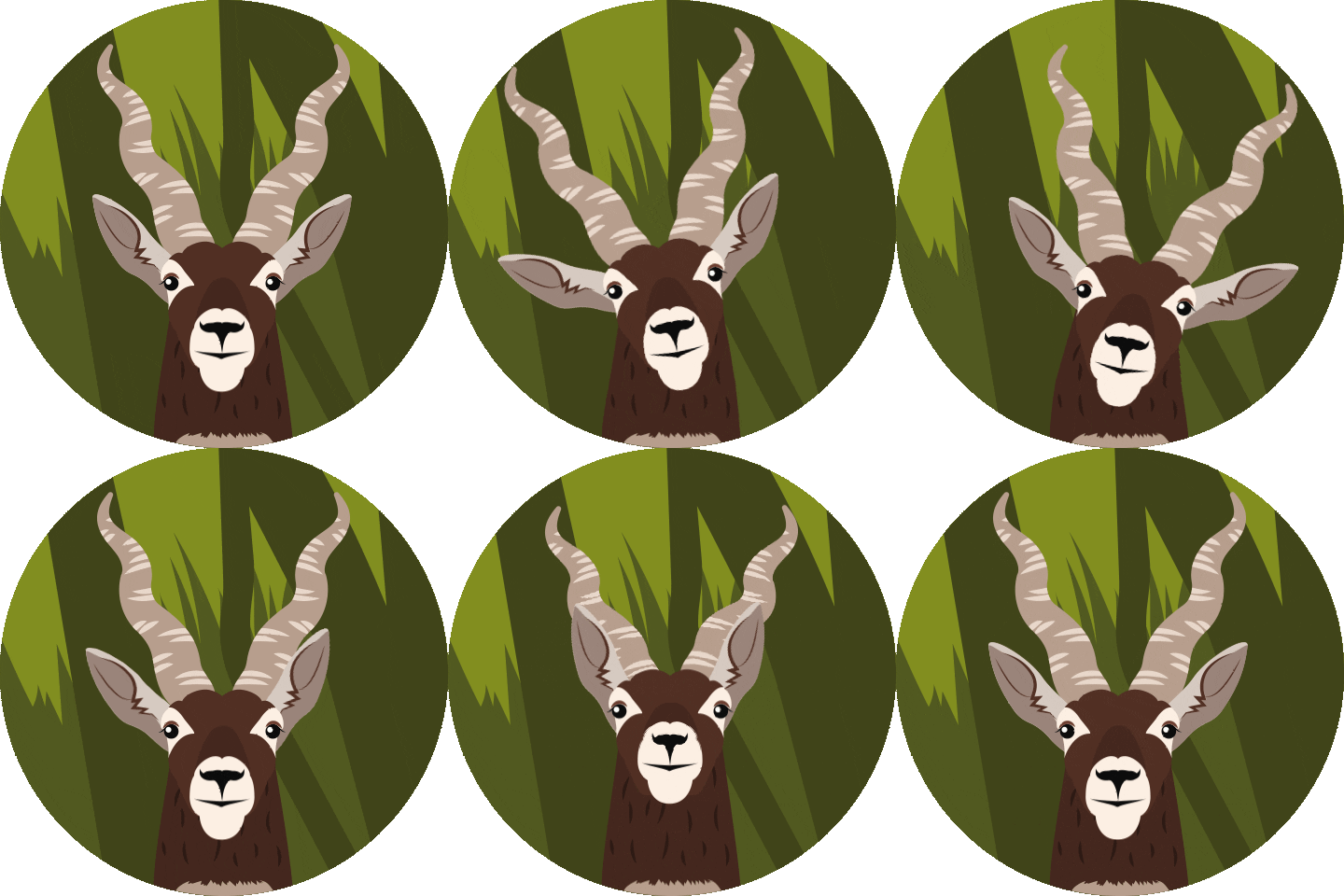
This week we will take a short trip to the India to meet local antelope - Blackbuck.
Blackbuck
The blackbuck is a moderately sized antelope. It stands up to 74 to 84 cm (29 to 33 in) high at the shoulder; the head-to-body length is nearly 120 cm (47 in). In the population introduced to Texas, males weigh 20–57 kg (44–126 lb), an average of 38 kg (84 lb). Females are lighter, weighing 20–33 kg (44–73 lb) or 27 kg (60 lb) on average. Sexual dimorphism is prominent, as males are heavier and darker than the females. The long, ringed horns, that resemble corkscrews, are generally present only on males, though females may develop horns, as well. They measure 35–75 cm (14–30 in), though the maximum horn length recorded in Texas has not exceeded 58 cm (23 in). The horns diverge forming a "V"-like shape. In India, horns are longer and more divergent in specimens from the northern and western parts of the country.
The white fur on the chin and around the eyes is in sharp contrast with the black stripes on the face. The coats of males show two-tone colouration; while the upper parts and outsides of the legs are dark brown to black, the underparts and the insides of the legs are all white. Darkness typically increases as the male ages. On the other hand, females and juveniles are yellowish fawn to tan. In Texas, blackbuck moult in spring, following which the males look notably lighter, though darkness persists on the face and the legs. On the contrary, males grow darker as the breeding season approaches. Both melanism and albinism have been observed in wild blackbuck. Albino blackbuck are often zoo attractions as in the Indira Gandhi Zoological Park (Andhra Pradesh, India).
Blackbuck bear a close resemblance to gazelles, and are distinguished mainly by the fact that while gazelles are brown in the dorsal parts, blackbuck develop a dark brown or black colour in these parts. The blackbuck is a diurnal antelope, though is less active at noon when summer temperatures rise. It can run at a speed of 80 kilometres per hour (50 mph).
Group size fluctuates and seems to depend on the availability of forage and the nature of the habitat. Large herds have an edge over smaller ones in that danger can be detected faster, though individual vigilance is lower in the former. Large herds spend more time feeding than small herds. A disadvantage for large herds, however, is that traveling requires more resources. Herd size reduces in summer.
Males often adopt lekking as a strategy on the part of males to garner females for mating. Territories are established by males on the basis of the local distribution of female groups, which in turn is determined by the habitat, so as to ensure greater access to females. The males actively defend resources in their territories, nearly 1.2 to 12 hectares (3.0 to 29.7 acres; 0.0046 to 0.0463 sq mi) in size; territories are marked with scent using preorbital gland and interdigital gland secretions, faeces and urine. While other males are not allowed into these territories, females are allowed to visit these places to forage. The male can attempt mating with visiting females. Lekking is a demanding strategy, as the males often have to bear injuries – thus it is a tactic typically adopted by strong, dominant males. Males may either defend their mates or try to forcibly copulate with them. Weaker males, who may not be dominant, might choose the second method.
The blackbuck is severely
Source
Changelog.gg summarizes and formats this update. How we read updates.