
In this update4
Full notes
Full Veliri: Planet of Machines update
Read the full published notes in a cleaner layout. The original post stays linked below.
Repeated intro
Greetings, friends!
What changed
- Balance
- Gameplay
- Store
- Server
Veliri: Planet of Machines changes
The economic model of the game has been improved. In my game, the economy is entirely driven by player actions. This means that all items in the game, from resources to hulls, can only be obtained from other players or made by oneself. At the same time, all items can be lost in battles: if you are killed, the hull and most of the cargo and equipment are destroyed.
However, this model has a problem: it will not work with low or absent online activity. To saturate the market, many people are needed to mine, craft, and trade.
Therefore, I decided to upgrade the bots to participate in trading and wrote a global trading bot that fills the market with hulls and related goods.
Bots
Some bots can now pick up items (including weapons and equipment) in the open world and take them to the base. Miners extract resources and also sell them at bases.
Trading Bot
The bot’s goal is to fill the market with hulls, weapons, etc., and also create “demand” for goods (during tests, it was found that iron is the most scarce resource :)). The bot does not generate items out of thin air (that would be too boring) and operates according to all the rules of the game:
The trading bot buys all the resources needed to craft an item;
If there are not enough items on the market, it creates purchase orders where players can sell;
When the bot has enough resources and blueprints, it crafts the item and puts it up for sale.
The bot takes the crafting assortment from the “faction shop,” so the assortment will be different in each region.
The bot also has an exit strategy to avoid affecting the market in case live trading picks up. It’s quite simple: the bot only crafts items that currently have fewer than 10 units on the market.
Pricing
If there were active trading in the game, one could take a range of transaction prices over a week, filter out the outliers, and get the “average price” according to the game. However, without players, this becomes a bit more complicated. How to determine the value of an item in currency?
I solved this problem as follows: all items in the game at a low level consist of resources, of which there are only 6. I roughly know the ratio and value of each resource and assigned each a price:
thorium — 1 cr;
copper — 1,5 cr;
iron — 2 cr;
plastic — 5 cr;
silicon — 4 cr;
titanium — 5 cr.
The sum of the prices of all resources is the fair server price of the item. It turned out to be quite high, so I had to adjust the mission rewards :)
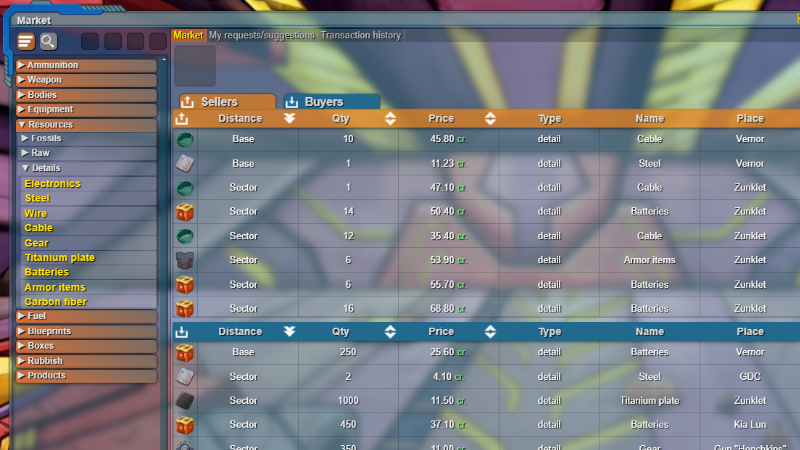
Reworked Trading Window
Now you can expand one table to the entire window;
Sorting by some fields works;
Data is loaded by filter from the back end, not all orders at once as before; 🙂
Text search for both items and orders.
Source
Changelog.gg summarizes and formats this update. How we read updates.