
Full notes
Full Traction Point update
Read the full published notes in a cleaner layout. The original post stays linked below.
What changed
- Store
- Gameplay
- UI and audio
Traction Point changes
I've tried to make the game description on Traction Point's store page as informative as possible, with lots of videos showing off different parts of the game, but there's only so much you can fit on the store page itself without making it overly long. So let's explore the core concepts presented on the store page in more detail, in a set of updates. I hope this will give you a better understanding of where I am coming from and what I am trying to accomplish with Traction Point.
I aim to publish one of these posts every week, roughly, until we've looked at all core concepts, starting with "The Joy of Driving".
Traction Point is a very personal project. I've been playing driving and racing games since the days of the original Test Drive and Need For Speed series. I've always loved the feeling of driving in games, even though I wasn't always very good at it. I'm not what you would call a "gearhead", and it was never about being the best, or playing the most realistic simulations. I simply like the idea of roaming the landscape in a large machine.
Over time, I've come to appreciate driving in games that aren't really driving games at all. The warthog in Halo is an absolute classic in my book. The game is about shooting aliens in the face, but it allows you to do it in the most satisfying way possible, from behind the wheel of the iconic vehicle. (Well OK, you don't actually shoot while driving, but you get my point. Also you can just drive over the enemy!)
Another game series I've spent a whole lot of time with are the Spintires games, especially MudRunners. The game has excellent (and reasonably realistic) driving physics, simulating everything from tire pressure to fluid dynamics for the gas in the tank, but that's not why it's awesome to me. It's because it feels satisfying to play, and you get to solve problems using large, loud, machines made out of steel and thunder.
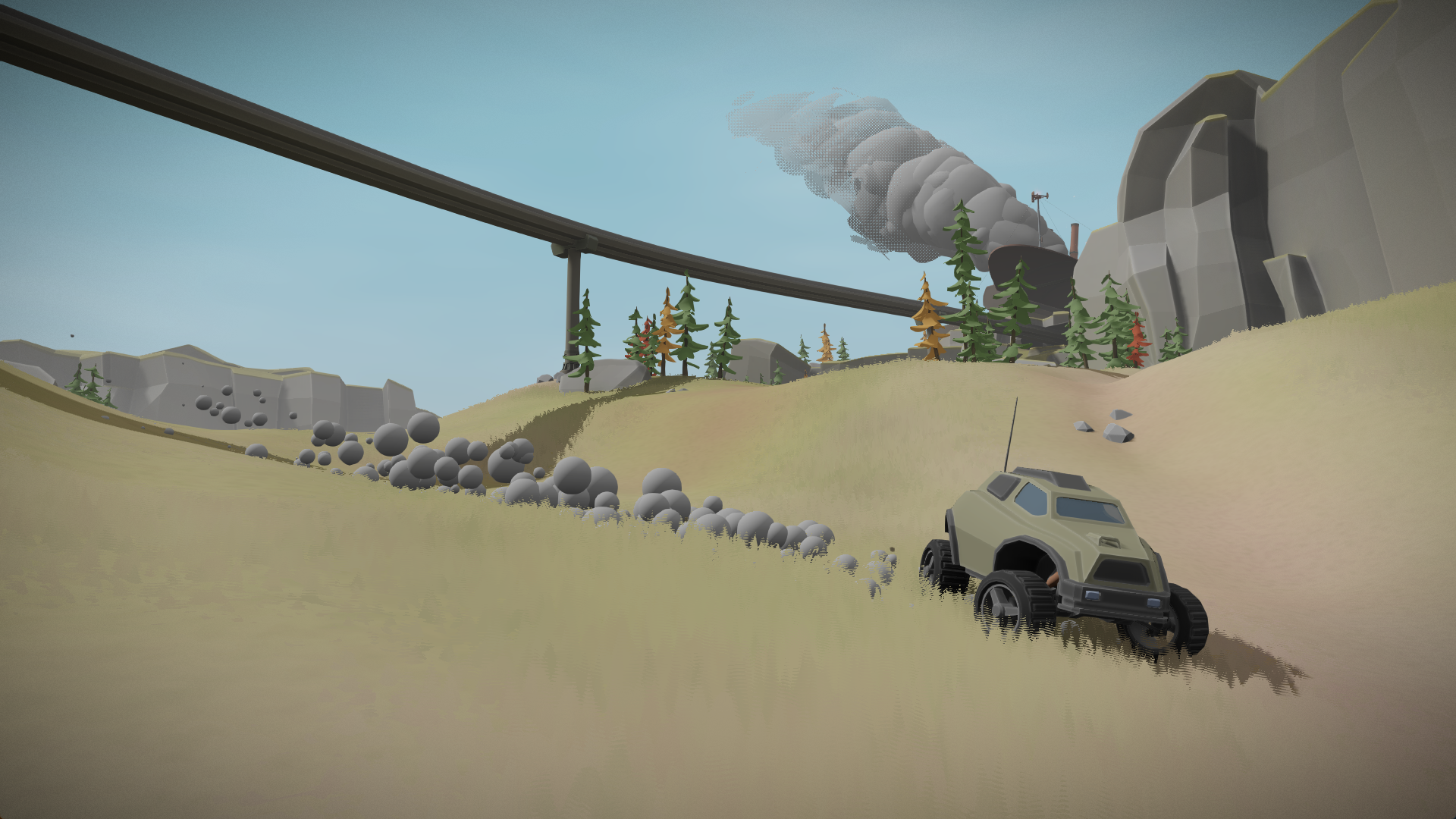
Traction Point is the game I've wanted to play for a long time. A game with really satisfying physical driving, set in a sci-fi universe, with both a single-player campaign as well as a physics sandbox mode. And it's pretty much the best thing I can pull off as a solo-dev building my own tech and creating most of the assets from scratch.
The most important part is obviously the driving, as that is how you move around the game world. I've done my best to keep it feeling really tactile and responsive. This is helped by the fact that the physics engine drives almost all of the vehicle movement in the game. PhysX, the physics engine Traction Point uses, comes with an advanced vehicle SDK which takes tire friction, gear changes, engine torque, differential, suspension etc. into account when simulating a vehicle. However, I still want the driving model to be accessible to anyone. For example, all the vehicles in the game have automatic gearboxes.
One very important aspect of getting the driving just right is the camera. I wanted to have really fast, nimble vehicles in the game, letting you live that warthog dream once more, and for that I wanted a typical racing game camera, one that stays more or less behind the vehicle, changes the field-of-view as you gain speed etc. However, that kind of camera can be very limiting when you are trying to solve a puzzle or find your way into an abandoned research station. For that, you need something closer to a typical 3rd person action game camera. So, I added that kind of camera too! By pressing the right thumbstick (or the right mouse button) you can smoothly and seamlessly switch between the two kinds of cameras.
The above video shows the seamless switching between the driving and orbit cameras. Not all vehicles use both kinds of camera. For example, Mother, the huge, yellow, lumbering cargo transporter only uses a camera which orbits around the vehicle, since you wont be doing a whole lot of racing with the Mother anyway.
There's one other thing I'd like to highlight in today's post: using dynamic physics objects as cargo. It's fun to have cargo bouncing around the back of your truck as you speed along a bumpy dirt road towards your destination, so why do very few games do this?
After working on Traction Point for a couple of years, I'm starting to understand why. With dynamic cargo you, as the driver, really are responsible for keeping the cargo inside the vehicle. But rather than seeing this as "risky" or a downside, Traction Point embraces it and makes it part of the gameplay loop.
There's only so much the player can do if the physics simulation isn't tuned properly though. During development I've had my cargo fly off into the atmosphere several times due to unfortunate physics impulses. It's much better now, but I suspect this is something I'll be working on and tuning right up until the game launches. Undoubtedly, having dynamic cargo leads to more "jank", but I think we can afford a little jank if it lets us do cool things.
In Traction Point, if you see a piece of cargo lying on the ground you have a bunch of different options for how to move it. You can push it with the scout vehicle. You can pick it up using the gripper truck. You can put it in the back of the gripper truck and then pick up the entire truck with the cargo crane of your mother vehicle, with the cargo still in the back of the truck. It's all good, it's just physics.
Phew, that was a long one. Not all of these are gonna be quite as long. But I hope it was interesting, see you next time!
--Sebastian
Source
Changelog.gg summarizes and formats this update. How we read updates.