
Full notes
Full The Last Voyage of the SS Aurelia update
Read the full published notes in a cleaner layout. The original post stays linked below.
What changed
- UI and audio
- Gameplay
The Last Voyage of the SS Aurelia changes
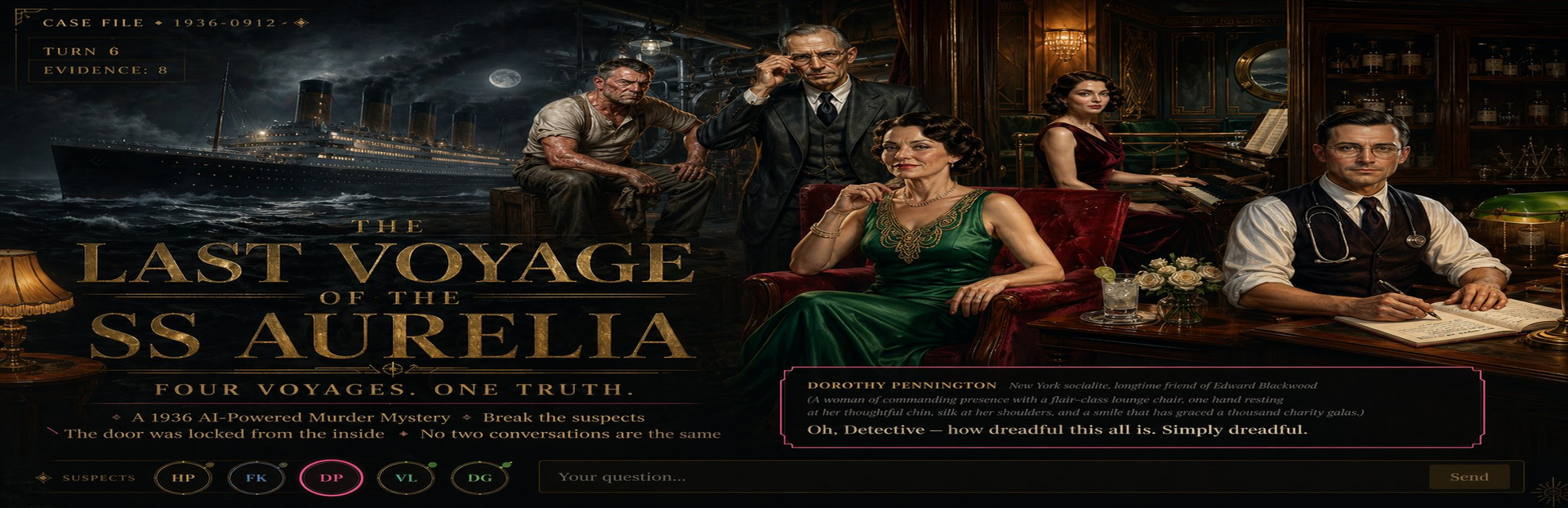
The idea behind this game is straightforward: I wanted to make a detective game where you can actually talk to suspects. Not pick from a list of pre-written options — talk to them. Ask whatever comes to mind and see how they respond.
That kind of thing wasn't really possible before. You'd need every NPC line scripted in advance, and there's only so many branches you can write. AI changed that — but when I started looking at other AI-driven games, I kept running into the same problem. The NPCs would lose character. You'd be interrogating someone and they'd suddenly say something completely out of place, or just agree with whatever you accused them of. For a mystery game, that kills the whole thing. A suspect who folds the moment you raise your voice isn't much of a suspect.
So I spent a long time figuring out how to keep the AI on track. The short version: there are two AI systems working in parallel. One evaluates the quality of your questions and reasoning. The other acts as a director for the NPC, making sure they stay in character — nervous when they should be nervous, evasive when they should be evasive, but never just making things up. Combined with some system-level guardrails, the result is NPCs that have room to improvise within the boundaries of the story.
What does that feel like in practice?
You're sitting across from five suspects. Each one has a story. Some of what they tell you is true. Some of it isn't. The game doesn't hand you a checklist of leads or tell you who to talk to next. You have to figure that out yourself — notice when someone's timeline doesn't add up, catch a detail that contradicts what another suspect told you an hour ago.
If you follow a reasonable line of questioning, the truth reveals itself gradually. It's not a sudden twist or a cutscene. It's you, realizing that two things you were told can't both be true, and going back to confront someone with that contradiction. When you finally have enough evidence to press a suspect hard, what happens next isn't a "correct answer" popup. It's a person unraveling in front of you, in their own words.
And because the dialogue is generated in real time, no two playthroughs are the same. A different opening question can lead to a completely different conversation. Different players find different cracks in different stories.
Some players will probably find angles I never anticipated. Honestly, that's part of what makes this kind of game interesting.
The game is fully playable in English, Japanese, and Chinese. In a pre-launch update, I also made it so that you can ask questions in any language a modern AI model understands — mix in some Japanese mid-conversation if you want — and the NPC will still respond in whatever language you chose at the start. They understand you regardless, but they stay in their lane.
If you like detective games — the kind where the satisfaction comes from working things out yourself — give it a look.
Source
Changelog.gg summarizes and formats this update. How we read updates.