
In this update6
Full notes
Full Survival Log update
Read the full published notes in a cleaner layout. The original post stays linked below.
Repeated intro
Hey Survivors, hope you're still kicking out there!
What changed
- Gameplay
- Performance
- UI and audio
- Balance
- Events
- Store
Survival Log changes
It's been a while since our last Dev Log. Last time we showed off Planning Mode, the Farming system, and progress on a few new scenes, and mentioned that "more survival-focused gameplay systems were deep in development." Over the past stretch, they've come together one by one.
A little while ago we ran a small closed test, inviting 200+ players to try the current build early. What surprised and genuinely warmed us was that even with some performance hitches and rough edges in the controls, everyone stayed remarkably engaged with the new content—the group chat was buzzing nonstop with talk of mechanics, systems, and survival strategy. We've since put a lot of effort into fixing the stutters, freezes, and other technical issues the test exposed. Huge thanks to this first batch of early players.
This time we're bringing previews across five directions: a complete electrical system, a multi-floor safehouse, deeper trap and cooking systems, two "survival helper tools" for before and after the disaster, and weather that hits you more directly.
(Note: all images in this log are from a build in development and don't represent final quality. The UI and presentation will be polished over time.)
A Multi-Floor Safehouse
The safehouse is no longer just one floor.
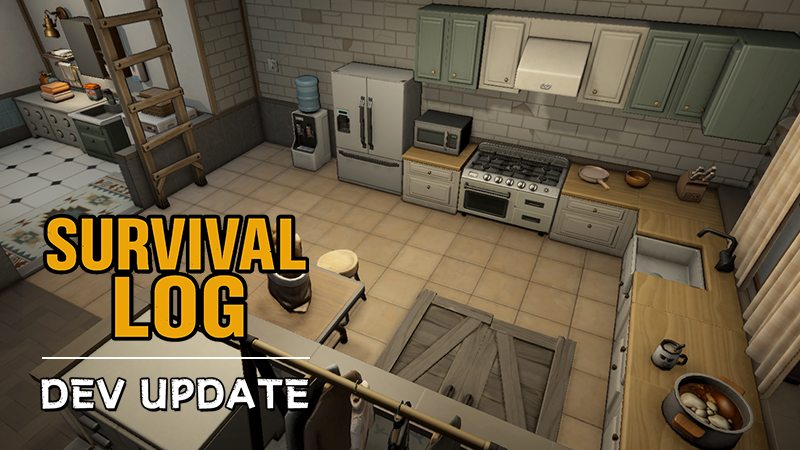
This time we focused on expanding the heroine's home. The ground floor is still the core of daily life; the second floor adds a bedroom, a storeroom, and a balcony; and the basement is for stockpiling supplies and housing big equipment like the generator. The three levels are connected by stairs, and the character moves between them on her own—tell her to water the planters upstairs and she'll walk to the stairs, climb up, head to the planter, and get to work, all without you directing every step.
The second-floor terrace is a new open space. Planters, drying racks, traps, solar panels… just about any furniture you can think of can go up there. In other words, you can run an entire survival loop at home without ever stepping outside. The safehouse's usable area is also about 40% larger than before. More space means more to do, but it also means thinking harder about one question: what should I turn this home into? That's exactly the kind of fun Planning Mode is meant to deliver.
The Complete Electrical System
Electricity is the apocalypse's most underrated luxury. Whether to keep the fridge plugged in, whether to leave a light on at night, when to spend your stored battery charge—every choice is a tradeoff against limited resources.
We gave the electrical system a full rebuild over this period. The safehouse now has a Power Overview Panel: the running status of every powered appliance, your current draw-versus-generation balance, remaining battery charge, and your solar panels' real-time efficiency—all readable at a glance. Every appliance now has an independent switch; you can keep the fridge running but cut the water dispenser, or the other way around—when power is tight, every watt counts.
Generation is more varied too. The diesel generator burns fuel for power—high output, but it eats fuel; the manual generator needs no fuel but drains your stamina; solar panels live and die by the sky, with output dropping sharply on overcast days and at night. The new weather system shapes your power rhythm—clear or cloudy skies directly affect your supply.
Traps & Cooking: Going Deeper
Last time we touched on Farming and Planning Mode; this time we want to talk about two systems that already existed but got another round of polish.
The trap system —in the previous version traps could be placed and triggered, but the feedback was weak. This time we've fleshed it out: added placement and trigger animations and sound effects, added trap slots on the second floor, and greatly expanded the range of catchable prey. Different floors and locations have different prey odds, so "where to set your traps" becomes a tradeoff worth weighing. The trap numbers have also been tuned over several passes to avoid the extremes of "always misses" or "guaranteed payout."
The cooking system —the previous version only had the basic flow. This time we did a complete pass on the recipe system, adding 14 recipes and 25 tag combinations so that common ingredients all have a use. In the cooking screen, fuel heat values are shown directly via tooltips, different fuels map to different heat levels, and the recipe-matching rules are clearer—exact recipe or free combination by tags, it's all at a glance.
Raw ingredients add another layer of tradeoff: eating them raw quickly restores a little nutrition but gives the lowest return; cooking a single item is steady and middling; a composite recipe has a shot at being great—but can also fail. The balance among the three becomes a small decision at every meal.
Two Survival Tools: The Stockpile Checklist & Smart Action Suggestions
Here we want to introduce two unobtrusive but genuinely useful quality-of-life improvements.
The Stockpile Checklist —it's a visual pre-disaster reserve sheet. The game sorts everything you can stockpile into 7 major categories and 18 dimensions, and gives you an at-a-glance "low / adequate / plentiful" readout based on your current stock. No more relying on gut memory for "did I buy enough canned food?"—just open the checklist and see what's missing. In those final hours of the disaster countdown, this list might be the last thing you check before your last sprint into the supermarket.
Smart Action Suggestions —it sits at the bottom of the post-disaster main screen and, based on your current state (hungry, exhausted, low morale, crops ready, food on the stove), automatically offers 3 suggested action buttons. One click and the character will "walk over and do it herself," no manual control needed. It won't make decisions for you—it just tells you, at the lowest possible effort, "here's what you could do right now."
These two tools bookend each other—the first helps you plan your pre-disaster reserves, the second helps you manage post-disaster daily life. We want to leave the strategy of "survival" to you, and hand the tedious busywork to the game.
The Impact of Weather
Weather is no longer just a backdrop.
Overcast skies lower your solar panels' efficiency, snowy days make outdoor activity burn more stamina, and the cold forces you to keep drinking hot beverages and bundle up in warm clothing. We've added a matching Cold debuff and the heating gear to counter it—space heaters, kettles, warm coats—and none of them are just for show; they determine whether you make it through this long winter.
Cold waves also officially enter the game as a mid-to-late-game crisis event. When one hits, temperatures plunge, staying outdoors becomes nearly impossible, and indoor heating sends your power consumption spiking—whether you stocked enough fuel and installed enough heating gear beforehand will directly decide how this crisis plays out.
The cold wave's effects don't stop there: cold-sensitive crops will stop growing or even wither in the low temperatures, so you'll need to fit them with heating gear or simply move the pots indoors to ride it out. People catch colds and run fevers in the prolonged chill too—stocking extra hot drinks and staying warm ahead of time is far easier than reaching for medicine after you've fallen ill.
On the Horizon
The "infrastructure"—multiple floors, farming, electricity, cooking, traps, weather—has steadily taken shape. Next, we want to shift our focus toward interaction between people.
The smartphone will become your window to the outside world—a neighbor's plea for help, a stranger's number striking up a chat, half-glimpsed messages in a group chat—all reaching your safehouse through this all-too-familiar device. Stranger trading lets you use a drone to carry out "contactless logistics" with distant survivors, bartering goods and haggling over prices.
We've also got some grayer mechanics in store: before the disaster you can sell blood on the black market for some startup cash, at the cost of anemia in the early post-disaster days; and as the end draws near, the streets erupt into disaster riots and"five-finger discounts"—whether you stand by or fish in troubled waters is yours to decide.
Writing all this, what we most want to say is simply: thank you, everyone, for your support and company every step of the way, and for all the valuable suggestions.
Catch you in the next one!
—— Midnight Workshop
Source
Changelog.gg summarizes and formats this update. How we read updates.