
In this update5
Full notes
Full Orbi Universo II update
Read the full published notes in a cleaner layout. The original post stays linked below.
What changed
- Maps
- Workshop
- UI and audio
- Gameplay
- Store
- Balance
Orbi Universo II changes
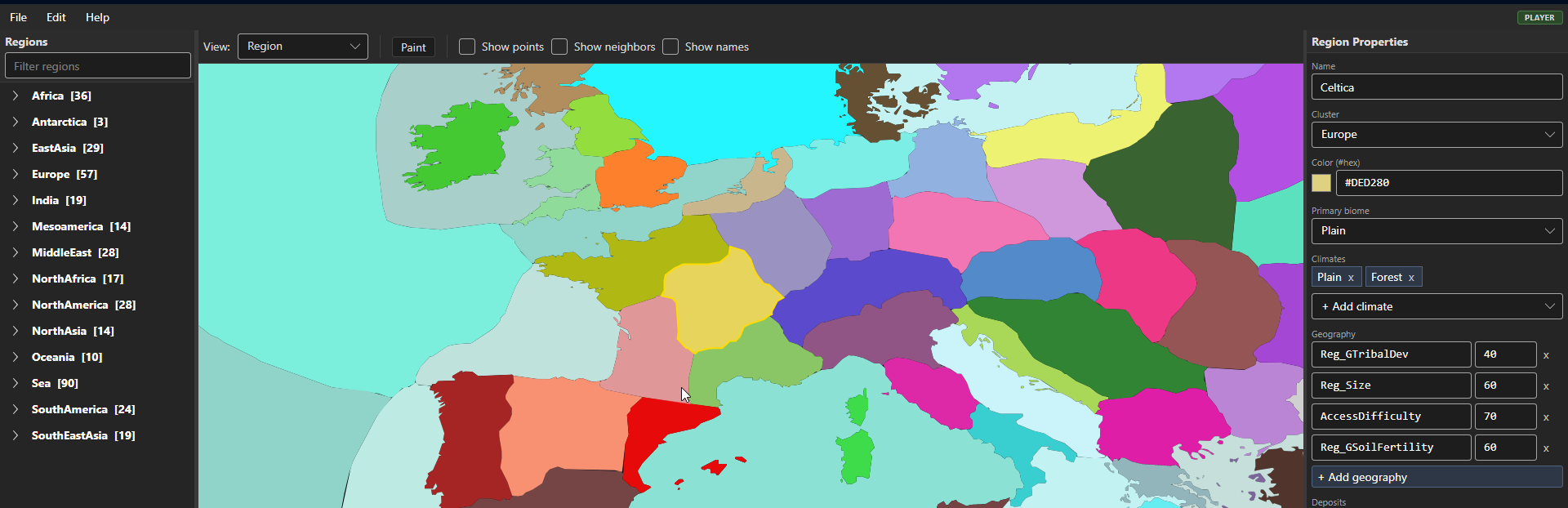
The Ouranos Editor Update lets you build your own maps. A standalone, cross-platform map editor now ships with the game: draw your own worlds, set up fixed-country scenarios, and share them on the Steam Workshop. It also brings a major overhaul of population classes and the industrial economy.
Ouranos Map Editor
A cross-platform map editor now ships alongside the game in StreamingAssets/Ouranos/. Draw regions, set their climate and geography, edit deposits and neighbors, then export a playable .oum world.
Builds ship a custom_earth.zip template, copied from vanilla, so authors start from a working world. It refreshes automatically whenever the main Earth file changes in a future update.
Ouranos is in English only for now. Localization will follow in a later update.
Custom Maps and Scenarios
The Workshop is now fully working: an in-game tool publishes your maps and pushes updates.
By default, Ouranos saves your maps to the game's AppData Maps folder, so the New Game menu finds them automatically. The new map picker lists Earth next to every installed custom map.
Scenarios let you define fixed starting countries: the regions they hold, their starting values, their culture and religion traits, and the start and end dates.
Each map can ship its own localization.csv, namespaced so its text never collides with vanilla.
Saves now record which map they began on and reload it automatically. If that map is missing, the game falls back to Earth with a warning.
The Forgotten Hyperwar, a fictional example map and scenario, is up on the Steam Workshop to show the format in action.
A note on Ouranos and the Workshop: the editor, the custom map pipeline, and the Workshop integration are all brand new. We have tested them, but some things will likely still need fixes before they run smoothly in every case. If you hit a problem or want to report a bug, join our Discord so we can sort out support and fixes together.
Population and Class/Industrial Overhaul
New Clerk Class: the scribes and palace administrators of any literate state. It spawns from Palace and Writing, Writing and Popular Education, Factories, or Financial Institutions, and evolves into the Middle Class once you have Factories. It also produces a small trickle of Political Power and feeds a little Culture.
The Middle and Clerk classes now split into six roles: Administrators, Educators, Diplomats, Engineers, Shopkeepers, and Financiers. Structures that need a given role pull people into the class.
New Encourage Clerks policy (it becomes Encourage Middle Class once you have factories). It moves people into white-collar work and eases off as they fall into unemployment.
Unemployment now treats Laborers and Middle Class as a single workforce, with a pie chart showing how the unemployed split between them so you can see which class is oversupplied.
Urban workers fall back to Peasants or Nomads when unemployment passes 25%, and surplus Middle Class steps down to Laborers or Nomads when there is no white-collar work, rather than sitting idle.
Population, Middle Class, and Elite Class now consume more Civil Goods. Per-head consumption climbs steeply with Urbanization, Industry Technology, and Electricity, so a primitive tribe barely dents the stockpile while a modern, electrified country burns through it many times faster.
New node: Industrial Profitability. It kicks in past 100 Factories and falls as the Civil Goods warehouse fills. At zero it shuts factories down, shrinks the Capitalists, demotes Merchants, and drags Stability down.
Factories are now capped by the size of the Middle Class, and that cap tightens as Factory Efficiency rises, since each factory needs more skill. Factory Efficiency itself climbs slowly and levels off near what your tech and mechanization can support.
Industrialization now turns artisans into factory workers (and a few into the middle class) as your factory base and mechanization grow, so the craft sector fades as industry takes over. Civil Crafts output saturates as the artisan sector grows: artisans stay the pre-industrial backbone, but a large workshop base no longer floods the goods market.
Factories now hire more, especially early on before automation kicks in, so a real working class forms as you industrialize. Even heavy mechanization no longer guts factory jobs, so advanced economies keep their workers. Factories also employ the middle class, more so the more mechanized they are.
Mechanized farming needs far fewer hands, so the peasant share shrinks as you industrialize while food output holds. A pre-industrial society can still be mostly peasants.
The clergy now settles at a share set by your Faith instead of piling up forever in big populations. A devout nation keeps a large priesthood, a secular one barely any, and tech alone never fully shrinks it.
Balance
Technology now hits diminishing returns past a soft ceiling: a research leader still pulls well ahead, but no single tech runs away to many times the field.
Space Program progress now scales with Computation and Natural Science, so the more advanced you are, the faster you climb to Mars.
Weapon production levels off at high Weapon Tech instead of pumping out absurd amounts, and arming stops once the stockpile is full.
Fishing output drops when fish stocks run low, so overfishing actually bites.
Foraging and hunting hit hard diminishing returns at large populations, so a modern civ no longer feeds itself on wild food.
Agriculture scales better with late tech and fertilizers.
Extraction no longer wastes mining on full or worthless stockpiles, and late-game extraction is a bit less overpowering while earlier eras are unchanged.
World tension cools down much faster once it is high.
Philosophy and Theology boost each other with diminishing returns.
Steam Engine and Nuclear Power now get a slow growth feed from Natural Science.
Urbanization produces a small trickle of Political Power, and Population and Urbanization generate more Criminality.
Recruitment can now drop to -25 to slowly disband soldiers.
Map and Fixes
The full-screen world map is sharper, especially when zoomed in, and can now show large country names (toggle on or off).
Fixed bad triangulation in big regions near the poles and the edge of the map, along with wrong or missing region neighbors and regions with empty climates or wrong biomes.
New region on Sakhalin island: Kuye.
Kaweskar deposits filled out to match the rest of Patagonia.
Fixed missing localizations and various optimizations.
Note: Save files from previous versions may not transfer to the new version.
Source
Changelog.gg summarizes and formats this update. How we read updates.