
Full notes
Full Nullpoint Protocol update
Read the full published notes in a cleaner layout. The original post stays linked below.
What changed
- Server
- UI and audio
- Gameplay
- Balance
We are almost a year into the development of Nullpoint Protocol and it occurs to us that we have been a little too tight-lipped regarding our progress! Some of you are already familiar with Everbloom Games after our nine years of creating Minecraft Marketplace content and have been kind enough to follow us as we make our first proper foray into indie game development. A number of you have also been so good as to follow what few updates we have given, but for those of you who are just joining us, let us give you a bit of a briefing on the journey so far.
If you want to watch a more detailed version of this dev diary, then check out this video on YouTube, where several of our teammates talk about their work and the process of creating this game!
Concepting Nullpoint Protocol
As with any and all projects, we started with nothing. A blank sheet of paper. A clean slate. As a team, the first thing we did was have everyone pitch various ideas to the group, making arguments for how a game concept might stand out in the modern market while taking our group’s skill level into account and, as ever, estimating what the scope of such an undertaking would be.
Between the twelve of us, we pitched twenty-five game ideas. At least, that’s how many I can remember. Some were too grand for our budget and capabilities, some were too vague or generic to feel actionable, but five of them caught our attention! We immediately started prototyping mechanics, concepting art styles, and drafting story pitches for each of them. We called them Projects Sound Wave, BB8 Murder Bot (please don’t sue us, Disney), Fear Garden, Clone Swap, and The Coanda Effect.
(Some quirky concept art for fear garden!)
Without getting into too many details, we finally settled on Clone Swap, which was intended to be a stylish action game in the same vein as Devil May Cry with a focus on being able to spawn and swap between clones of the player character. Pair that with a cuter art style and a more involved story, and we thought we had something that could stand on its own. We even had a decent prototype for the combat finished around this time last year and one of the boss monsters was nearly fully modeled, but progress was slow. Too slow. As much as we enjoyed the story of Project Clone Swap and as much as we hated the idea of tabling something that we had already dedicated lots of time to, we realized that we simply did not have the time or budget necessary to do the game justice. For one, even though we have nine years of experience as a studio, we had minimal experience with creating stylish, 3D hack and slash games and the learning curve involved was just too steep to be affordable. We were stepping a little too far out of our wheelhouse to be comfortable with the risks.
So it was back to the drawing board and back to pitching ideas. Thankfully, after a couple weeks of debate and a few new pitches, we finally settled on Project Bite Sized Raids, the brain child of Ryan and the seed of what would become Nullpoint Protocol.
Nullpoint’s Inspiration
The basic premise for Project Bite Sized Raids came from Ryan “wanting to share the experience of MMO raiding with friends who don’t have the time to reach those end-game [raids] or keep up with [the various updates], because that can sometimes feel like a full time job.” In his own words, some of these raids can require over 90 hours of game time, which many people are not willing to sink into a game, regardless of how good the end-game material is.
So we knew we wanted the combat to revolve around something that felt like the big boss raids in Final Fantasy XIV, but without the crazy amount of grinding necessary to reach those raids. One game that came across our desk as a source of inspiration was Rabbit and Steel, which is a bullet hell boss rush multiplayer game. It had a lot of features that we liked, but we did not want our game to be so punishing as a bullet hell game and we wanted our players to have the flexibility of creating their own character classes, rather than being stuck with specific builds like your usual tank or DPS fighter.
All told, we had a pretty good idea for how we wanted the gameplay to feel and an even better idea of how to achieve that.
Style Decisions
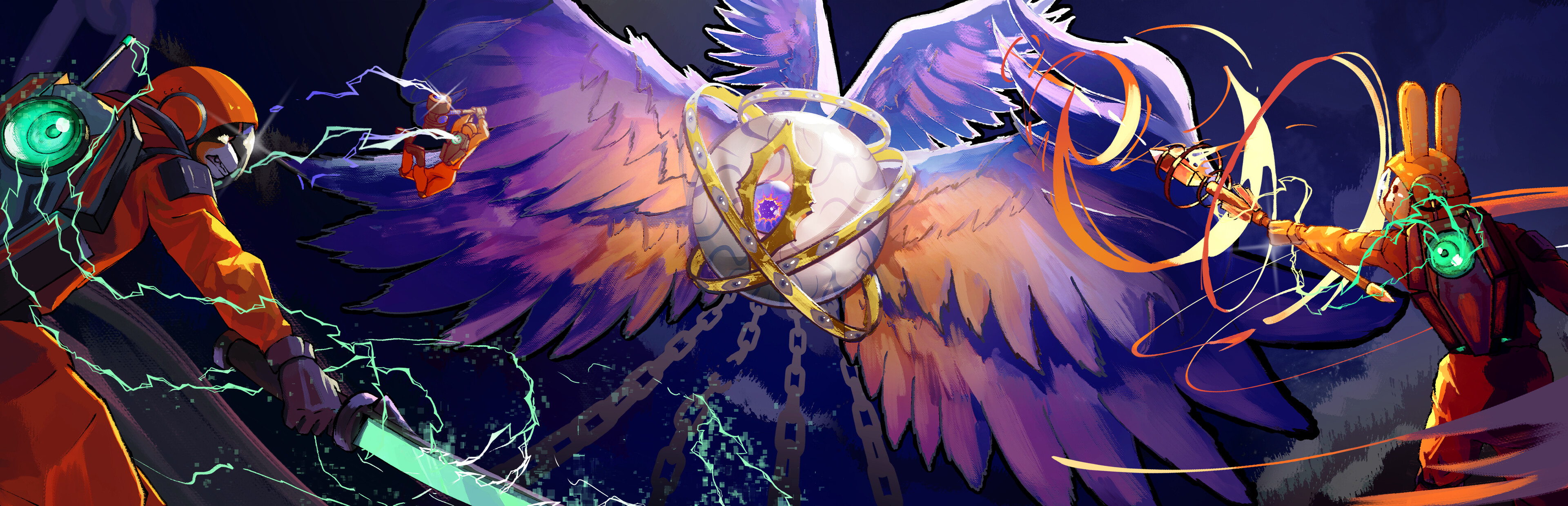
After deciding what we wanted to do with the game mechanically, we had to start making decisions regarding its atmosphere and theming. Very early on in the process, someone pitched the idea of using a “biblically accurate” angel as one of our various boss monsters. For those of you who are unfamiliar, the bible is none too flattering with its descriptions of angels’ true forms, saying that cherubim are covered in eyes and have wheels about their bodies which have even more eyes on them… Yeah, it seems that whoever wrote the Book of Ezekiel was big on eyes.
Anyhow, members of the team latched onto that idea, yet at the same time, other team members were dead set on this game taking place in a sci-fi setting. How on earth do you reconcile mythological creatures with outer space? Eldritch horror, that’s how. To help explain why these creatures from outer space should look so familiar in many ways to our terrestrial sensibilities, we settled on a plot element that directly tied these monsters to the characters we wanted to portray. I hesitate to explain more for fear of plot spoilers, but suffice to say that these eldritch horrors derive their forms at least in part from their victims, despite otherwise having inscrutable motivations and mind-bending powers. Thus were our boss monsters, the Void Shepherds, born. From there, we set them loose upon the stars, allowing the creatures to engulf entire planets and stars in darkness as they exterminated sentient life wherever they found it.
Creating a Rogue-Lite Yet we also wanted to create a rogue-lite experience and, as per the nature of rogue-lites, that necessitated building in a very good chance of the player losing, potentially multiple times. How did we want the consequences of failure to manifest? Did we want an immortal character like Zagreus from Hades who keeps coming back no matter how often they’re beat down? Did we want to just hand wave the issue of mortality like in Slay the Spire and pretend that death simply never happened? Well, certainly not that one. Instead, we decided that failing to stop the Void Shepherds in a run meant that the entire species you are playing as in that run gets wiped from existence. When that happens, the Nullpoint Protocol is enacted, which uploads all of your race’s knowledge (the game’s meta progression) on a hidden space station so that future races who discover this station might have a better chance of defeating the Shepherds than those who came before.
In short, each time you lose a run, your entire species gets exterminated, and all of its knowledge and progress gets passed on to future generations of aliens. When you begin a new run, you step into the shoes of the next race to discover the station, which inherits all of this knowledge and thereby (hopefully) has a better chance of overcoming the Void Shepherd threat.
What We Have Worked On Since
Well, saying “since” is a bit misleading, because much of this development happens simultaneously, but you get the idea!
For one, after we drafted concept art for the various Void Shepherds (boss monsters) that we wanted to have in the game, our artist Misty began working on creating thematically-matching arenas! They went through several iterations for each one’s basic shape before they even started adding key features, such as the eye in the center of the angel boss’s arena that opens up and shoots lasers at you. From there, the artists continued to add details, such as cathedral-esque architecture, until the arenas looked and felt more fleshed out!
While that was happening, our other artist, Anna, began modeling and rigging the various monsters based on their concept art. We wanted to experiment with visual styles while also saving on scope, so we decided that the boss monsters would remain as 2D models within a 3D environment. In many ways, creating such models was like creating paper puppets, with each segment of paper having its own “bone” for the purposes of animation. That decision allowed Anna to draw from her plethora of past experiences working on Minecraft models, as many of the processes and rigging principles were much the same!
Once we had the enemies modeled and the basics of their arenas mapped out, Jamie (one of our developers) was able to start playing around with creating in-game hazards, such as huge area of effect attacks like big, sweeping chain strikes and whirlwinds of bladed feathers. While creating the attacks themselves, he created a system that allows for a mixture of predetermined and somewhat randomized attacks to trigger while fighting the boss, creating a more dynamic, organic combat experience that eschews repetitive patterns. At the same time, he and our other developers, Ryan and Daniel, created an adaptable difficulty system. If a run is going particularly smoothly, then the system will crank up the bosses’ difficulty a bit or, if the run is going poorly, it will adjust the difficulty so that the experience is not quite so painful. The result (hopefully) is a self-balancing system that meets players’ needs to keep them challenged while preventing them from either getting bored or throwing their controller across the room in fury.
And throughout all of this, our composer and sound designer, Kyle, was giving himself aneurysms over creating music tracks that both fit the bosses thematically, yet were unique enough to stand out. Once again, we went back to Final Fantasy XIV for inspiration. Kyle wanted to emulate the musical styles there, where boss fights often start with a single music track before reaching phase two, at which point one or more additional tracks are added in that actively contrast with the original track or, alternatively, the original track is entirely scrapped and a whole new genre of music gets blasted in! Hopefully, you will enjoy the thematic dissonance and contrasting elements that Kyle has created, as he put his blood, sweat, and tears (potentially literally?) into making the soundtracks for each boss.
If you want to hear more about Kyle’s thought process and listen to his particular brand of whacky narration, I would highly encourage you to check out our dev log, starting at 16:56. Truly, I do not know that I can do proper justice to his enthusiasm here, nor am I sure that Steam would appreciate some of the choice language that he employs in his increasingly joyful rant about music.
Trust me, it’s worth a listen.
Dev Log 1 Wrap Up: What’s Next?
We are well underway and have already shown off early versions of our game to the thousands of people who attended PAX West and Boston FIG. The feedback and reception have been far more positive and encouraging than anything we could have hoped for (no, seriously, people have been getting HYPED while playing this, and even we aren’t sure why), so where do we go from here?
From here, we bring the game to you!
Our playable demo will be available for free on Steam next week! We encourage you to take a peek at what we have made so far. The best way to help us make the game as good as it can be is by giving some feedback on our progress!
In addition, we will be handing out playtest keys in our Nullpoint Protocol Discord server (https://discord.com/invite/XJC8SWpE74)
If you want to be a part of development and shaping the final product, then this is a great way of getting involved and making your voice heard! I’m not exaggerating when I say that we analyze EVERY scrap of feedback we get. So have some fun while playing the game and share your thoughts and ideas with us by joining the playtest group! We look forward to seeing your contributions!
Until then, happy hunting and keep an eye out for planet-eating abominations!
Sincerely,
Everbloom Games
Source
Changelog.gg summarizes and formats this update. How we read updates.