
In this update6
Full notes
Full Fading Echo update
Read the full published notes in a cleaner layout. The original post stays linked below.
What changed
- Gameplay
- UI and audio
- Maps
- Store
Fading Echo changes
Cutscenes are tricky, especially for an indie, gameplay-first studio like us.
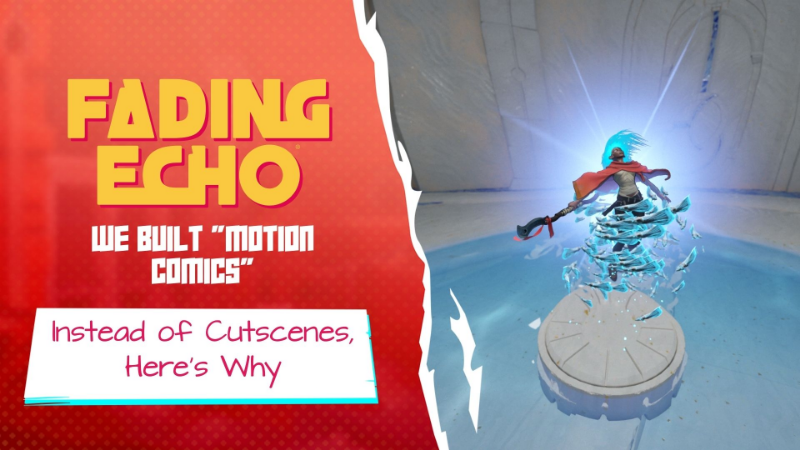
We knew early on that we wanted strong narrative moments in Fading Echo. But we also knew we didn’t want to constantly pull players out of the game. So instead of going for traditional cinematic cutscenes, we chose a different path.
Here’s how and why.
Our Graphic Novel DNA
Visually, Fading Echo lives somewhere between manga, US comics… and European graphic novels.
That mix is intentional. These influences shaped us growing up, and we wanted the game to carry a distinctly European comics flag.
What we love about European graphic novels is how they handle time and framing. They often rely less on fluid animation and more on strong compositions, carefully chosen angles, and moments where a single image does most of the storytelling.
That approach heavily influenced our cutscenes. Rather than fully animated sequences, we use:
mostly static scenes
camera movement inside the frame
lighting, VFX, and sound to suggest motion and intensity
It’s not about copying comics panel by panel, but about borrowing their visual language and adapting it to a game, in the same spirit you might find in Batman: Arkham Asylum or certain TV series intros.
Motion comics is an entire genre in its own and a strong influence for us as it perfectly captures one of Fading Echo game design pillars around movement and fluidity against rigidity.
Constraints as a Creative Tool
Cutscenes are expensive. There’s no way around it.
For a small team focused on gameplay systems, fully animated cinematics just weren’t realistic. Forcing them would have meant sacrificing other parts of the game, and that wasn’t an option.
So we asked ourselves a simple question:
"How do we make this feel intentional, not compromised?"
This approach allowed us to:
keep production costs under control
iterate faster
stay visually consistent
and (hopefully) create something that doesn’t look like the usual indie cutscene
What started as a limitation slowly turned into a style we genuinely liked and wanted to push further.
Steam post image
Cutscenes as Narrative Anchors
We don’t want Fading Echo to stop you every few minutes to explain itself.
Movement is core to the game, so cutscenes are used sparingly and with purpose:
more present at the beginning to set the stage
stronger at the end to support the epic moments
and at key milestones, like when you free an island
They act as narrative anchors, not constant interruptions, moments that punctuate progression rather than breaking momentum.
Breaking the Rules With Werlen Meyer
A big part of this came from our collaboration with our friends at Werlen Meyer.
We chose them not only because they’re incredibly talented, but also because they had never worked on in-game cutscenes before.
No habits.
No “this is how it’s usually done”.
Together, we experimented a lot:
how far we could push still images
how much emotion sound and lighting could carry
how camera movement alone could suggest action
That shared willingness to break things and occasionally get things wrong was key to finding the final style.
This cutscene approach isn’t about reinventing storytelling. It’s just us trying to tell our story in a way that fits Fading Echo, our constraints, and our tastes.
💬Got questions? Wanna see more? Join us on Discord to share your thoughts & feedbacks!
The Fading Echo Team
🌊 Flow with us
✨ Wishlist Fading Echo
Steam | Epic Games Store | PlayStation Store | Xbox Store
And follow the adventure:
Source
Changelog.gg summarizes and formats this update. How we read updates.