
In this update2
Full notes
Full DREADMOOR update
Read the full published notes in a cleaner layout. The original post stays linked below.
What changed
- Gameplay
- Events
- Maps
- Balance
- Store
DREADMOOR changes
There are many dangers in the world of DREADMOOR, some can be seen, some can be heard, and some drift silently through the air, or lie hidden beneath the surface of the water.
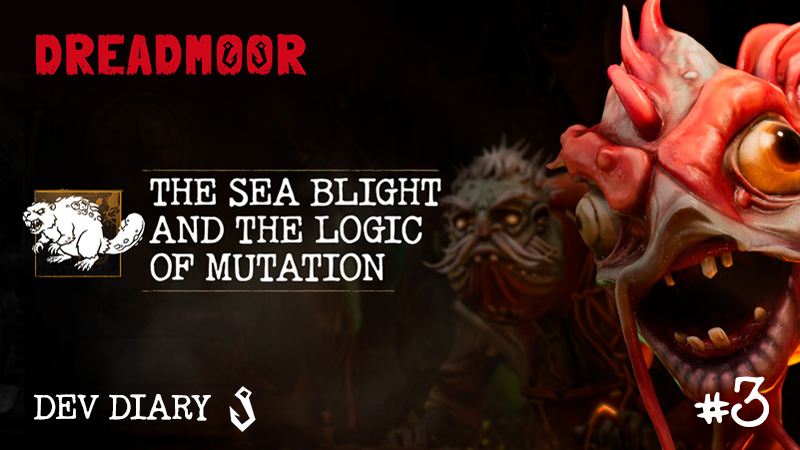
The Sea Blight is one of them. Not a creature, nor a weapon, nevertheless, it has shaped the world of DREADMOOR more than anything else that has come after the collapse.
WHAT IS THE SEA BLIGHT?
Surprising though it may be, the Sea Blight existed before the apocalypse that devastated the world. It was discovered during an expedition to the far North as a biological substance, but before the collapse, it was not known as a blight. In fact, it was seen as a breakthrough for humanity and found its way into medicine, science, and engineering. It brought forth advancements that would have once been deemed impossible.
However, after the apocalyptic events that submerged the world, the Sea Blight did not remain the same; it changed. No longer was it a benefit to humanity (and the world). It is now something to be feared, a true blight.
WHY IT IS FEARED
The Sea Blight spreads, and as it does, it infects, and as it infects, it alters, and as it alters, it reshapes and corrupts.
Throughout human history, nature has been contaminated many times over. For the most part, these contaminations were contained and, in one way or another, cleaned up. However, the Sea Blight was the one that got away, the exception to the rule. It did not stay contained; it seeped into the water, clung to surfaces, and lingered in the air, often manifesting as a faint green mist.
As the Sea Blight spread, the remnants of humanity, who were already struggling to survive after the apocalyptic events, found out the hard way just how terrifying the Sea Blight really was.
Humans were found to be the most vulnerable to the Sea Blight. Prolonged exposure leads to something worse than death. Sanity begins to fracture, and what remains of the person is twisted into something feral, something no longer human.
Humanity had to learn this the hard way, and this is why entire regions are completely avoided, not just for what lives there, but for what the air itself carries.
HOW IT SPREADS AND MUTATES LIFE
The Sea Blight behaves like a disease, but not one that follows predictable rules. It spreads through water, it lingers as airborne fog, it embeds itself into living organisms and changes them from within.
Most mutations appear chaotic, unpredictable, and unstable. But there are exceptions, sometimes patterns emerge. Over time, mutations caused by the Sea Blight have begun to stabilize, especially in animals. Traits that once appeared randomly have become functional, aiding survival in a world that no longer follows natural laws.
These changes are also being passed on, inherited across generations, but the mutations do not stop; they continue to build up.
This is why no two creatures are truly the same.
Some are grotesque.
Some are strangely elegant.
And some exist somewhere in between, unsettling not because they are monstrous, but because they feel almost intentional.
Rare specimens can differ so drastically that they become valuable, not just as curiosities, but as resources as they can be used, refined, and repurposed.
In a world shaped by mutation, even corruption has its uses.
HOW IT SHAPES THE WORLD
As the Sea Blight spreads, humanity withdraws, and nature mutates, and the land slowly degrades. High humidity and lingering contamination wear down structures and terrain alike, turning once solid ground into unstable swampland. Ruins decay, coastlines erode, and entire regions become increasingly hostile to human life.
As for the animals, though, it could be said that some animals have (somehow) adapted. Their mutations, while often extreme, serve a purpose - to enhance their chances of survival by gradually mutating them into efficient predators or resilient scavengers.
Humans are less fortunate. Exposure to the Sea Blight does not grant clarity or strength, it breaks the mind before it reshapes the body. Partial mutations exist, but they come at a cost as insanity gradually takes over. Finally, a full transformation strips away what made a person human, leaving behind feral, grotesque creatures.
For the most part, people simply try to survive the Sea Blight. This is why trust is rare among humanity's survivors, people fear the hidden agendas of the other survivors, and worse, they often fear what those people may turn into.
But, humans are complicated creatures, and when things look bleak, they look to unlikely sources of hope. Some people, driven by desperation, insanity, or the creeping mutation brought on by the Sea Blight believe it to be the source of human evolution. In their folly, they worship it and even seek to use it.
CLOSING
The Sea Blight is one of the most important parts of the world of DREADMOOR. It is the reason the world exists in its current form. It explains the creatures you catch, it shapes the waters you travel, it lingers in the fog you sail through, and sometimes, it is the reason you turn back before going any further.
As we continue exploring the systems and design behind DREADMOOR, the Sea Blight will remain at the center of it all, influencing not just the world, but the choices you make within it.
About DREADMOOR
DREADMOOR is a dark first-person fishing adventure game. Anglers explore both land and sea, fishing for a wide variety of aquatic creatures lurking in the depths of the treacherous waters, and fighting their way through a flooded wasteland filled with danger and mystery.
https://store.steampowered.com/app/3629430/DREADMOOR
OFFICIAL LINKS
Join us on Discord → https://discord.gg/dreadmoorgame Follow on X → https://x.com/DreadmoorGame Discuss on Reddit → https://www.reddit.com/r/DreadmoorGame Watch on TikTok → https://tiktok.com/@DreadmoorGame Explore on Instagram → https://www.instagram.com/DreadmoorGame
Source
Changelog.gg summarizes and formats this update. How we read updates.