
In this update7
Full notes
Full Dead Reckoning: The Long Drift update
Read the full published notes in a cleaner layout. The original post stays linked below.
What changed
- UI and audio
- Balance
Dead Reckoning: The Long Drift changes
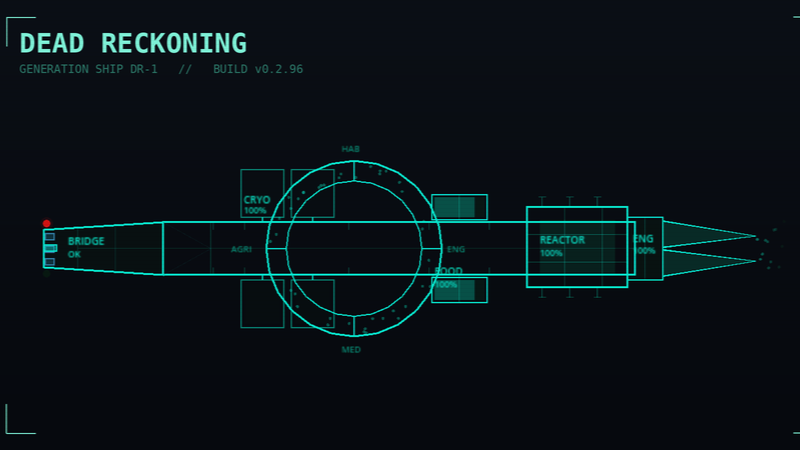
Steam post imageThe poor, procedural art depiction up here isn't the future; it's the past. This was the first asset I built in Dead Reckoning. It was the start of a concept, and I hope it shows how far it's come — and that it's these iterative steps that will take the game to the next level.
Time to get to work
Here's what I'm working on next. The basic game logic runs end to end now — the voyage, the drift, the endings, five languages (minus a few bugs on all) — but the weak spot has always been the moment-to-moment: between the big decisions, you mostly read and click. The next stretch is four systems aimed squarely at that. Not drifting in the dark — four things, done properly.
1. Who you become
Right now your ship's ideology and its slow decline are just numbers you watch tick. I'm turning both into something you decide. When the ship has drifted far enough that you can't pretend otherwise, you choose what these people have become — a command hierarchy that rules by the captain's line, a commune that shares everything and answers to no one, a faith that grew up in the dark, a rule of engineers who keep everyone breathing and expect to be obeyed, a people who've cut all ties to Earth, or a people fighting to stay exactly who they were. Running alongside it: how the colony copes as it forgets things it can no longer fix — following the old manuals by rote, keeping the knowledge alive as craft and song, or treating the reactor like something to be appeased. You don't pick any of it off a list. You get there through the choices you've been making the whole voyage, and once it sets, you can slow how deep it goes — but you can't take it back.
2. A crew with a will
The crew stop being passengers. Morale becomes something you spend and rebuild, not a meter that drifts on its own. Every livable world you fly past to keep searching costs you some of their patience — and they remember it. Sabotage goes in too: a named crew member, pushed far enough, can wreck a system or burn the one manual that kept it running, and knowledge lost like that doesn't come back easily. Push them past the point they were willing to go, and the helm stops being yours. They might force the ship to turn for home, or mutiny and put down half the crew on a world you'd never have chosen — and you find out years later, on a faint signal, whether they made it.
3. Your founding story
Before the ship ever leaves, you set who these people were. Why they left Earth — fleeing a dying planet, a slow exodus, a sealed lifeboat — what they packed, and what they already knew how to do. You get a fixed budget and you spend it by trading: take on a real weakness to afford a real strength, because no expedition leaves deliberately broken. A research head start, the kind of people aboard, the cracks they launched with. The point is to let you build your own backstory and have it actually shape the run — without it becoming a way to stack the deck.
4. Endings that remember
More ways for a run to end, and the endings you can already reach paying closer attention to how you got there. What you believed by the end, who ended up holding the power and the rations, how much the colony forgot, who you left behind on some rock along the way — all of it should read back in the final word, instead of a generic finish. The people you cast off might even send word back, long after, that against the odds they made it.
What comes after
Further out, there's deeper colony life after you land, and more to see on the approach to a world — both come after this set.
Now — what else do you want?
This is a draft, and I'd rather hear from you before it's locked. Which of these four matters most to you, and which leaves you cold? What's missing — the thing you've been wanting from Dead Reckoning that isn't on this list at all? Tell me, and I'll try and help shape it into the game.
Cheers!
— Garan Lorn / Selenodrome
Source
Changelog.gg summarizes and formats this update. How we read updates.