
In this update3
Full notes
Full Dandelion Void update
Read the full published notes in a cleaner layout. The original post stays linked below.
What changed
- UI and audio
- Balance
Dandelion Void changes
Hi everyone, and welcome to another Dandelion Void devlog.
In a post last year we introduced the 4 members of our engineering and art teams: Brian, Dara, Roland, and Robin (yours truly). Today we’re (re)introducing the audio team for Dandelion Void: Catton Arthur, our composer and audio director, and Frenchy Francois, our sound designer!
Catton and Frenchy both contributed to the game last fall, and as of April they’ve resumed work on Dandelion Void for a long-term basis. The game is already sounding scores better thanks to them, and today Catton will be showing us how.
I’ll pass the mic to you, Catton!
FMOD Demo: Combat and Pollen!
Hello! This is Catton Arthur speaking and I'm the composer for Dandelion Void! I joined the project a little over a month ago. You may have heard my work before in Fields of Mistria, Sorry We're Closed, and Impaler. Today I'm gonna introduce you to the tool I and our sound designer, Frenchy, use to make audio for Dandelion Void: FMOD!
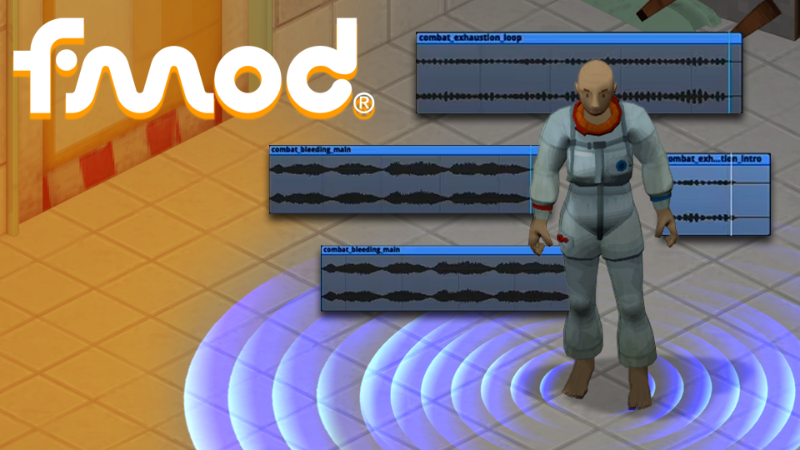
FMOD can do a lot of cool things beyond just playing a sound file. We can pass information from the game back to FMOD which changes audio in relation to the gameplay. Here is an example using our combat music:
Let’s break down what’s happening in this example! As a terminology note, a “stem” is an individual layer of music, often just a single instrument, which can be mixed with other stems to create a dynamic composition.
0:00 - We start with the feedback-heavy bass guitar stem that forms the backbone of our combat music.
0:10 - When the player gets exhausted from running and swinging weapons, that state is communicated to FMOD via a parameter. This brings in the exhaustion stem - a layer of pulsing mid-range synth and some higher beeps and boops, both evocative of warning alarms. There is also a close-up rasping pulse that sounds a bit like labored breathing.
0:26 - The player is likely to get cut during combat, causing them to lose health over time. This brings in a layer of flowing, tense, synth arpeggios. They occupy a higher set of frequencies so they'll always cut through the basic combat stem. Both the exhaustion stem and the bleeding stem work on top of the base combat music, and they both have 4 levels of intensity depending on the severity of the player’s exhaustion / bleeding
0:40 - Entering a pollen field also triggers the player's exhausted state, but this can occur in or out of combat and the ~vibe~ of the exhaustion is very different, so it needs to be handled separately from the combat music.
As the composer, I imagine this effect doesn't feel like the more familiar bodily exhaustion of physical effort. At first it's a mysterious lack of response. You don't know why you're tired, but maybe it's related to the itching, then the burning: first in your throat, then throughout your entire body. It must be coming from the tiny grains of pollen swirling all around you. Your body tries to breathe harder and harder, with less and less in return. Panic sets in, and you slowly suffocate.
Pollen requires some of the same audio cues as physical exhaustion, and it shares a status icon, but it evokes a different emotion. The music should be related, but different. The pulsing is at a different tempo. Instead of an alarm-like element, there is a high, sparkly synth layer to depict the haze of pollen in the air.
The music for pollen exhaustion and combat-physical-exhaustion do not work together. They have both redundant and clashing instruments. So when combat occurs within a pollen field, the typical exhaustion cue is muted. I imagine if you're already choking to death, the additional burn in your legs from running wouldn't even consciously register.
1:17 - If you do manage to escape the pollen you would still have lingering exhaustion, but we need to communicate to the player that the threat of pollen is no longer pressing. In this case, the pollen music stops and the standard exhaustion music cue returns to the combat mix. Maybe you even manage to fully recover your stamina and it returns to a more typical combat situation.
We hope to make the combat music reactive to even more gameplay elements as we develop Dandelion Void. The type of enemy, the player's health, and many other status effects will all change the music so that the experience will be different each time!
Mixing Down
Thanks Catton! I can promise everyone that as hair-raising as the music in this video is, the effect is even more chilling when you’re cornered by a group of uproots and fighting for your life. Audio is crucial for Dandelion Void as a title with many horror elements, and we’re all happy to have the game in such capable hands.
Please look forward to a future devlog down the line with Frenchy, where we can go deeper into sound effects. Until next time, everybody please take care and have a great week!
– Robin and the Manzanita Interactive Team
Source
Changelog.gg summarizes and formats this update. How we read updates.