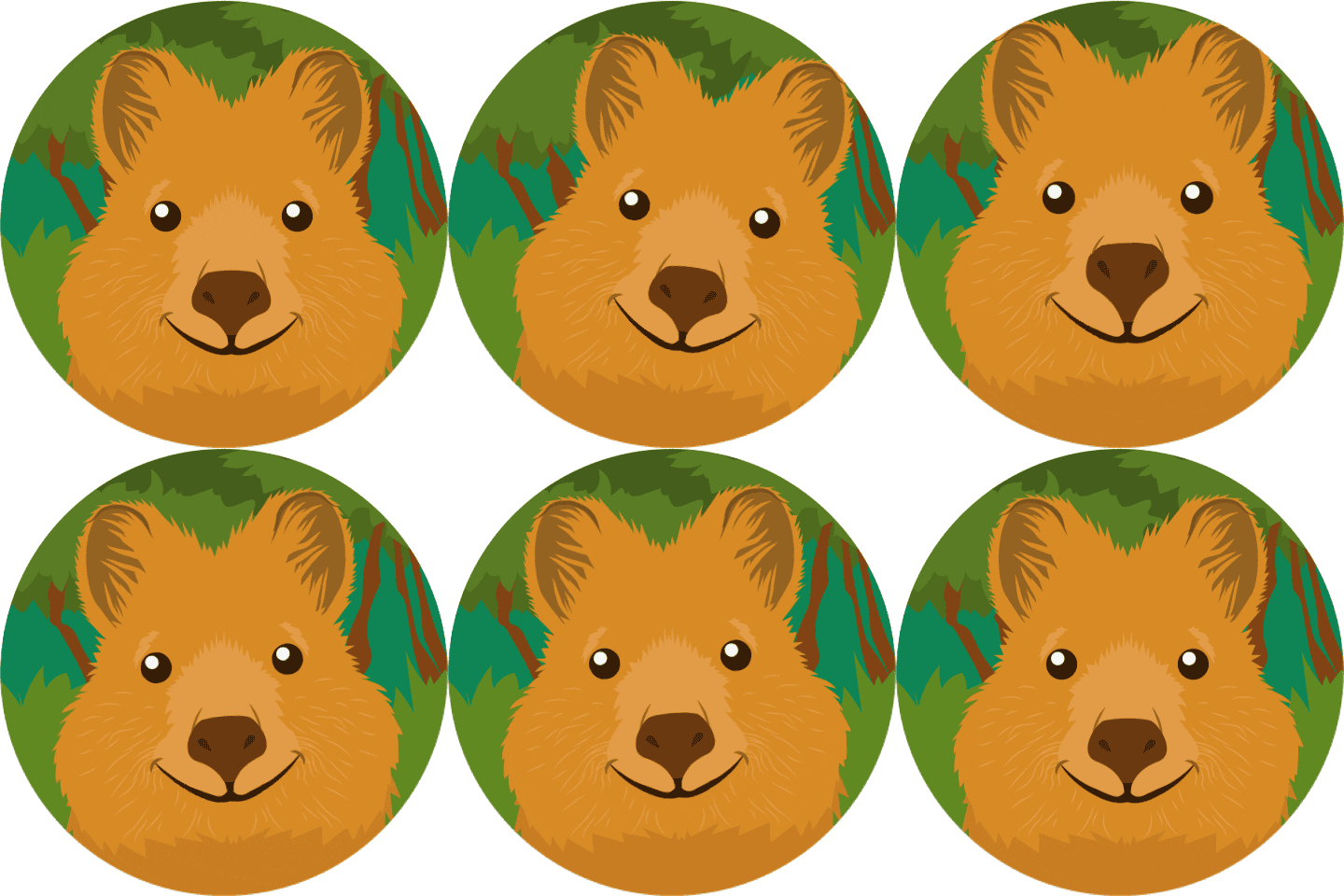
And now it's time for "the world's happiest animal" - Quokka. Quokka A quokka weighs 2.5 to 5.0 kg (5.5 to 11 lb) and is 40 to 54 cm (16 to 21 in) long with a 25-to-30 cm-long (9.
In this update2
Full notes
Full Zooconomy update
Read the full published notes in a cleaner layout. The original post stays linked below.
What changed
0 fixes2 additions1 change0 removals
Balance
Gameplay
changedQuokkaLike most macropods, quokkas eat many types of vegetation, including grasses, sedges and leaves. A study found that Guichenotia ledifolia, a small shrub species of the family Malvaceae, is one of the quokka's favoured foods. Rottnest Island visitors are urged to never feed quokkas, in part because eating "human food" such as chips can cause dehydration and malnourishment, both of which are detrimental to the quokka's health. Despite the relative lack of fresh water on Rottnest Island, quokkas do have high water requirements, which they satisfy mostly through eating vegetation. On the mainland, quokkas only live in areas that have 600 mm (24 in) or more of rain per year. The quokkas chew their cud, similar to cows.
addedDistributionDuring the Pleistocene period, quokkas were more abundant and living on open landscapes. When the Europeans arrived in Australia, they introduced new species, some of which became predators to the quokkas. This caused the habitats of quokkas to eventually shift to islands and forests, where there were minimal predators and more vegetation. In the wild, the quokka's roaming is restricted to a very small range in the South West of Western Australia, with a number of small scattered populations. One large population exists on Rottnest Island and a smaller population is on Bald Island near Albany. The islands are free of certain predators such as red foxes and cats. On Rottnest, quokkas are common and occupy a variety of habitats, ranging from semiarid scrub to cultivated gardens. Prickly Acanthocarpus plants, which are unaccommodating for humans and other relatively large animals to walk through, provide their favorite daytime shelter for sleeping. Additionally, they are known for their ability to climb trees.
addedConservationDespite being numerous on the small, offshore islands, the quokka is classified as vulnerable. On the mainland, where it is threatened by introduced predatory species such as red foxes, cats, and dogs, it requires dense ground cover for refuge.
Zooconomy changes
changedLike most macropods, quokkas eat many types of vegetation, including grasses, sedges and leaves. A study found that Guichenotia ledifolia, a small shrub species of the family Malvaceae, is one of the quokka's favoured foods. Rottnest Island visitors are urged to never feed quokkas, in part because eating "human food" such as chips can cause dehydration and malnourishment, both of which are detrimental to the quokka's health. Despite the relative lack of fresh water on Rottnest Island, quokkas do have high water requirements, which they satisfy mostly through eating vegetation. On the mainland, quokkas only live in areas that have 600 mm (24 in) or more of rain per year. The quokkas chew their cud, similar to cows.
addedDuring the Pleistocene period, quokkas were more abundant and living on open landscapes. When the Europeans arrived in Australia, they introduced new species, some of which became predators to the quokkas. This caused the habitats of quokkas to eventually shift to islands and forests, where there were minimal predators and more vegetation. In the wild, the quokka's roaming is restricted to a very small range in the South West of Western Australia, with a number of small scattered populations. One large population exists on Rottnest Island and a smaller population is on Bald Island near Albany. The islands are free of certain predators such as red foxes and cats. On Rottnest, quokkas are common and occupy a variety of habitats, ranging from semiarid scrub to cultivated gardens. Prickly Acanthocarpus plants, which are unaccommodating for humans and other relatively large animals to walk through, provide their favorite daytime shelter for sleeping. Additionally, they are known for their ability to climb trees.
addedDespite being numerous on the small, offshore islands, the quokka is classified as vulnerable. On the mainland, where it is threatened by introduced predatory species such as red foxes, cats, and dogs, it requires dense ground cover for refuge.
And now it's time for "the world's happiest animal" - Quokka.
Quokka
A quokka weighs 2.5 to 5.0 kg (5.5 to 11 lb) and is 40 to 54 cm (16 to 21 in) long with a 25-to-30 cm-long (9.8-to-12 in) tail, which is quite short for a macropod. It has a stocky build, well developed hind legs, rounded ears, and a short, broad head. Its musculoskeletal system was originally adapted for terrestrial bipedal saltation, but over its evolution, its system has been built for arboreal locomotion. Although looking rather like a very small kangaroo, it can climb small trees and shrubs up to 1.5 metres (4 ft 11 in). Its coarse fur is a grizzled brown colour, fading to buff underneath. The quokka is known to live for an average of 10 years. Quokkas are nocturnal animals; they sleep during the day in Acanthocarpus preissii, using the plants' spikes for protection and hiding.
Like most macropods, quokkas eat many types of vegetation, including grasses, sedges and leaves. A study found that Guichenotia ledifolia, a small shrub species of the family Malvaceae, is one of the quokka's favoured foods. Rottnest Island visitors are urged to never feed quokkas, in part because eating "human food" such as chips can cause dehydration and malnourishment, both of which are detrimental to the quokka's health. Despite the relative lack of fresh water on Rottnest Island, quokkas do have high water requirements, which they satisfy mostly through eating vegetation. On the mainland, quokkas only live in areas that have 600 mm (24 in) or more of rain per year. The quokkas chew their cud, similar to cows.
Quokkas have a promiscuous mating system. After a month of gestation, females give birth to a single baby called a joey. Females can give birth twice a year and produce about 17 joeys during their lifespan. The joey lives in its mother's pouch for six months. Once it leaves the pouch, the joey relies on its mother for milk for two more months and is fully weaned around eight months after birth. Females sexually mature after roughly 18 months. When a female quokka with a joey in her pouch is pursued by a predator, she may drop her baby onto the ground; the joey produces noises which may serve to attract the predator's attention, while the mother escapes.
Distribution
During the Pleistocene period, quokkas were more abundant and living on open landscapes. When the Europeans arrived in Australia, they introduced new species, some of which became predators to the quokkas. This caused the habitats of quokkas to eventually shift to islands and forests, where there were minimal predators and more vegetation. In the wild, the quokka's roaming is restricted to a very small range in the South West of Western Australia, with a number of small scattered populations. One large population exists on Rottnest Island and a smaller population is on Bald Island near Albany. The islands are free of certain predators such as red foxes and cats. On Rottnest, quokkas are common and occupy a variety of habitats, ranging from semiarid scrub to cultivated gardens. Prickly Acanthocarpus plants, which are unaccommodating for humans and other relatively large animals to walk through, provide their favorite daytime shelter for sleeping. Additionally, they are known for their ability to climb trees.
Conservation
Despite being numerous on the small, offshore islands, the quokka is classified as vulnerable. On the mainland, where it is threatened by introduced predatory species such as red foxes, cats, and dogs, it requires dense ground cover for refuge.