
Full notes
Full Zooconomy update
Read the full published notes in a cleaner layout. The original post stays linked below.
What changed
- Store
Zooconomy changes
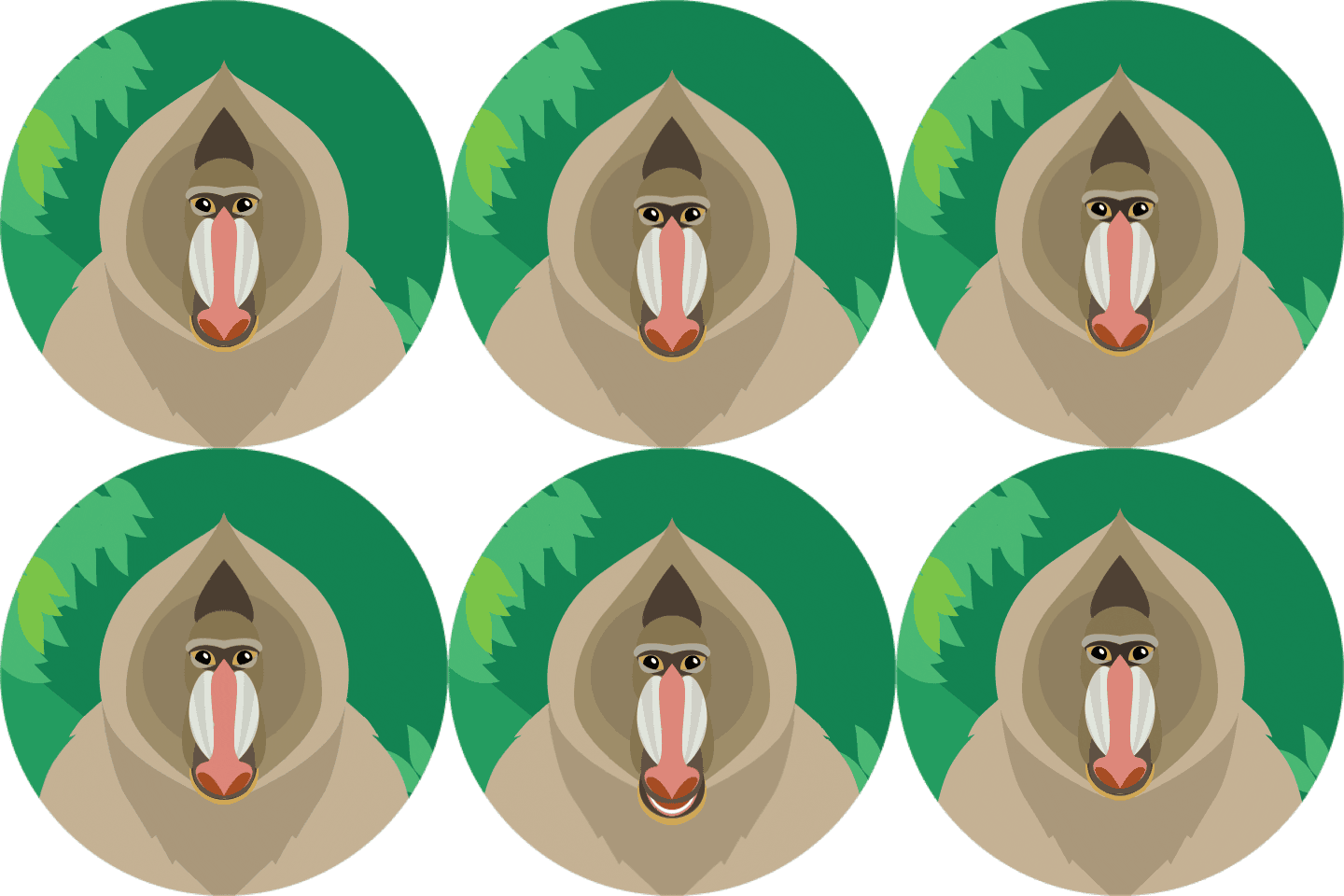
We continue our trip in Africa and today we are gonna meet an interesting primate - Mandrill.
Mandrill
The mandrill has a stocky body with a large head and muzzle, as well as a short and stumpy tail. The limbs are about evenly sized and the fingers and toes are more elongated than in baboons, with a more opposable big toe on the feet. The mandrill is the most sexually dimorphic primate, and the adult male is considered to be the largest monkey. Females are less stocky and have shorter, flatter snouts. Males have a 70–95 cm (28–37 in) head-body length and weigh 19–30 kg (42–66 lb) while females have a 55–70 cm (22–28 in) head-body length and weigh 10–15 kg (22–33 lb). Most of the teeth are larger in males and the canine teeth reach up to 4.5 cm (1.8 in) and 1 cm (0.39 in) long for males and females respectively. Both sexes have 7–10 cm (2.8–3.9 in) long tails.
The coat of the mandrill is primarily grizzled or banded olive-brown with a yellow-orange beard and sparse, light hairs on its underside. The lips are surrounded by stiff white whiskers, and white bare skin exists behind the ears. Male mandrills have a "crest" of long hairs on the head and neck, while both sexes have chest glands which are covered by long hairs. The face, rump and genitals have less hair.
Mandrills have a red line running down the middle of their face which connects to their red nose. On either side of the line, the skin is blue and grooved. In males, the blue skin is supported by ridged bone swellings. Females have more subdued facial coloring, but this can vary between individuals with some having stronger red and blue hues and others being darker or almost black. In males, the rump and areas around the genitals are multi-colored, consisting of red, pink, blue and purple skin, with a red penis shaft and violet scrotum. The genital and anal areas of the female are red.
Mandrills are noted for being among the most colorful mammals. Charles Darwin wrote in The Descent of Man: "no other member of the whole class of mammals is coloured in so extraordinary a manner as the adult male mandrill". The red coloration is created by blood vessels near the surface of the skin, while the blue is a form of structural coloration caused by parallel arrangements of collagen fibers. The blue ridges on males contrast both with the red facial hues and the green foliage of their environment, helping them stand out to other individuals. The darker and more subdued coloring of female faces is caused by melanin.
Mandrills live in large "supergroups" or "hordes" that can contain hundreds of individuals. These large groups are fairly stable and do not appear to be gatherings of smaller ones. At Lopé National Park, Gabon, mandrill hordes were found to have an average of 620 individuals, and some groups were as large as 845, making them possibly the largest cohesive groups of wild primates. Another study in Lopé found that a horde of 625 mandrills consisted of 21 dominant males, 71 less dominant and subadult males, 247 adult and adolescent females, 200 juveniles, and 86 dependent infants. A mandrill horde of around 700 individuals in northern Lopé had a total home range of 182 km2 (70 sq mi), 89 km2 (34 sq mi) of which was suitable habitat. The supergroup would occasionally diverge into two to four subgroups before reuniting. Another 15-month long study of a 120 member group
Source
Changelog.gg summarizes and formats this update. How we read updates.