
Full notes
Full Zero-K update
Read the full published notes in a cleaner layout. The original post stays linked below.
What changed
- Balance
- Gameplay
Zero-K changes
Slow damage is the more prolific, yet less dramatic, cousin of EMP and disarm. It is weaker than EMP in that it never fully disables a unit, but the effect gradually ramps up from the very first instance of damage, making it useful in more situations. This gradual but persistent effect let us spread slow across more weapon types and roles, to the point it became a meme. But whereas EMP was inherited from pre- Complete Annihilation modding, slow was created from scratch, and upon reviewing the history it is somewhat surprising that it came to exist at all.
Last time we covered the development of EMP, and how it became synonymous with lightning. But I did not mention that both stun and lightning were exclusive to Arm in Total Annihilation, and this focus was mostly carried through by TA modders. Complete Annihilation pushed faction differentiation hard, so when we merged lightning with stun, the smattering of Core stuns were moved to Arm. This gave Arm a monopoly on disabling status effects, which proved to be a bit too one-sided. Even though Core had a few more damaging options, such as a tacnuke missile to mirror the Arm tactical EMP missile, we eventually looked for a way to break the monopoly.
Slow damage was the solution to the Arm monopoly on status effects: a new status effect just for Core. I recall MidKnight adding it as an alternative to moving the main Core stun unit, the Gnat-equivalent, to Arm. Gnat ultimately gained lightning and was transferred, but slow stuck around. Numerous Core units gained slow damage over the years, until the mechanic found its home as a core aspect of the Amphbot factory. This factory was added after we merged the factions, yet in many ways maintains the old Core aesthetic of raw power and toughness.
The underlying mechanics of slow damage have been quite stable over the last 16 years. Slow damage accumulates on units and is shown on a bar under their main health bar, the same as EMP. Units with slow damage are slowed immediately by an amount equal to the accumulated slow damage as a fraction of current health. For example, a unit with 1000 health and 150 slow damage is slowed by 15%. Slow damage is capped at 50% of current health (with a few exceptions) and decays over time at a rate of 4% per second, although decay is halted for half a second after taking slow damage.
Some slow weapons (Moderator, Limpet, and Disco Rave Party) can push units to 58% slow damage, but still only slow them by 50%. Slow decays at 4% per second, so this corresponds to two extra seconds at full slow. But this is not the only way to extend a lingering slow, since regular damage reduces health, which increases slow as a fraction of current health. This interaction between status effect percentage and current health was a huge problem for EMP, but slow decays so quickly that it rarely matters.
Slow has driven and benefited from the development of increasingly powerful gadgetry. There is no stated limit on what can be slowed, so we have gradually expanded its scope by making more and more things slowable. Almost everything is covered at this point, including movement speeds, reload times, and economic rates, with the main exception being jump speed. This is great for modding, and shows off the power of the engine, since slow would be harder to implement in an engine that updated less than 30 times a second. The high tick rate lets us treat time as continuous without too many issues, even though actions only happen every 33 milliseconds.
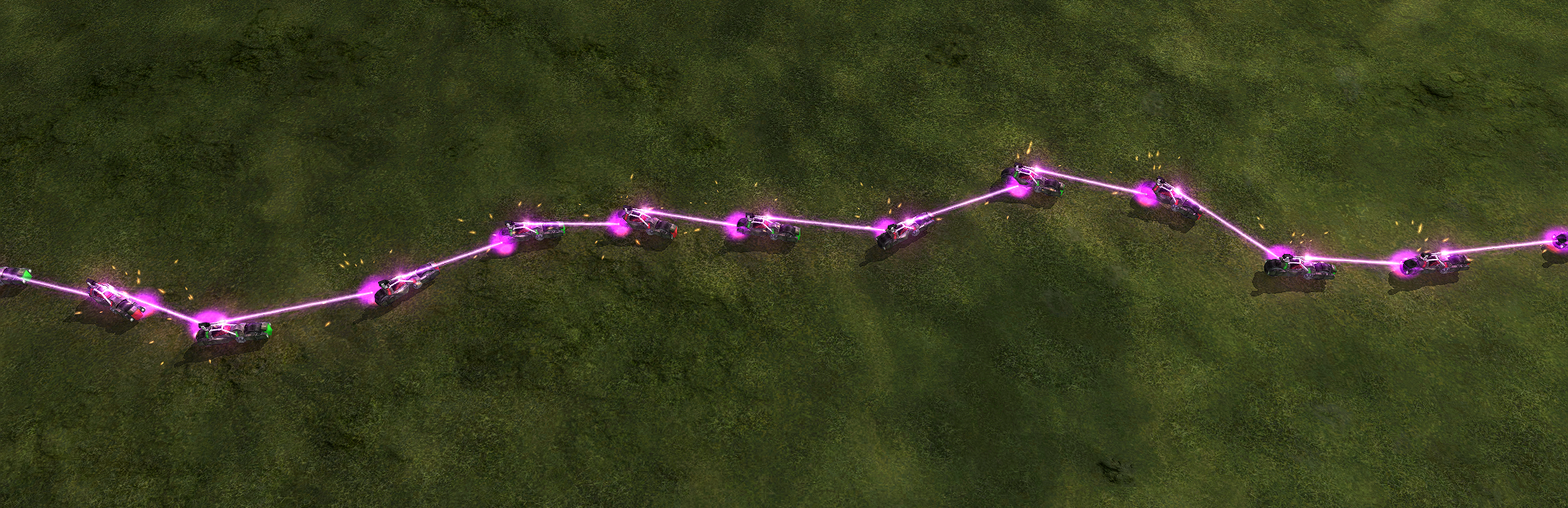
There are some caveats to be aware of when slowing rapid-fire weapons. For example, the Light Laser Tower seems to shoot a continuous laser, but it actually fires a 0.1 second burst every 0.1 seconds. This corresponds to one shot per 3 frames, which increases to one shot per 6 frames when slowed by 50%, as expected. However, when slowed by 45%, it shoots once every 4 frames, for 40% reduction in damage output instead of 45%. This barely matters for how Zero-K uses slow, but would matter for a mod that, say, implements global fire rate upgrades and expects the increase in damage output to be absolutely consistent across units.
The first recipients of slow damage were Outlaw and Moderator. The Outlaw used to be a standard riot armed with a Bandit blaster in one hand and a Ripper gun (then Leveler) in the other, which is where we get the phrase "Leveler sidearm". It gained the disruptor pulse while the rest of Core T1 bots were undergoing a shield makeover, since friendly-fire-less area of effect damage works great in a shield ball. The disruptor pulse is unique in that it does not damage allied units, and was conceptualised as some sort of control system attack.
Moderator gained slow because the old Moderator was too generic. This left it prone to being monospammed, and it was hemmed in by similar units on all sides. Imagine a long-range skirmisher like Rogue, with a Sling-like plasma cannon, and the weight of a Recluse. Range is particularly hard to balance in RTS, especially for units that can fire while moving, so in Zero-K it comes with severe drawbacks; Recluse and Sling are flimsy, Bulkhead and Fencer deploy to fire, and Rogue has a very slow projectile. The design space around Moderator was too full or troublesome to find it a healthy place, so we gave it slow.
A few units gained slow for similar reasons to Moderator, to the point that "give it slow" became a meme. This was done to units that were underwhelming or lacking a distinct role. The skirmisher gunship Harpy was in an awkward spot between the faster Locust and tougher Revenant, while Dart lacked a clear purpose within Rover. Cyclops used to have a flamethrower sidearm, but this made it hard to counter with swarms, so it was switched out for a slow beam to give it utility over Minotaur. Seawolf gained a slowing torpedo as part of a sea rework.
Slow damage was also a popular choice for brand new units. The Amphbot factory was created after factories replaced factions, so it could have contained anything, but we decided to make slow one of its main mechanics. To some extent, Buoy deals slow damage because little room remained for an ordinary skirmisher of its class, and Limpet explodes with slow damage because the other bomb types were taken. But we had better reasons to give the factory slow. Part of the plan was to make a particularly slow moving factory which could use slow damage to bring the enemy down to its own speed. The idea behind the large disruptor pulse of the Limpet was to let it reach the surface of the water from the ocean floor.
The strongest reason for Buoy to deal slow damage is that slow is good against heavy units, and ships tend to be heavy. Heavy units are weak to slow because they tend to live longer, which gives the effect more time to have an impact. Slow also makes it harder to retreat for repairs, which is a big part of using heavy units. Bolas, the disruptor beam hovercraft raider, was added to Hovercraft for a similar reason, although admittedly it also deals slow because no other proper raider does so.
We avoided adding too much slow, but it has still accumulated over the years without really considering what it is in the game world. Is it time dilation, or perhaps a virus, as implied by Outlaw? Are units being mechanically gummed up by some sort of purple goo? Slow damage is dealt by various types of missile, beam and arcing projectile, with the only unifying characteristic being the colour purple. Compared to the consistency of lightning and EMP it is a bit of a mess. This may be a minor problem, but systems generally feel better when presented in a consistent way.
Of the twelve sources of slow damage, only one, the tactical missile, deals pure slow. This is not for want of trying, since the original slow Moderator was a slow-only unit. However, we failed to find a place for it where it was not either too niche, or too obnoxious. Part of this issue is that status effect-only weapons risk cluttering the screen and soundscape without progressing the game. Racketeer, the disarming artillery, suffers from this exact issue, but the greater utility of disarm over slow lets it feel powerful without spamming projectiles. Pure status effects also give units more ways to be stupid, since spreading the effect around becomes more central to the usefulness of the unit.
These days most slow damage weapons deal slow as a bonus, rather than as their primary purpose. Outlaw, Moderator, Buoy and Constable would be much worse without slow, but with a corresponding cost decrease, would probably still find use. It would be interesting to experiment with more pure slow, but for now, slow provides a much-needed counters for heavy units and mitigates a bit of damage. The more dedicated sources of slow, such as those with large area of effect, are fairly niche, but this is probably preferable to permanently playing the game at half speed.
Source
Changelog.gg summarizes and formats this update. How we read updates.