
In this update5
Full notes
Full We Were Here Before update
Read the full published notes in a cleaner layout. The original post stays linked below.
What changed
- Balance
- Performance
- Store
- UI and audio
- Maps
- Events
We Were Here Before changes
A Settlement You Cannot Save
We Were Here Before is coming to Steam Next Fest — here's what to expect, and what not to.
We Were Here Before is a roguelite about a settlement you cannot save.
That's not a difficulty warning. It's the premise.
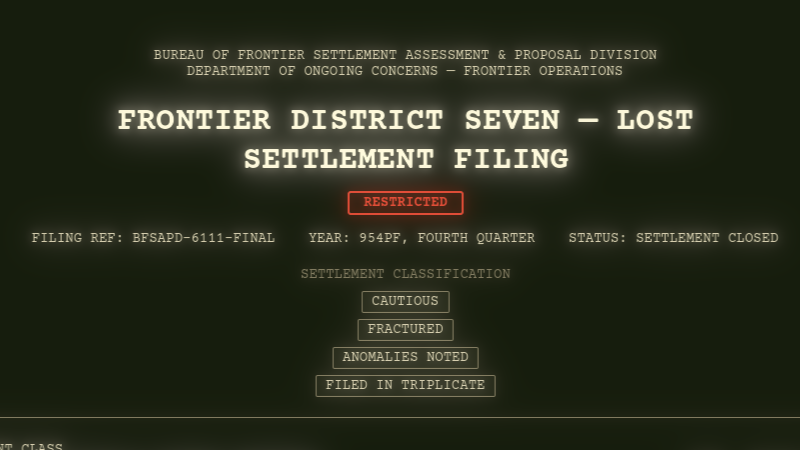
Most roguelites ask whether you can survive the run. This one asks a different question: what will remain when we're gone? You are a governor sent to the edge of a strange frontier to build a settlement that will, eventually, be lost. There is no health bar for the settlement. There is no game over. What you produce, choice by choice, is a record — and when it's over, that record is filed, in triplicate, as an obituary by an imperial bureau that does not have the correct form for most of what you did out there.
With Next Fest coming up June 15–22, I'd rather be honest about what you're walking into than sell you something this isn't.
What it isn't
I'd genuinely prefer you bounce off the demo for the right reasons than wishlist for the wrong ones. So, plainly:
It is not a survival game. You cannot lose the settlement — losing it is the story, not the failure.
It is not a combat deckbuilder. There are cards. You will not fight anyone with them.
There is no resource panic. No optimization treadmill. No meter ticking quietly toward death.
The Horizon — that countdown at the center of the screen — is not a threat. It is a pulse. It is the rhythm the frontier breathes at, and each time it turns over, something happens.
There is no correct ending. There are several. None of them are winning.
If "the number went up" is the feeling you play for, this will frustrate you — and I'd much rather you discover that in a free demo than after a purchase.
What it is
A narrative-first roguelite where the story is the loop. You build districts by dragging resources together — no recipe menus, no crafting screens, you simply place things and the settlement grows. In between the building, the frontier produces moments: small choices, quiet beats, and longer branching arcs where you decide what kind of governor you're going to be.
Not a good one or a bad one. There is no obvious wrong answer anywhere in this game. Every choice is defensible. The cost only becomes visible after you've made it.
Each decision nudges three quiet measures of who you're becoming — roughly, how much you contain versus reveal, whether you send others or go yourself, whether you resist the frontier's strangeness or make your peace with it. You never see these as stats. You see them at the very end, in the obituary, in the way a dry institutional voice describes the person you turned out to be. The settlement is gone by then. The record is what's left of it.
The tone is melancholic and wry without ever tipping into comedy. Settlers file formal complaints that they are not, in fact, wet. A clerk knows a name she has no way of knowing and cannot say from where. Where there is horror, it is administrative — things behaving correctly for reasons nobody will explain.
And, if you look
Some players will find exactly what I just described: a quiet roguelite with unusually careful writing and strange events at the edge of the map. That's a complete experience, and a real one.
Some will start to notice that the strangeness rhymes. That certain things have happened before. That the title might not be a mood — it might be a statement of fact.
That's also the complete experience. The second one is just the reward for paying attention. I won't say more than that here.
The demo
The Next Fest build is one short run — a single trade settlement, from the founding charter to the final filing, somewhere around fifteen to twenty minutes. It's a true slice, not a tutorial on rails: real arcs, real choices, a real ending, and a real obituary at the end of it.
The full game opens out from there — science and explorer frontiers, many more arcs, endings that only surface once the frontier starts to remember you, and runs that quietly change because you have been here before.
If you play it, here's what I'd love to know: does that first run make sense without me sitting beside you explaining it? Does it land — or does it just read as slow? Tell me honestly. The thumbs are data. The comments are better data. This is exactly the moment in a solo project where that feedback changes the game.
Next Fest
We Were Here Before will be free to play during Steam Next Fest, June 15–22. If the premise does something for you, a wishlist is the single most useful thing you can do for a solo developer — it's the difference between a settlement that gets found and one that doesn't.
Thank you for reading this far. Per BFSAP protocol, first contact designates you a Bureaucrat of the project. Non-transferable. Probably.
— Craig, Inkdrift
Filed in triplicate.
Source
Changelog.gg summarizes and formats this update. How we read updates.