
In this update6
Full notes
Full We Were Here Before update
Read the full published notes in a cleaner layout. The original post stays linked below.
What changed
- UI and audio
- Events
We Were Here Before changes
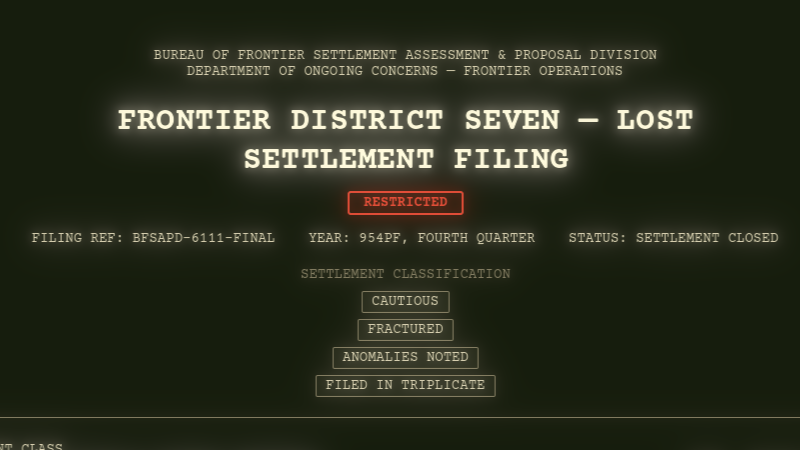
BUREAU OF FRONTIER SETTLEMENT ADMINISTRATION Inkdrift Development Notes — Filed: April 2026
Language Design as a Discrete Discipline
On writing a game where the prose is the mechanic When you make a game that is almost entirely text — no combat, no platforming, no puzzle that can be solved without reading — the writing stops being content and becomes architecture. Every sentence load-bears. Every word choice is a design decision. The prose is not describing the game. The prose is the game. We Were Here Before is a bureaucratic cosmic horror narrative card game. You govern a doomed frontier settlement. The settlement will inevitably be lost. What remains is a personalized obituary filed by a bemused imperial bureau — a bureaucratic record of who you became as a governor. Every run ends in a different document. The document is the point. Making it required developing what I now think of as language design — a discrete discipline sitting between writing and game design that has its own rules, its own failure modes, and its own craft. This is an attempt to document some of what I learned.
I. The Weight of Sentences
The most important decision in WWHB was the staccato structure. Short sentences. Almost uniformly. The Bureau does not explain itself. This was not initially intentional — it emerged from the game's aesthetic — but once it was established, it became a load-bearing rule. Short sentences carry weight individually. Longer sentences distribute it. In a text-heavy game where every word must justify its presence, the short sentence is the default unit because it forces each thought to stand alone. Consider this passage from The Prior Record, one of the game's story arcs:
The Administrator has stopped working. She stands in the archive room holding a register. The register is ours. The dates inside are not. Someone has been keeping records here for twenty years. We arrived three months ago.
Each of those sentences would work differently in a longer construction."We arrived three months ago"lands differently as its own sentence than embedded in a clause. The paragraph structure is part of the horror. The silence between lines is doing work. The rule I arrived at: when a sentence in WWHB runs long, something is wrong. Either the thought needs to be broken apart, or the longer sentence is earning its length through contrast — a departure from the rhythm that signals something has changed. A longer sentence is an event.
II. The Pronoun is the Character
WWHB uses two pronouns with deliberate intent: We and I. Every sentence in the game is assigned to one of them. This is not stylistic — it is mechanical. We is the Bureau. The collective. The institutional voice. It governs at the settlement level, files reports, manages populations. We is the voice of procedure. It does not feel things. It notes them. I is the governor. The individual. The private record. When a sentence switches from We to I, something has broken through the administrative surface. A personal opinion has been filed. The governor has let the mask slip. The governor recognizes that there is an element of personal accountability, something that will stick with them personally. Here are both voices in the same arc — The Dreaming Sickness, where workers begin sleeping and refuse to wake: We — the Bureau's voice:
We have double-checked the register. The dates are real. There are no contradictions we can find. There are only dates that should not be there. The Administrator has not moved. We should check the archives. Cross-reference. Copy everything in triplicate. Oh. She is already doing it.
I — the governor's voice:
The bells worked. Attendance is up. Shifts are full. I have brought her tea twice. She has not looked up. The settlement runs correctly. I know this because I check. I lie awake and I listen to the settlement not dreaming. It is a specific sound.
The reader learns to feel this distinction without being told it. We signals safety — this is documented, processed, filed. I signals danger — this has escaped the record. When We and I appear in the same passage, something is breaking down. The governor is losing professional distance."I lie awake and I listen to the settlement not dreaming. It is a specific sound. I did not know silence had varieties until this."That passage is entirely in I. It could not be in We. The Bureau does not lie awake. The governor does. The pronoun is doing character work that would otherwise require paragraphs of exposition.
III. Half-Named Characters
No character in WWHB has a proper name. Every recurring figure carries a title only — a role the player names themselves in the UI. This was not a technical constraint. It was a language design decision. The Administrator — Settlement's institutional conscience. She noticed before the governor did. She is already doing it before she is asked. The Bookkeeper — Ledger and records. Numbers are always right. That is sometimes the problem. Her face gives nothing away. The Scout — They always debrief. Everything, in order, without editorializing. Pay attention to when they stay seated. The Cartographer — She holds the maps and the long memory. She has already done the arithmetic. She does not knock. A title gives you half a character. The player's imagination gives the other half. The Bookkeeper is more specific than any invented name — it tells you exactly what she does and leaves everything else to the imagination. Her competence is implied by the title. Her humanity has to be earned by the writing. The recurring character notes I write for each figure are intentionally spare. She does not bring things until she has checked twice. When the debrief ends, she gets up and leaves. Pay attention to when she stays seated. This is all the reader needs. The rest they construct themselves, and the version they construct is always more personal than any version I could write for them.
IV. Horror Through Administrative Language
The most important discovery in making WWHB was that bureaucratic language is inherently uncanny. The form that exists to flatten emotion — the report, the ledger, the filing — reveals horror precisely through its refusal to acknowledge it. From The Dreaming Sickness, after the governor orders the workers roused with bells:
A worker came to City Hall last week. She stood in the doorway a long time before speaking. She said she wanted to report something. She said no one in the settlement dreams anymore. Not the workers. Not the administrators. Not the children. She asked if that was supposed to happen. We thanked her for the report. We filed it under expected outcomes.
We filed it under expected outcomes. That line requires no monster. No jump scare. No explanation. The horror is in the filing category chosen. Something that should be alarming has been categorized into normalcy. The bureaucracy has processed the impossible and found a drawer for it. This is what administrative language makes possible: the thing that cannot be said can be filed. The form that has no field for it generates a new field. The Bureau does not scream. It cross-references. The Debt arc takes this further — the Empire literally bills settlements for words. One hundred and seven Reserved Word Units, payable in full:
The Bookkeeper opened the second letter. It contained a list. One hundred and seven words. She read it once and set it down. She said: I know these. Not — I recognize these. I know these. I read the list. She was right. I knew them too. We could not have said why. Only that they were the ones we reached for when we needed exactly the right word. The ones that felt, somehow, like ours.
The cosmic horror of language being owned and traded is made more disturbing, not less, by the bureaucratic frame around it. An invoice. A list. A courier who does not sign anything.
V. Repetition as Recursion
WWHB uses deliberate verbal repetition — phrases that recur across arcs, characters, and contexts. This is not laziness. It is mechanical. The Bookkeeper is described across multiple arcs with the same line:"She is very good at her job. Her face gives nothing away."The Administrator:"She is already doing it before she is asked."The Scout:"They always debrief. Everything, in order, without editorializing."These repeated phrases work like musical motifs. When a player encounters them for the third or fourth time, they carry accumulated weight. The phrase"That is either reassuring or it isn't. We have not decided."appears first as a small uncertainty. By the third time — in a different arc, a different context — it has become something closer to dread. The Bureau still hasn't decided. Something has been unresolved across multiple runs, multiple settlements, the entire history of the frontier. The repetition is also thematically loaded: the frontier is recursive. The same things happen to every settlement. The Bureau processes them each time with the same language because the same things keep needing to be filed. The verbal repetition is the form matching the content.
VI. What the Language Cannot Do
The hardest lesson: there are things literary prose cannot do that game writing needs to do. WWHB has to communicate mechanical choices — three branches, each with consequences — using the same prose voice it uses for its horror. The branch text is a choice card. It has to be both beautiful and legible under decision-making pressure. The solution was to make the branch text the governor's internal monologue at the moment of choosing. Not a description of what will happen — the governor doesn't know. A description of what the governor is thinking as they decide. This keeps the prose in the right register while communicating the emotional stakes of the choice. Crucially, the pronoun the governor reaches for in that moment is itself a character signal. A governor choosing institutional resolve reaches for We — sheltering a personal decision inside collective language. A governor whose feelings have broken through reaches for I. HIBERNATE is written almost entirely in We — "We have made a decision," "We are not certain this is wise" — because the governor is using the institutional voice to protect themselves from the weight of what they are choosing. The most human thing the settlement has done is phrased in We. That is either reassuring or it isn't.
From The Dreaming Sickness — the HIBERNATE branch, where you allow the sleeping workers to continue rather than waking them:
Five workers have not woken in three days. We have made a decision. Rather than rouse them, we will give them what they seem to need. Proper beds. Water when we can get it in. Someone to sit with them. We will let them dream it through to the end. Whatever the end looks like. We are not certain this is wise. It is the most human thing we have done in some time.
That is a choice card. The player is clicking it to select this path. But it reads as lived experience. The game is simultaneously asking the player to make a decision and showing them who they are for making it. That double register — decision and revelation — is what language design in a text-heavy game has to solve. The prose cannot just be beautiful. It has to carry the player through a choice while telling them something true about themselves for making it. Getting that right took most of the game's development time. I am still not certain I always get it right. The Bureau is still filing.
We Were Here Before is a bureaucratic cosmic horror narrative card game. Every run ends in a personalized obituary. Free demo available now on Steam. Steam page: https://store.steampowered.com/app/4513390 Demo: https://store.steampowered.com/app/4561810
Source
Changelog.gg summarizes and formats this update. How we read updates.