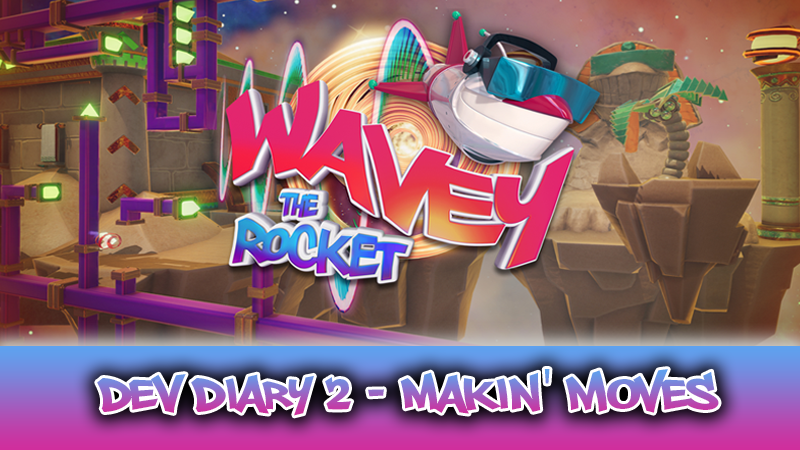
Hello, I’m Rob, the programmer at UpperRoom Games, and today we're going to dive into exactly how Wavey moves in our debut release as an indie studio, Wavey The Rocket!
Full notes
Full Wavey The Rocket update
Read the full published notes in a cleaner layout. The original post stays linked below.
Repeated intro
Hello, I’m Rob, the programmer at UpperRoom Games, and today we're going to dive into exactly how Wavey moves in our debut release as an indie studio, Wavey The Rocket!
What changed
1 fix0 additions4 changes0 removals
Performance
Gameplay
Events
Balance
changedWith Wavey we set out to make a platformer unlike any other. When looking at some of our favourite characters from the past, such as Crash Bandicoot, Sonic and Rayman, they all presented a similar core puzzle; how do I use run and jump to get through the level? While trying to come away from this quintessential platformer concept, we had an idea to move a character along a waveform that the player could shape. After some experimentation we arrived at a sine wave based movement that allows Wavey to weave through obstacles in a skillful and unique way!
changedThe vertical wave motion never stops and has a consistent rate but the player can choose to grow or shrink the vertical distance of this movement (the wave amplitude). What's really interesting here, is how Wavey’s current position on the wave when it changes has a big effect on how much Wavey moves and the direction he moves in!
changedBeing a stylish, yet simple rocket, does have its limitations. While Wavey has amazing fine movement control, he can only accelerate so fast and can only go so fast. A lot of our time in perfecting his movement was focused on setting these limitations to maintain challenge while feeling responsive.
fixedHis other key limitation is the fixed cycle duration of the wave. Understanding and utilizing this timing cycle adds a very high skill cap to his control. It becomes a focal element in reflexive play as well as puzzle solving as the game progresses. Players with the best grasp on this are the ones topping speedrun leaderboards!
changedStill hungry for more? Here’s a peek into the maths for those of you who love some number crunching. Wavey’s wave cycles once every 3.11 seconds. We output this wave as a normalised value (-1 to 1) and multiply it by the players current amplitude to grow or shrink the wave vertically from input. This movement is applied directly to the Wavey’s Y axis, along with a linear horizontal translation (speed over time) on his X axis. The wave is plotted as a prediction of his current trajectory by running these same equations but further forward in time.
We output this wave as a normalised value (-1→1
Wavey The Rocket changes
changedWith Wavey we set out to make a platformer unlike any other. When looking at some of our favourite characters from the past, such as Crash Bandicoot, Sonic and Rayman, they all presented a similar core puzzle; how do I use run and jump to get through the level? While trying to come away from this quintessential platformer concept, we had an idea to move a character along a waveform that the player could shape. After some experimentation we arrived at a sine wave based movement that allows Wavey to weave through obstacles in a skillful and unique way!
changedThe vertical wave motion never stops and has a consistent rate but the player can choose to grow or shrink the vertical distance of this movement (the wave amplitude). What's really interesting here, is how Wavey’s current position on the wave when it changes has a big effect on how much Wavey moves and the direction he moves in!
changedBeing a stylish, yet simple rocket, does have its limitations. While Wavey has amazing fine movement control, he can only accelerate so fast and can only go so fast. A lot of our time in perfecting his movement was focused on setting these limitations to maintain challenge while feeling responsive.
fixedHis other key limitation is the fixed cycle duration of the wave. Understanding and utilizing this timing cycle adds a very high skill cap to his control. It becomes a focal element in reflexive play as well as puzzle solving as the game progresses. Players with the best grasp on this are the ones topping speedrun leaderboards!
changedStill hungry for more? Here’s a peek into the maths for those of you who love some number crunching. Wavey’s wave cycles once every 3.11 seconds. We output this wave as a normalised value (-1 to 1) and multiply it by the players current amplitude to grow or shrink the wave vertically from input. This movement is applied directly to the Wavey’s Y axis, along with a linear horizontal translation (speed over time) on his X axis. The wave is plotted as a prediction of his current trajectory by running these same equations but further forward in time.
With Wavey we set out to make a platformer unlike any other. When looking at some of our favourite characters from the past, such as Crash Bandicoot, Sonic and Rayman, they all presented a similar core puzzle; how do I use run and jump to get through the level? While trying to come away from this quintessential platformer concept, we had an idea to move a character along a waveform that the player could shape. After some experimentation we arrived at a sine wave based movement that allows Wavey to weave through obstacles in a skillful and unique way!
This works through a combination of two motions; a vertical wave motion and a horizontal linear motion. The horizontal motion takes a set speed and maintains it. The player can adjust this maintained speed, including being able to go backwards!
The vertical wave motion never stops and has a consistent rate but the player can choose to grow or shrink the vertical distance of this movement (the wave amplitude). What's really interesting here, is how Wavey’s current position on the wave when it changes has a big effect on how much Wavey moves and the direction he moves in!
Being a stylish, yet simple rocket, does have its limitations. While Wavey has amazing fine movement control, he can only accelerate so fast and can only go so fast. A lot of our time in perfecting his movement was focused on setting these limitations to maintain challenge while feeling responsive.
His other key limitation is the fixed cycle duration of the wave. Understanding and utilizing this timing cycle adds a very high skill cap to his control. It becomes a focal element in reflexive play as well as puzzle solving as the game progresses. Players with the best grasp on this are the ones topping speedrun leaderboards!
Still hungry for more? Here’s a peek into the maths for those of you who love some number crunching. Wavey’s wave cycles once every 3.11 seconds. We output this wave as a normalised value (-1 to 1) and multiply it by the players current amplitude to grow or shrink the wave vertically from input. This movement is applied directly to the Wavey’s Y axis, along with a linear horizontal translation (speed over time) on his X axis. The wave is plotted as a prediction of his current trajectory by running these same equations but further forward in time.
As always, we can’t give out all the special details on exactly how it all works, but we’re extremely grateful you’ve taken the time to read this and check it out! You can Wishlist Wavey The Rocket now on Steam, or check us out on Twitter (@upperroomgames) or on Facebook (search UpperRoom Games!) for more info!