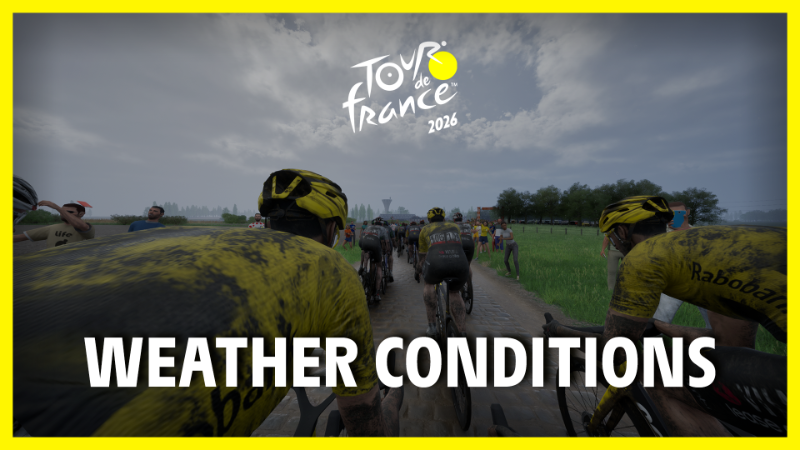
Hello cycling fans! For this first devblog dedicated to Tour de France 2026, we are going to look at a long-requested new feature: weather conditions.
In this update2
Full notes
Full Tour de France 2026 update
Read the full published notes in a cleaner layout. The original post stays linked below.
Repeated intro
Hello cycling fans!
What changed
0 fixes3 additions4 changes0 removals
Gameplay
Maps
Performance
addedFor this first devblog dedicated to Tour de France 2026 , we are going to look at a long-requested new feature: weather conditions .
addedCycling is an outdoor sport subject to meteorological hazards, and it is undeniable that this aspect was one of the game's obvious shortcomings. If this addition took time to be implemented, it is mainly because we wanted to base it on the new game engine introduced last year (Unreal Engine) rather than on the old in-house engine that we knew was at the end of its life.
changedSo much for this quick history, but what does it actually look like in the game?These atmospheric conditions are not chosen randomly. They are based on real statistical data collected over a 5-year period. When you start a race, our algorithm randomly selects a year to obtain a different climate from one game to the next. The weather depends on the geographical location of the stage and the date on which it takes place. It will therefore be difficult to avoid the rain on a race like Paris-Nice, but the chances of the weather improving as the riders get closer to Nice will be high.
changedSo much for this quick history, but what does it actually look like in the game?Whatever your choices, the weather forecast only extends for the next 4 stages. They are announced by 2 parameters: the temperature and the risk of precipitation. The temperature influences how the riders equip themselves. Leg warmers and arm warmers will be out when the thermal level is low. The risk of precipitation will indicate the risk of encountering rain during the stage: sun, overcast, showers, or rain will be the 4 possible indications.
changedThat's it for the visual aspect in the race and in the menus, but what does it change with the controller in hand?As a direct consequence of the rain, the risks of massive crashes are much higher than on dry roads . Not only do your opponents risk crashing more easily, but your rider could also make a mistake if you are not careful. As soon as the roads become wet, you must be even more attentive to your speed and your trajectory.
changedThat's it for the visual aspect in the race and in the menus, but what does it change with the controller in hand?Braking too hard and your rider risks losing grip and going into a more or less controlled skid depending on their agility rating. The higher it is, the more time you have to correct the slide. To do this, you just need to have the reflex to release the accelerator in time... and hope that the rider manages to recover to avoid the fall.
Tour de France 2026 changes
addedFor this first devblog dedicated to Tour de France 2026 , we are going to look at a long-requested new feature: weather conditions .
addedCycling is an outdoor sport subject to meteorological hazards, and it is undeniable that this aspect was one of the game's obvious shortcomings. If this addition took time to be implemented, it is mainly because we wanted to base it on the new game engine introduced last year (Unreal Engine) rather than on the old in-house engine that we knew was at the end of its life.
changedThese atmospheric conditions are not chosen randomly. They are based on real statistical data collected over a 5-year period. When you start a race, our algorithm randomly selects a year to obtain a different climate from one game to the next. The weather depends on the geographical location of the stage and the date on which it takes place. It will therefore be difficult to avoid the rain on a race like Paris-Nice, but the chances of the weather improving as the riders get closer to Nice will be high.
changedWhatever your choices, the weather forecast only extends for the next 4 stages. They are announced by 2 parameters: the temperature and the risk of precipitation. The temperature influences how the riders equip themselves. Leg warmers and arm warmers will be out when the thermal level is low. The risk of precipitation will indicate the risk of encountering rain during the stage: sun, overcast, showers, or rain will be the 4 possible indications.
changedAs a direct consequence of the rain, the risks of massive crashes are much higher than on dry roads . Not only do your opponents risk crashing more easily, but your rider could also make a mistake if you are not careful. As soon as the roads become wet, you must be even more attentive to your speed and your trajectory.
For this first devblog dedicated to Tour de France 2026, we are going to look at a long-requested new feature: weather conditions.
Cycling is an outdoor sport subject to meteorological hazards, and it is undeniable that this aspect was one of the game's obvious shortcomings. If this addition took time to be implemented, it is mainly because we wanted to base it on the new game engine introduced last year (Unreal Engine) rather than on the old in-house engine that we knew was at the end of its life.
So much for this quick history, but what does it actually look like in the game?
Let's start with the graphical aspect. Weather conditions vary from one race to another. From sun to rain, through cloudy skies with different intensities of precipitation and brightness, the races change their visual atmosphere depending on the weather. You may even, on rare occasions, encounter snow on the highest mountain passes and more frequently mud when taking on the cobbled sectors of Paris-Roubaix if rain appears.
These atmospheric conditions are not chosen randomly. They are based on real statistical data collected over a 5-year period. When you start a race, our algorithm randomly selects a year to obtain a different climate from one game to the next. The weather depends on the geographical location of the stage and the date on which it takes place. It will therefore be difficult to avoid the rain on a race like Paris-Nice, but the chances of the weather improving as the riders get closer to Nice will be high.
For customizable modes like MyTour and private games in Criterium mode, you will have the ability to influence the weather conditions. Cold or heatwave, rain or sun, it will be up to you to determine these parameters.
Steam post imageSteam post image
Whatever your choices, the weather forecast only extends for the next 4 stages. They are announced by 2 parameters: the temperature and the risk of precipitation. The temperature influences how the riders equip themselves. Leg warmers and arm warmers will be out when the thermal level is low. The risk of precipitation will indicate the risk of encountering rain during the stage: sun, overcast, showers, or rain will be the 4 possible indications.
Keep in mind that forecasts can sometimes be capricious and that overcast weather does not 100% guarantee the absence of rain and that conversely, even if showers are forecast, you may get through without a drop.
That's it for the visual aspect in the race and in the menus, but what does it change with the controller in hand?
As a direct consequence of the rain, the risks of massive crashes are much higher than on dry roads. Not only do your opponents risk crashing more easily, but your rider could also make a mistake if you are not careful. As soon as the roads become wet, you must be even more attentive to your speed and your trajectory.
Braking too hard and your rider risks losing grip and going into a more or less controlled skid depending on their agility rating. The higher it is, the more time you have to correct the slide. To do this, you just need to have the reflex to release the accelerator in time... and hope that the rider manages to recover to avoid the fall.
That's it for this first devblog concerning the addition of weather conditions in TDF2026. The next one will be devoted to the new content added this year.