
Full notes
Full The Blackout Project update
Read the full published notes in a cleaner layout. The original post stays linked below.
What changed
- Store
- Balance
- Maps
- Gameplay
The Blackout Project changes
As expected, a transportation model is being implemented in The Blackout Project.
The first step focuses on the local automatic transportation system.
Here, local means that transportation operates within a limited range, mainly determined by the type of site involved—warehouses or standard companies—with a maximum distance of 2 to 3 hexes.
Automatic means that, at least for short distances, players will not need to manually plan routes, purchase vehicles, or manage fleets.
Deliveries are driven by purchase orders: consumers place orders with producers, and producers then attempt to deliver the requested goods. For inhabitants, the logic is reversed—they travel to collect goods themselves, for example by going to bakeries to buy food.
Once items are purchased, they immediately become the property of the buyer and are no longer available to other companies. A clear and explicit view of item ownership is provided at all times.
Each site will be limited by several factors in its exchange capacity :
Internal storage volume, which is divided between incoming and outgoing areas. Players can decide how to allocate capacity between these two zones.
Item volume, which depends on the type of item being stored or transported.
Local transport capacity, which represents a site’s limited ability to move goods. This corresponds to a maximum exchange volume per day and depends on the size of the company. This capacity is divided among transferable items—rows marked as movement prohibited do not consume any transport capacity.
For each item, players can explicitly authorize incoming and/or outgoing transfers, regardless of individual ownership.
It is, of course, possible to destroy existing stock to make room—but in upcoming updates, this will not be such a trivial decision.
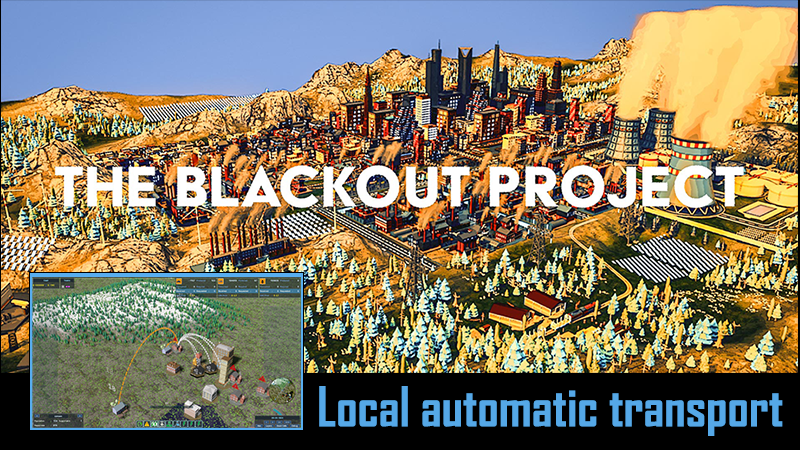
To provide better insight into what is happening under the hood, the game will feature a dynamic schematic view of exchanges, allowing players to clearly understand how goods are flowing between sites.
The exchange view uses colors for products, as well as dashed or solid lines to distinguish potential exchanges, ownership, and the effective transfers that occurred during the last day. Keep in mind that the default time scale is one in-game day per two seconds of real time, resulting in a fast-paced simulation.
To prevent overly efficient chaining of local automatic deliveries, a buffer is applied during stock processing. In practice, this means that products become available with a one-day delay, representing reception, handling, and internal processing. Only after this delay can goods be used for production or further distribution. From a player perspective, the impact is minimal due to the fast pace, but this mechanism prevents goods from being transported instantly across the map and ensures that long-range routes and transportation systems remain relevant.
We also plan to limit warehouse placement based on city density, as part of a broader urban development system.
Finally, keep in mind that all of these mechanics are, in most cases, strongly constrained by daily exchange capacity.
Do not hesitate to share your expectations and feedback with us on our social media channels.
Source
Changelog.gg summarizes and formats this update. How we read updates.