
In this update4
Full notes
Full Swarmdustry update
Read the full published notes in a cleaner layout. The original post stays linked below.
What changed
- Gameplay
- Server
- Store
- Performance
- Balance
Swarmdustry changes
Hi everyone, and welcome to the very first development blog for Swarmdustry! This is where I’ll be sharing the progress of the game each week showing off new features or deep dive into existing mechanics, talking about design decisions, and giving you a peek behind the curtain at what it’s like to build a game about an alien hive that thinks in factories.
I’m really excited to finally start putting these posts out. First impressions of many players is that this game is a clone of Factorio, and although I'm not disputing the fact that it is heavily inspired by it, it is a very different experience gameplay wise, technical wise and vibe wise. At the same time, it will also feel familiar and should provide players with tons of hours of fun.
In this first dev blog, I'll talk about 4 things: what is Swarmdustry, why build it, describe its aesthetic and finally do one deep dive into one mechanic, the spire network (aka power grid to all human engineers out there).
What is Swarmdustry?
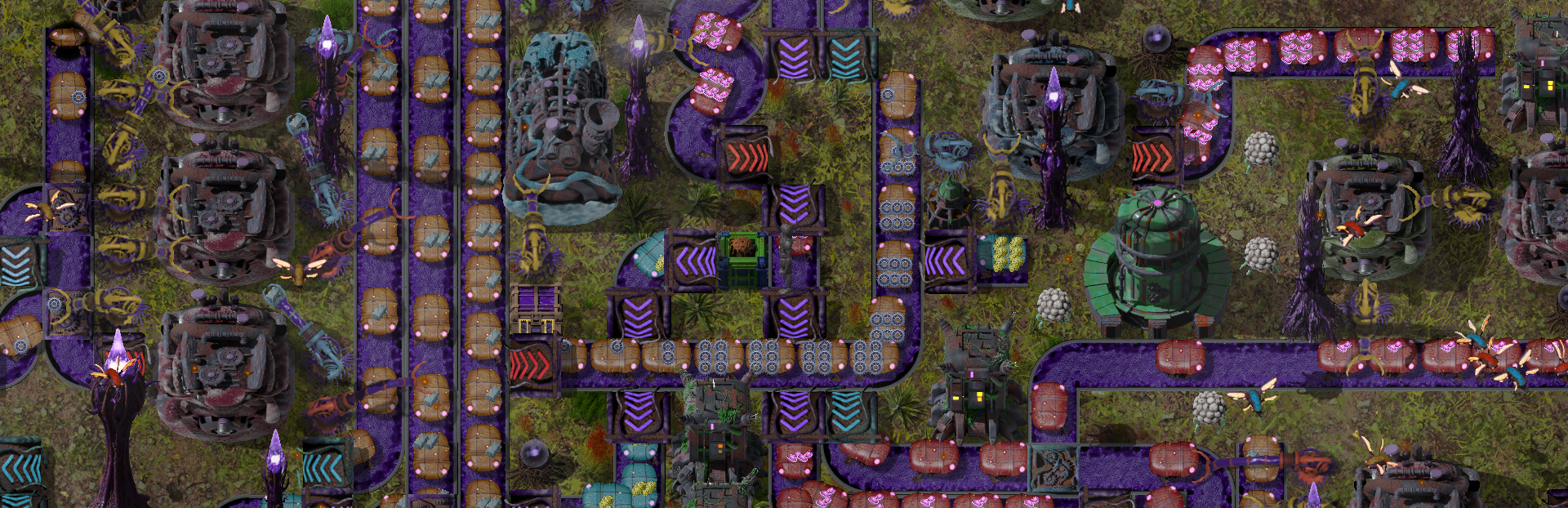
At its core, Swarmdustry is a factory building strategy game, inspired by titles like Factorio and Mindustry. But instead of playing as humans or machines, you play as the Swarm: an alien hive that spreads across the land, builds organic structures, and uses living creatures to transport, defend, and fight.
It’s an automation game, but with a very different skin (and, in some places, actual skin). Think:
Quantity over quality. That is the way of the swarm.
Acid pods instead of machine gun turrets.
Creeping walls of flesh and carapace instead of stone walls.
Unit mechanics instead of robotics.
The Swarm is both your army and your infrastructure. Everything is alive, and everything serves the hive.
Why Build This Game?
I’ve always loved factory games because they scratch that perfect itch of problem solving, creativity, and optimization. But one thing I’ve noticed is that almost all of them lean heavily into industrial aesthetics: metal, sparks, belts, pipes.
That’s awesome in its own right, but I kept asking myself: what would this genre look like if it was organic instead of mechanical?
What if your entire factory felt like a creature —something pulsing, growing, spreading, and reacting?
What if instead of belts, you have units move items?
What if instead of an electrical grid, you had fireflies carrying energy through a spire network?
These questions became the seed of Swarmdustry.
The Swarm’s Aesthetic
One of the first design goals was nailing down the look and feel of the Swarm. I didn’t want it to be too cartoony, but I also didn’t want it to slide all the way into grotesque horror. The sweet spot is somewhere between creepy, alien, and powerful.
Here are some of the themes we’re going for:
Molted browns, purples, and greens for walls and structures.
Bioluminescent accents on units and wings.
Hybrid of organic and metallic — Most entities have both a metal and an organic component to them
Alive but functional: nothing is just decorative. Even walls have texture and presence, as if they’re muscle fibers hardened into armor.
Spire network
The spire network is basically a grid of spires, energy producers and energy consumers.
Spires come in 3 flavors: Needle spire, Crystal spire and Beacon spire. Each spire has a different energy and connection radius, much like Factorio's poles.
Energy producers come in 2 flavors: Boil chamber and Breathing blob. The former produces energy from fuel items such as coal and wood, but does so in 'bursts'. When it consumes a fuel item from its input buffer every X seconds, it instantly generates a certain amount of energy based on the type of fuel, say 50 units. Then it gradually and slowly loses that energy over time (the Swarm is an organic, imperfect machine after all). Breathing blobs produce free infinite energy, but their storage capacity is very low, the buildings take up a lot of space, and the energy generation is slow.
Energy consumers are all the different buildings of the Swarm, such as grabbers.
In other games, those 3 are the basic building blocks to power up your factory or city. Not in Swarmdustry. In this game, you need an extra component: Fireflies. Fireflies are these cute little flying bugs whose job is to deliver energy across the spire network, from producers to consumers. Starting out as any other craftable item in your inventory, you can place a firefly in the game world like you would any building. Or you can have a grabber do it for you. This is an automation game after all.
The firefly will then have to decide which producer to get assigned to. This involves unit jobs, job sites and worker bays. This is another deep mechanic of Swarmdustry, which I'll talk about in another dev blog. For now, let's assume the firefly will just pick the closest eligible energy producer. So it flies its way there, hovers around on top of it until it charges up to its maximum capacity (which can be increased via genetic codes), and then starts its journey in search for consumers. But it does so by following a set of rules: First, an energy producer needs to be connected to one spire. That would be the entry point into the network. Then, the firefly will go from spire to another connected spire by following the path of least resistance. Each spire has a resistance meter to it which is incremented every time a firefly visits it, and decays slowly over time. This is to ensure that fireflies visit all the spires in your network, where the demand is highest. Once it reaches a spire that has some energy consumer nearby, then the firefly will power up the consumer and keep flying around the network until it's time for it to go back and recharge.
So now you may be wondering how does energy storage work? That's a discussion for another dev blog, involving Acflies and Accumulators.
So that will be all for this blog, hope you enjoyed the read. If you've got any questions, you can reach me on Discord linked on the main page, or Steam discussions. Happy gaming!
Source
Changelog.gg summarizes and formats this update. How we read updates.