
In this update12
Full notes
Full Soulbound: Online update
Read the full published notes in a cleaner layout. The original post stays linked below.
What changed
- Gameplay
- Store
- Balance
- Workshop
- Maps
Soulbound: Online changes
Your House, Your Rules: Player Housing in Soulbound
Every Pioneer needs a place to come home to.
We may have that retro-pixel feel we all remember, know, and love, but Soulbound is, in many ways, a modern homage. It used to be that in many MMOs, characters existed in a strange kind of homelessness. Great heroes without a place to call their own!
You’d wander from zone to zone, dump loot in a bank when visiting your favourite city, and log off wherever you happened to be standing, or at an inn to get some rest. There was rarely an anchor, or a place that was yours, even if modern games now offer housing.
We set out to give players a way to build their own part of Soulbound: Online.
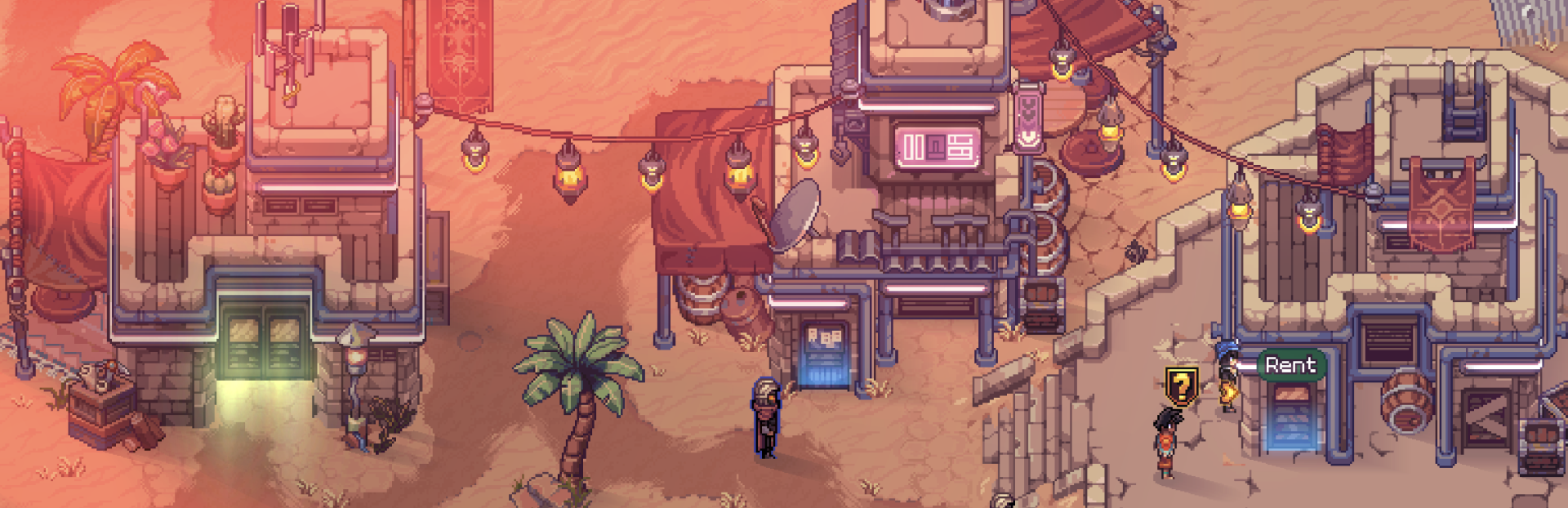
Every player in Soulbound gets their own house. A real, physical space in the world that you build, customise, upgrade, and share with the people you choose. It's where you craft your gear, grow your power, and hang out with friends. You can even open your house up in a local city for all players to enter and access, and run your very own shop.
We were heavily inspired by games like Stardew Valley, Factorio, and Valheim. We love the idea of building something, owning it, and nurturing it over time. So, this is our chance to extend that feeling to players inside an MMO. This space can be a place for you to invite your friends (and maybe one day guild members too) to come help or just to hang out. We think we've landed on something genuinely special, and want to give you a first look at what player housing looks like in Soulbound: Online.
Every Player Gets a House
Shortly after you finish the tutorial, you'll get to check out your very own home. Everyone will start in the same zone, but one day you'll be able to unlock a specific location somewhere in the world so that other players can come and find you. Your home starts off as a small workshop, but gives you room to grow it through automations (on the roadmap), factories, and a shop front. Want a compact one-room workshop where everything is within arm's reach? Do that. Want to expand into a sprawling multi-room lair with dedicated wings for different activities? You can do that too.
The Station System: Where Crafting Lives
Here's where housing stops being cosmetic and starts being the backbone of the entire game.
Everything you craft in Soulbound, weapons, armour, potions, food, materials, components, is built at crafting stations inside your home. When you craft something at a station, both you and the station gain EXP making this a key component of progression.
The Stations
At launch, your home can house up to twenty-eight types of specialised crafting stations, but here's a quick taste of what you'll be working with:
The Generator powers everything, so you'll need to keep it fueled to run your stations while you’re offline.
The Furnace smelts raw ore into the metals that everything downstream depends on.
The Manufacturing Table turns ingots and materials into the components for your weapons and armour.
The Chemistry Lab lets you brew potions and elixirs, and refine rare Yoku.
The Kitchen cooks farmed crops into food that provides various buffs. Serious dungeon runners and gathers will rely on these buffs for extra combat power and stamina.
The Weapon & Armour Stations are your final assembly points for the gear you take into battle.
Specialist stations like the Power Core Fusion Station, will allow you to upgrade your weapons and abilities to unlock new relic pathways.
Each one has its own upgrade path and recipe library to grow into.
Upgrade Everything
Every station in your house has a multi-level progression system.
Each level you upgrade a station, you unlock:
New recipes open up with every level, giving you access to higher-tier materials, more powerful gear, and new consumables, so a Level 1 Manufacturing Table only crafts crude components while a Level 7 one is producing epic weapon cores and ability cores.
More crafting slots become available as you upgrade, so where a Level 1 station runs just two simultaneous crafts, a fully upgraded one lets you run three or four queues in parallel for far more output per session.
[On The Roadmap] Add-on module slots let you install complementary furniture that enhances your stations. For example a Basic Refinery could add two extra crafting slots to your Furnace and halves its crafting time, a Transmutation Matrix can unlock four exclusive stim potion recipes on your Chemistry Lab, or a Dutch Oven could unlock Pizza and Coq Au Vin recipes for your Kitchen Right now we have over 25 unique modules planned across all stations, each carrying its own crafting requirements and upgrade chains.
The more you use a station, the closer it gets to being eligible for its next upgrade. Every upgrade you make is a permanent improvement to your production capability.
The Power Grid
Your Generator is the heart of the operation. It burns fuel, coal, wood, oil, or power items and produces a power output that's shared across every station in your home. Production stations draw from that pool so, if your total power draw exceeds your generator's output, something has to be switched off.
This creates real decisions early on, you might need to choose between running your Furnace or your Chemistry Lab as both draw 20 power at Level 1, but your Level 1 Generator only outputs 10. You'll need to upgrade your generator before you can run everything simultaneously.
Crafting Works While You're Offline
This is one of the things we're most excited about.
When you set your stations to work on smelting ore, crafting components, refining Yoku, cooking food, or upgrading a station that work continues even after you log off. Your home doesn't sleep when you do, and one of our roadmap items is to allow you to let other players pay you to use your stations, generating additional in-game gold income for you even while offline.
The vision is straightforward: you come home from a dungeon run, dump your gathered materials into your stations, queue up your crafts, and log off. Go play another game. Go to sleep. Watch some TV. Go to work. But when you come back, your crafts are done and your stations have been working the entire time.
We studied how games like Clash of Clans, AFK Arena, and Valheim handle progression timers, and we found a consistent pattern: the best retention loops happen when players naturally settle into a rhythm of "queue, leave, return." At Tier 3, you're queuing crafts before a dungeon run and coming back to finished products. At Tier 4, you're queuing armour pieces before bed and waking up to completed gear.
And in the future, we want to extend this further. Imagine checking in on your house from your phone, or your Steam Deck, or a mobile device, seeing what's finished, queuing the next batch, and getting on with your day. We also plan to allow for delegation of your home management duties as part of our roadmap, so you could send a DM to a friend to check in on your home and help you keep stations running at optimum levels.
A Social Space, Not Just a Workshop
Your house isn't a solo experience. It's designed to be shared with friends. We had a dream of collaborative base building, so multiple players could work together to upgrade their base, working as a team to make the task easier. We won’t get the balance just right first time, but that’s the dream. Logging on and working with 5 friends to get your weapon station to Tier 3 so you can start running Tier 3 dungeons.
You control who gets access with granular access controls, and can invite your friends. Open the door to your party members and when guilds launch (coming soon after the initial release), you'll be able to gate access to guild members too. Your homestead is a private space by default, and you decide who's welcome. We’ll continue to improve access controls over time so you can curate the best experience possible within your home.
When friends visit your house, they can see what you've built, how you've decorated, what stations you've upgraded, and what you're working on. But it goes deeper than just looking around.
This creates natural social dynamics. The friend with the best kitchen becomes the group's cook. The player who invested early in the Chemistry Lab becomes the potion supplier. High-level stations become gathering points. People visit each other's houses not just to hang out, but because there's a functional reason to be there.
We're building toward a world where your homes station library and recipe collection make you genuinely valuable to your social circle. Not in a transactional, cold way. In the same way your friend who's a good cook makes dinner better. Your home becomes a place people want to visit because good things happen there.
Decoration and Personalisation
Beyond the functional stations, the power grid, and the crafting queues, your house is also just... yours. A place you can make look however you want.
Placing furniture in Soulbound is unique because you can drop furniture anywhere. There's no snapping to a grid. And you can also place furniture items on top of tables or on walls. You can choose your floor tiles and wall tiles and even put rare cosmetic items on display. Our roadmap includes adding cosmetic reward like trophies from dungeon completions, achievement rewards, limited-time events or being the top ranked player. Your house tells the story of what you've done and what you care about.
We'll be introducing rare cosmetics and unique achievement-linked items that can only be displayed in your home so that if you’ve cleared the hardest raid in the game, there's something to show for it on your wall. Or, been playing since day one, there’s a trophy for that, or maybe a comfy sofa. Basically, your home is a living museum of your time in Soulbound.
And because friends can visit, decoration isn't vanity for vanity's sake. It's showing off, flexing, inviting a new player over over and having them notice the thing on your shelf that they haven't earned yet. It's the MMO equivalent of having a nice flat and actually having people round to see it.
The Bigger Picture: Your Homestead in the Core Loop
The core gameplay loop in Soulbound is: Home → Craft → Dungeon → Gather → Home.
The tutorial to introduce your home gives you the instructions and material to craft some basic gear. From here, you’ll head to the dungeon gather more materials as you defeat enemies and open treasure chests.
Or maybe you’re hitting a wall in the dungeon, and just can’t progress further? Don’t worry, there are also materials available to gather outside of dungeons through things like farming, mining, foraging, and hacking.
Combining the loot from dungeons with the materials from gathering outside of dungeons, you’ll be able to craft even better gear and consumables which you can use to make it that much further than before.
No matter what, you’ll always return home. That’s where you drop off and use your hard earned and gathered materials to craft the next thing you need to improve your home, your combat power, or even your appearance.
The Meta-Progression Hub
We’ve already talked about your home being a social space, a workshop, and an expression of yourself. Even more broadly though, your home is a snapshot of what you’ve accomplished in Soulbound, and what you can work towards next.
As much as we know people love chasing numbers and positions on a leaderboard, we want houses to be an organic and even aesthetic way to showcase your time in Soulbound. From the cosmetics and furniture you use as decorations to the quantity and quality of your stations, your progress (and the progress of anyone you visit) is immediately visible.
Letting people showcase the cool stuff they’ve done and see what others have accomplished in a natural, immersive way is an important goal of ours in combining game-like progression with the comfort and beauty of a home away from home.
What's Coming Next
Player housing at launch is the foundation. Here's what we're excited to bring to Soulbound Online’s Housing System in the future:
Cosmetics for stations and furniture are on the way, with different styles you can collect and use to decorate your whole home around a specific aesthetic, or mix and match if that is what you want to do.
Expanded complementary furniture; ever dreamed of running your own trade empire? We are working on a system that will let you really mod your stations out and build a full factory of your own.
Automation is something we are keen to bring to the world, with the idea that you'll be able to have robots running in your home to carry out tasks for you while you're offline or out adventuring.
Guild functions will let you build shared guild bases where members can collaborate on resource collection and production together.
Build Your Home. Build Your Guild.
Your home is the center of your world in Soulbound. Instead of a game where customization and gameplay are two distinct loops, we’re combining them into a seamless experience that makes the world both social and engaging.
Stations are both functional and aesthetic. Inviting people into your home lets you hang out with them, but also help them (or have them help you). Dungeon progression rewards you with practical loot to get further and cosmetics to commemorate your progress. Your home exists even when you’re not online, adding to the backdrop of the world while giving you practical benefits. This fusion of aesthetic and progression is what makes Soulbound unique, and what gives you the power to shape the world of Soulbound.
We can't wait to see what you build.
Wishlist Soulbound on Steam.
Source
Changelog.gg summarizes and formats this update. How we read updates.