
In this update7
Full notes
Full Shape Swarm update
Read the full published notes in a cleaner layout. The original post stays linked below.
What changed
- Gameplay
- Balance
- UI and audio
- Events
- Store
Shape Swarm changes
It took three years, but Digital Sagas has officially released its first commercial game: Shape Swarm.
Shape Swarm was never intended to be a breakout hit or a game that would financially support the studio. Instead, the project was designed as a proof of concept and a way to learn the publishing process from start to finish. While larger projects like No One Leaves the Field and Lost Colony continue in development, I wanted Digital Sagas to become a studio that had actually shipped a game.
The goal was straightforward:
Build a smaller scoped game
Launch a demo quickly
Participate in Steam Next Fest
Learn the release pipeline
Several concepts were considered early on, including kart racers, puzzle games, and breakout clones. Ultimately, I settled on a minimalist action roguelite inspired by survivor-like games.
Building the Core Gameplay
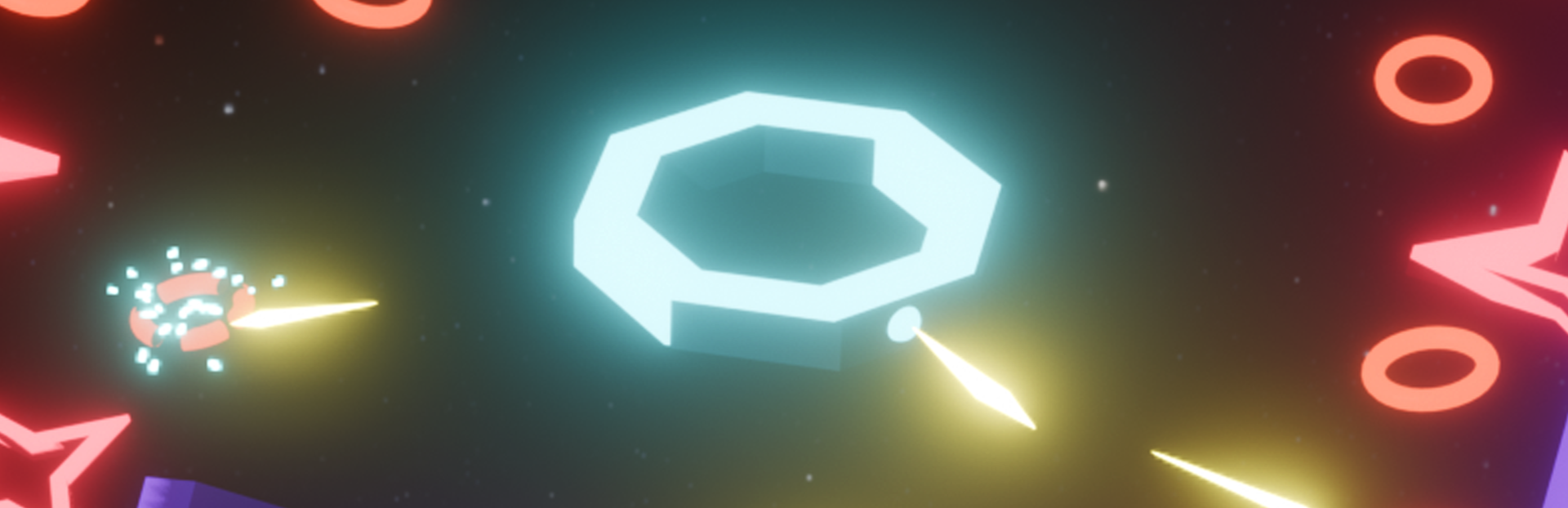
The visual style centered around glowing geometric shapes and a retro arcade aesthetic. At the beginning, the game only needed a few core systems:
Player movement
Enemy spawning
Auto-targeting weapons
The player became a glowing hexagon while the first enemies were simple circles that drifted toward the player.
Interestingly, many of the foundational systems came from Lost Colony. Enemy spawning, state management, and object pooling were all adapted from work already completed on that project. Reusing those systems helped accelerate development significantly.
As development continued, enemy types expanded with different movement patterns and behaviors. The goal was to force players to constantly adapt their strategy during a run rather than rely on a single overpowered build.
Learning From Other Games
During development, I spent time studying games within the genre to better understand pacing and balance. Vampire Survivors became an important reference point, while Geometry Survivor helped inspire some ideas because of its similar visual style.
More importantly, I spent time reading player reviews and feedback on those games. Understanding what players enjoyed — and what frustrated them — directly influenced Shape Swarm’s design.
That research ultimately led to the creation of:
Infinite Mode
Architect Mode
Architect Mode became the feature that most differentiated Shape Swarm from other survivor-likes. Instead of enemy evolution happening automatically, players choose how enemies power up throughout the run, making the mode significantly more strategic and challenging.
Rapid Development
Development moved extremely fast.
By the end of the first weekend, the project already had:
Player movement
Enemy spawning
Endless scrolling backgrounds
The infinite space background eventually created an unexpected issue. Some players discovered they could simply outrun enemies and survive until the timer expired. To solve this, enemies now wrap around the playfield whenever the player gets too far away from combat.
By the second weekend, the game already included:
Four enemy types
UI systems
Music tracks
Level timers
At the same time, work began on Steam assets and capsule art. Because Shape Swarm was never intended to be a high revenue project, hiring a capsule artist would have pushed the game over budget. Instead, I used Blender to create glowing 3D renders of the shapes before refining the images in Photoshop.
The Steam page officially launched on December 18th.
The Demo and Steam Next Fest
The demo launched on January 13th and targeted a 12-minute run. The full game would later expand runs to roughly 18 minutes.
Fortunately, the demo also became a useful live playtesting environment. Feedback from players helped rebalance several abilities, especially Thorn Shield and Health Recovery, which were redesigned into passive upgrades for the final release.
Unfortunately, marketing became the biggest challenge of the project. Because development moved so quickly, there simply was not enough time to build significant visibility before Steam Next Fest.
When February’s Next Fest arrived, the game had around 40 wishlists. By the end of the event, that number had grown to 111.
If Shape Swarm had been intended as a major commercial release, I likely would have delayed the launch to build more awareness first. However, the primary goal was experience and learning rather than sales.
Expanding the Full Release
For the full version, several major additions were implemented:
New enemy types
Boss encounters
Infinite Mode
Achievements
Architect Mode
Architect Mode quickly became the standout feature because it dramatically changed the flow and difficulty of each run.
Launch Results
Shape Swarm officially launched on April 14th with 131 wishlists.
During the first month, the game sold 16 copies and received four positive reviews on Steam.
Financially, those numbers are obviously small. However, the real achievement is that Digital Sagas successfully shipped a commercial game that people purchased and enjoyed.
A huge number of developers never reach that milestone.
Lessons Learned
More importantly, the project accomplished exactly what it was supposed to do:
Teach the release pipeline
Improve production workflows
Build development confidence
Provide real launch experience
The game also now serves as a long-tail cross-promotional title for future projects. There are currently plans for:
A mobile version
A WebGL version for Patreon supporters
Ultimately, Shape Swarm taught me more than any tutorial or course ever could. Every lesson learned from this project will carry directly into future titles.
Meanwhile, work continues on both No One Leaves the Field and Lost Colony.
Thank you to everyone who supported the project, downloaded the demo, left feedback, wishlisted the game, or purchased a copy. Releasing our first game has been a huge milestone for Digital Sagas.
Play Shape Swarm on Steam:
[dynamiclink href="https://store.steampowered.com/app/4252070/Shape_Swarm/"]
More Studio News:
Source
Changelog.gg summarizes and formats this update. How we read updates.