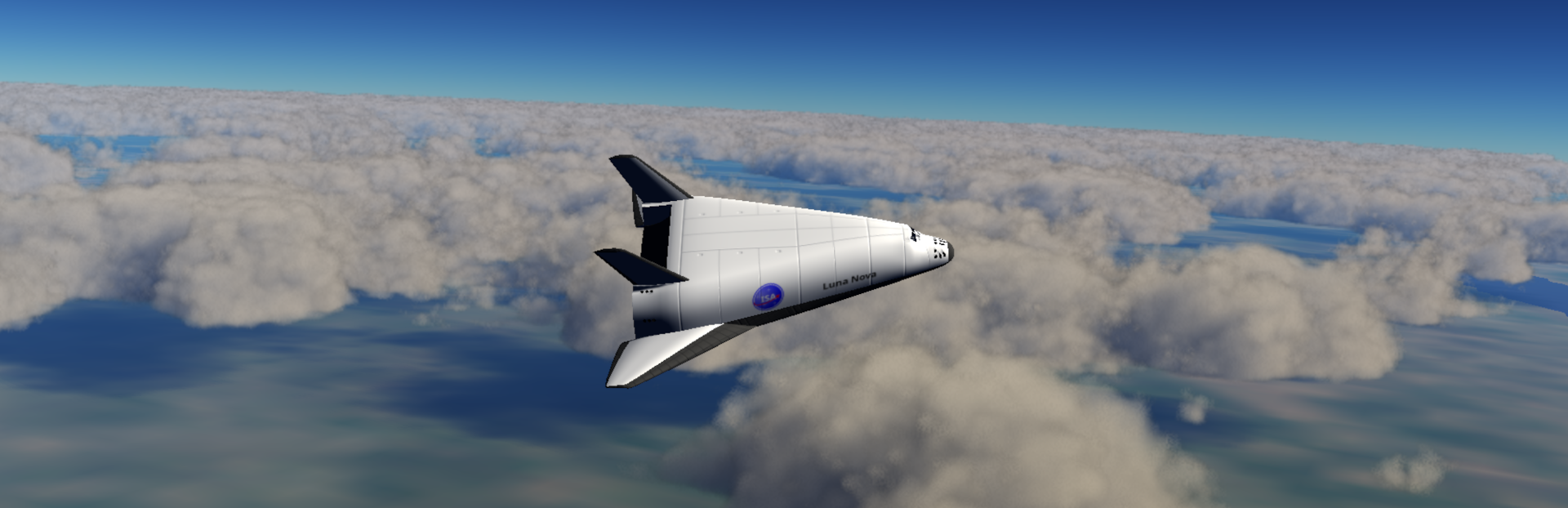
Currently I am working on deferred shading. This requires me to separate rendering into two passes: Geometry pass: render data to a point buffer, normal buffer, and a color buffer, etc.
Full notes
Full sfsim update
Read the full published notes in a cleaner layout. The original post stays linked below.
What changed
0 fixes1 addition5 changes0 removals
Performance
changedCurrently I am working on deferred shading. This requires me to separate rendering into two passes:
changedGeometry pass : render data to a point buffer, normal buffer, and a color buffer, etc.
changedThe change is quite a bit of work, because I have to split up the graphics code and the shaders for rendering the space craft, the planet, and the atmosphere.
addedHowever this will facilitate rendering of runway textures which are at the same height as the rest of the scene but have a higher texture resolution. Simply adding textured polygons to render a runway does not work, because extra geometry placed at the same elevation as the ground causes z-fighting . Z-fighting is a rendering artifact where two surfaces are so close together that the depth buffer can’t reliably tell which one is in front.
changedAnother nice feature of deferred shading is that it allows for multiple localized lights to be rendered at once. You can render the backfaces of a small cube around the light source and use the geometry buffers to light the scene additively, factoring in both the incident angle and the distance from the light source.
changedI.e., deferred shading enables detailed nighttime runway rendering with dense, spatially localized illumination, while keeping performance manageable compared to forward rendering with many dynamic lights.
sfsim changes
changedCurrently I am working on deferred shading. This requires me to separate rendering into two passes:
changedGeometry pass : render data to a point buffer, normal buffer, and a color buffer, etc.
changedThe change is quite a bit of work, because I have to split up the graphics code and the shaders for rendering the space craft, the planet, and the atmosphere.
addedHowever this will facilitate rendering of runway textures which are at the same height as the rest of the scene but have a higher texture resolution. Simply adding textured polygons to render a runway does not work, because extra geometry placed at the same elevation as the ground causes z-fighting . Z-fighting is a rendering artifact where two surfaces are so close together that the depth buffer can’t reliably tell which one is in front.
changedAnother nice feature of deferred shading is that it allows for multiple localized lights to be rendered at once. You can render the backfaces of a small cube around the light source and use the geometry buffers to light the scene additively, factoring in both the incident angle and the distance from the light source.
Currently I am working on deferred shading. This requires me to separate rendering into two passes:
Geometry pass: render data to a point buffer, normal buffer, and a color buffer, etc.
Lighting pass: use the geometry buffers to compute lighting including shadows and volumetric clouds.
The change is quite a bit of work, because I have to split up the graphics code and the shaders for rendering the space craft, the planet, and the atmosphere.
However this will facilitate rendering of runway textures which are at the same height as the rest of the scene but have a higher texture resolution. Simply adding textured polygons to render a runway does not work, because extra geometry placed at the same elevation as the ground causes z-fighting. Z-fighting is a rendering artifact where two surfaces are so close together that the depth buffer can’t reliably tell which one is in front.
Another nice feature of deferred shading is that it allows for multiple localized lights to be rendered at once. You can render the backfaces of a small cube around the light source and use the geometry buffers to light the scene additively, factoring in both the incident angle and the distance from the light source.
I.e., deferred shading enables detailed nighttime runway rendering with dense, spatially localized illumination, while keeping performance manageable compared to forward rendering with many dynamic lights.