
In this update11
Full notes
Full 商道逐权 Pursuit of Mercantile Power update
Read the full published notes in a cleaner layout. The original post stays linked below.
Repeated intro
Hello everyone—this is a devlog for Pursuit of Mercantile Power (GuYuan Village).
What changed
- Balance
- Store
- Maps
- UI and audio
- Events
- Performance
商道逐权 Pursuit of Mercantile Power changes
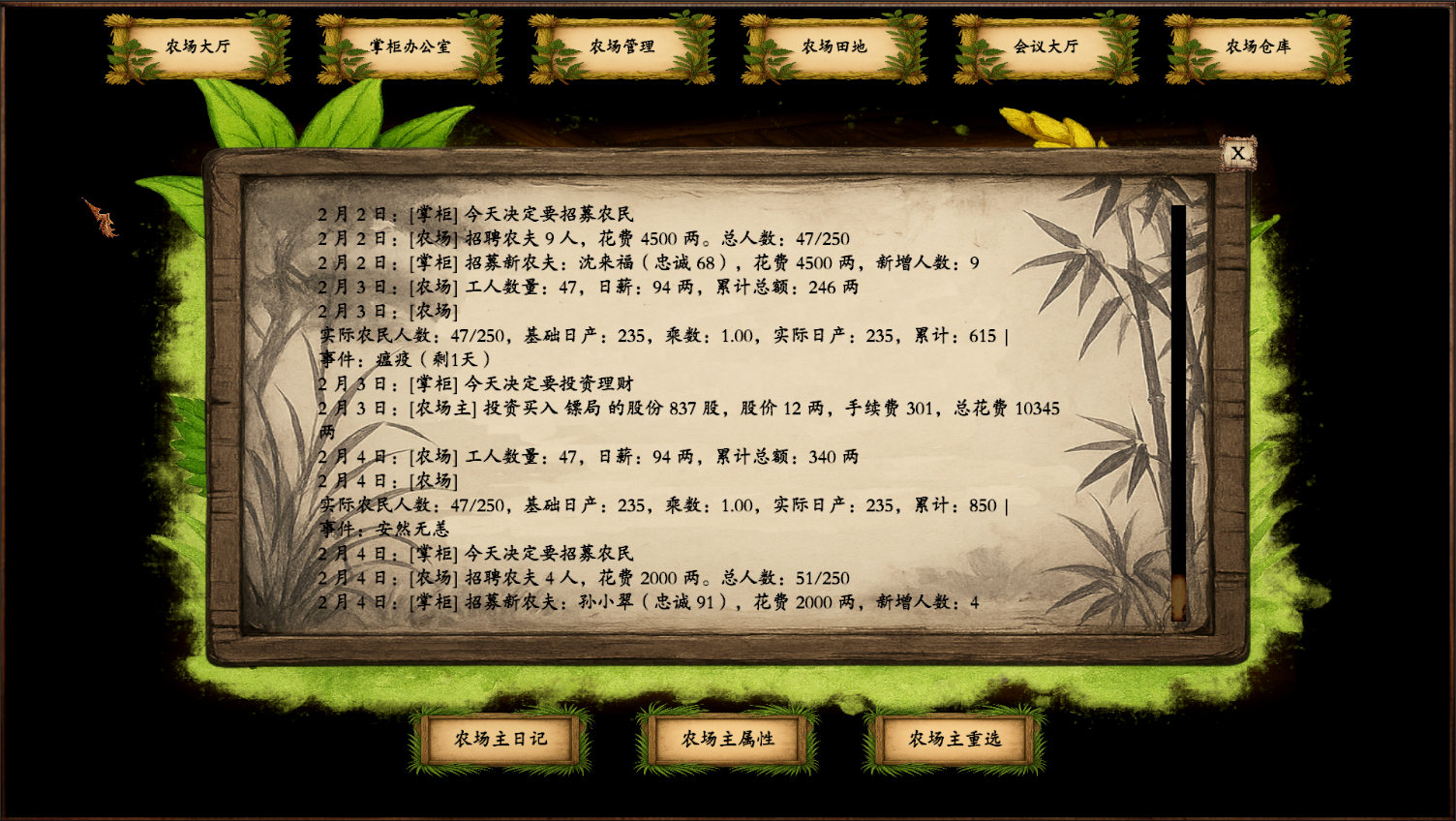
In the previous posts, we covered the Escort Agency, the Commerce Guild, and the Bank—systems where the money is obvious and loud. This time, we’re talking about the part that looks the most “simple,” but is actually the most lethal: the Farm, grain, and population.
In GuYuan Village, every grain of rice in your bowl was paid for— in real silver—by someone, ahead of time.
1) Another Cash Flow: “Grain Flow”
Grain in GuYuan Village isn’t conjured out of thin air, and it’s not just “bookkept at month-end.”
Each month, the system estimates how much grain the village will consume based on population. Then the first key transaction happens:
The Village (community granary) pre-buys a batch of grain from the Farm
Grain enters the village granary, while silver moves from the village fund pool into the farm’s fund pool
After that, the villagers’ daily “eating” is simply consuming granary stock
Here’s the problem: estimates can be wrong.
If population suddenly increases—or unexpected consumption happens— and the granary runs out before the month ends, what happens?
Answer:
When the granary is empty, villagers can only turn to the Commerce Guild and buy expensive ready grain out of pocket.
And if the Commerce Guild’s stock also runs dry?
That’s no longer “price inflation.” That’s:
People start going hungry
Some residents starve or migrate out
Population, labor, and tax revenue all drop together
So “monthly grain pre-purchase” isn’t a decorative number. It’s the monthly decision that determines whether the village lives calmly— or gambles its survival until month-end.
2) The Farm Sells to the Highest Bidder: A Grain Market Is a Battlefield
The farm is not a charity. It’s a business.
It accumulates daily yield, but when it comes to actual sales, it follows one brutally simple rule:
Whoever pays more, gets served first.
So the monthly price structure works roughly like this:
If the Commerce Guild’s buy price > the Village’s buy price:
The farm sells part of its grain to the Commerce Guild first
Then sells grain to the Village based on the village’s purchase demand → stored into the granary
After both sides settle, any remaining unsold grain goes back into the farm warehouse as inventory
This creates very real tension when you tune prices:
If the Commerce Guild bids higher:
The farm is happy (stronger cash flow)
The Commerce Guild has stock to flip (bigger profit margins)
But the village granary may not last—mid/late month villagers get “fed” by high-priced guild grain
If the Village bids higher to keep the granary safe:
Villagers are more stable
The Commerce Guild can’t hoard much grain and must behave (or sell other goods)
The farm might earn less than it wants
As a player, you can side with the farm, the guild, or the government— but no matter who you favor, grain prices, inventories, and risk will deform along with it.
Steam post image。
3) Population Isn’t “Always Good”—It’s Mouths on a Payment Schedule
In many games, population growth equals prosperity and is purely positive. In Pursuit of Mercantile Power, population first means:
More mouths eating every day.
The system calculates daily grain consumption from population:
Population up → daily consumption up → granary drains faster
Monthly pre-purchase might not be enough
“Buy from the Commerce Guild” high-price mode triggers early
Population down → consumption pressure eases …but taxes, labor, and enterprise hiring capacity shrink too.
So you can’t just chase “Population 9999.” You must keep asking:
“With our current farm scale, grain prices, and stock… can we actually feed this many people?”
Get the rhythm wrong, and the prosperity you built can get eaten alive by famine and migration within a few months.
4) How Can the Player Intervene in This Grain War?
You’re not a spectator staring at spreadsheets. You can step onto the battlefield.
(1) Buy Farm Shares Directly
The most direct method: buy farm shares via the Commerce Guild and seize control.
Increase your farmland and raise your “farmer status,” enabling stronger influence through proposals
Use Village Assembly proposals to steer direction
(2) Develop Your Own Private Farm
Reclaim land and hire your own farmers.
You decide whether this grain is sold to:
the Village,
the Commerce Guild,
or kept in storage waiting for better prices
The more land you own, the greater your “voice” in the farm system—and your farmer status rises with it.
Farmer status affects your farm proposals, caps farmer headcount, and limits output.
(3) Use Proposals to Move Prices and Structure
Through proposals to the Government and the Commerce Guild, you can:
Change the gap between the village buy price and the guild buy price
Decide whether grain policy favors “stability for the people” or “profits first”
Pair it with tax rates and subsidies to let certain classes breathe
Even increase grain-sale dividends for farmers—boosting survival rates and strengthening the stock liquidity pool reserve
Early game, you may use proposals to pull the village back from the edge. Late game, you can also push extreme proposals and see what happens when you treat the whole village like harvestable “chives.”
(4) Combat and Escort Missions: Save a Bowl of Rice—or Smash One
Combat is a supporting system here, but it isn’t cosmetic.
Certain boss fights and event battles directly affect:
out-of-village grain procurement
government relief grain
Every win in battle shifts real numbers behind the scenes: someone eats better, someone can’t hold on and leaves, someone gets rich off the chaos.
5) This Is an Economic Systems Game—Not a Cozy Farming Game
The farm’s role in this game can be summed up in one sentence:
It’s not a casual “plant some crops for buffs” feature. It’s one of the village’s economic arteries—and a major choke point for population stability.
Grain prices, granary stock, farm funds Population, guild inventory, disasters and accidents —all orbit around that one bowl of rice.
You can choose to save the village, squeeze it dry, or gamble on the market— but GuYuan Village will quietly record the consequences in its ledger.
If the farm goes bankrupt and the player isn’t producing grain, the village will run out of food and population will collapse rapidly.
When everyone leaves GuYuan Village, this place becomes nothing but abandoned land.
Steam post image...
6) Extra Farm Features
The farm can also produce herbs and crops.
Herbs are used to craft medicine, which can be consumed before entering battles to improve survival
Crops can be used for cooking
Players can buy directly from the farm, or cultivate themselves (costing days and stamina)
Raising life-skill levels grants skill points to upgrade herb/crop tiers
Herb/crop tiers directly affect monthly yield and how much the player can purchase
Closing
If you enjoy gameplay where you’re so deep in the economy that you’re afraid to price grain casually…
Pursuit of Mercantile Power is a single-player economic strategy game centered on cash flow, share warfare, and enterprise power struggles:
Start as a nobody, run escort missions and train martial arts. Then step into the Commerce Guild, Bank, Farm, and Government. And reshape where the money flows—and where people go—through your decisions.
If you’re interested in a game where you fight escort battles while calculating an entire village’s cash flow, search Pursuit of Mercantile Power on Steam and wishlist it.
For a solo project built from zero, that single click matters more than you think.
Source
Changelog.gg summarizes and formats this update. How we read updates.