
Full notes
Full OCTOPinbs update
Read the full published notes in a cleaner layout. The original post stays linked below.
What changed
- Balance
- Gameplay
- UI and audio
OCTOPinbs changes
An Interview with the Development Team Behind OCTOPinbs
【Developer Q&A: Director Edition】
In this Director Edition, we speak with the director of OCTOPinbs about the game’s core concept, character motifs, balance philosophy, and the vision behind this new take on social deduction action games.
Q1. The concept of “social deduction games without words” is very novel.
Why did you decide to focus on “judging through action” instead of discussion?
We wanted to remove as many barriers as possible that are typical of social deduction games and create a more casual experience, one that even people who’ve never played social deduction games before could enjoy easily.
Personally, when I first played social deduction games, I was extremely nervous. Just having discussions with people I’d just met was difficult, and sometimes my voice would shake from tension, which only made others suspect me even more. On top of that, it takes time to understand genre-specific terms like “CO,” “white,” or “black,” and then express your reasoning clearly in words.
Because of that, many players end up feeling the difficulty before they ever get to experience the fun.
That’s why, with OCTOPinbs, we aimed to make a game that could be enjoyed by people who were interested in social deduction games but never took the plunge, as well as those who tried them before but left because discussion felt too intimidating.
In this game, players can infer what’s happening based on how fires spread and how other players act—without relying heavily on words. For example, if you spot someone suspicious, you can mark them with a color ball to communicate your suspicion to others. This allows players to express intent without needing voice or text chat.
At the same time, we were very particular about making the game feel good as an action game. We focused on ensuring that every input feels responsive. Even something as simple as extinguishing a fire was carefully adjusted so it wouldn’t feel like a task, but something inherently satisfying.
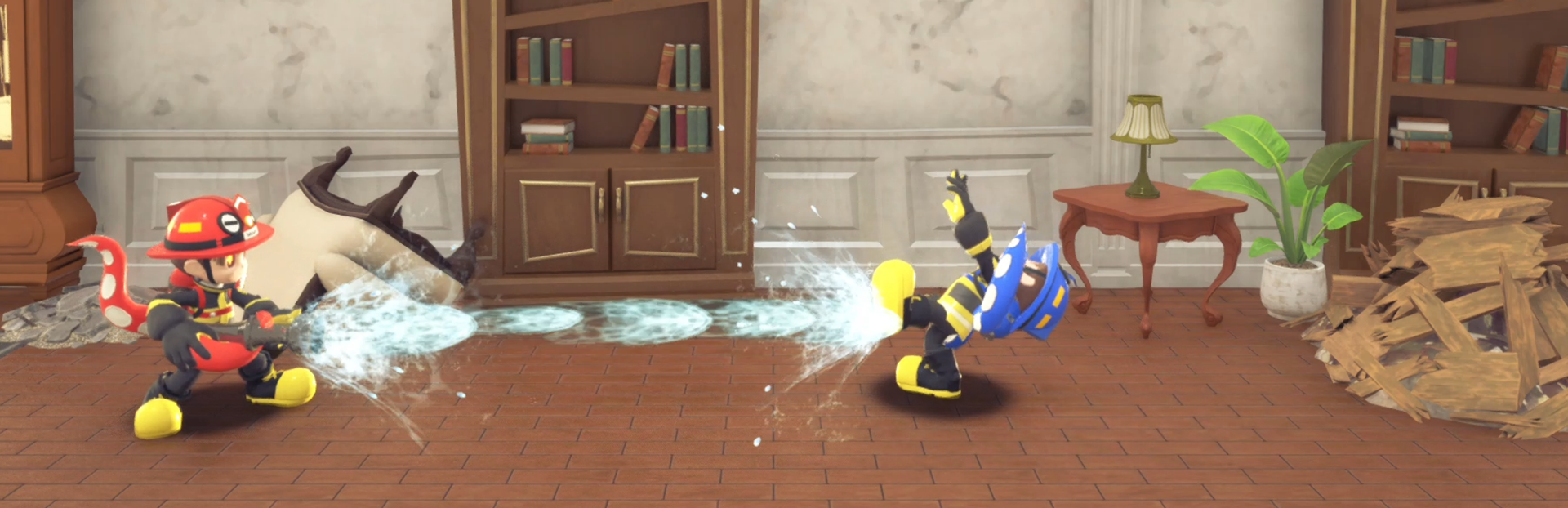
In particular, we paid close attention to the sense of exhilaration you feel the moment you incapacitate an opponent. From sound effects to timing of animations, everything was tuned so players clearly felt, “That move landed.”
For the water-based multiplayer battles, the rules themselves are intuitive and simple, but once you start playing, deeper mind games naturally emerge. We aimed for an experience that’s easy to jump into, yet full of depth—where positioning and reading opponents ultimately decide the outcome.
Q2. What kind of team was behind the development of OCTOPinbs?
This project began with the concept of “creating a full game led by younger developers.” As a result, it was developed under a youth-centered production structure that is quite rare even among tri-Ace projects.
Not only the core game rules, but also level design, story and character settings, and even character design were shaped through active discussion and idea sharing across the entire team. Areas that would normally be handled in a more divided, role-based way were instead developed collectively, with everyone involved in the conversation.
Before the final game characters were decided, we explored a wide range of concepts. Some ideas leaned toward psychological horror, such as firefighters becoming possessed by evil spirits during firefighting missions, while others proposed more straightforward motifs like “If it’s about fire, it has to be dragons.”
Because the process involved everyone freely sharing ideas, bringing it all together was certainly challenging. However, each team member was extremely passionate. It wasn’t just that we gathered younger developers, everyone was genuinely committed to making something great.
In the end, we feel that the momentum and sense of unity born from this ambitious development structure directly translated into the game’s overall charm and appeal.
Q3. When it comes to action-based deduction,
what aspects of balance tuning were the most challenging or important?
The most obvious way to identify an Artist is to catch them setting fires. However, Artists can escape and even disguise themselves as other players for a limited time. If you act too rashly and start spraying water, your own actions may look suspicious and turn others against you.
Even without direct evidence, details like how proactively someone extinguishes fires, how they keep their distance from others, or even how they use emotes can gradually reveal their intentions.
Equally important to spotting suspicious players is deciding who to trust. The game isn’t just about doubting everyone, it’s also about identifying allies you can rely on. That balance between trust and suspicion plays a huge role in winning.
With the default settings for new players, Firefighters generally can’t win without some degree of cooperation. We spent a lot of time fine-tuning that emotional tension, how players oscillate between trust and paranoia.
At the same time, this balance can shift based on player skill, so we’ve included rule customization options in the lobby. We hope players experiment and discover the rule sets that suit their groups best.
Q4. Was there any memorable moment during internal testing that made you laugh—or think “Well played”?
The most unforgettable moment was a match where an Artist player pulled off what I’d call a “triple combo”: misdirection, wall-clinging, and a final PvP shootout. I lost spectacularly.
In this game, you can peek beyond walls, but you only see silhouettes, not clear identities. You can’t be sure who is there—just what kind of action they’re performing.
I was playing as a Firefighter and saw a silhouette setting a fire, so I rushed over. The Artist perfectly used invisibility, crossed paths with another player, and made me think that player was the culprit.
This sort of tactic only works if you’ve thoroughly read the Firefighter’s behavior. We had anticipated it in theory, but the timing is very strict, and we didn’t expect many players to execute it successfully.
But that player did it flawlessly. I fully took the bait, attacked a teammate I thought was guilty, and knocked them out. Only after that did I notice the real Artist, who had been hiding invisibly. I tried to turn it into a water battle—but I lost that fight too.
As a result, both my character and the teammate I mistakenly eliminated were taken out, and the Artist team secured a perfect victory.
It was incredibly frustrating, but even more than that, it left a strong impression. It showed that the kind of mind games we’d designed for were working at an even higher level than we imagined. It was a moment that truly embodied what makes OCTOPinbs unique.
Q5. Finally, could you share a message for players who’ve avoided social deduction games,
or those who love action games?
Social deduction games often feel intimidating because they rely so heavily on conversation and deduction. Even action game fans might hesitate just hearing the word “social deduction.”
That’s exactly who I hope will try OCTOPinbs.
Even if you manage to gather strong evidence or reach a solid conclusion, the game doesn’t end there. In the final stretch, you still have to win the water battle and fully capture your opponent. This feeling, that it’s not just deduction or just action, is what makes the game special.
Players confident in PvP skills can overpower opponents through sheer mechanical ability. But if you’ve lost the trust of your teammates, you may find enemies being reinforced at crucial moments, turning the tide instantly.
Action strength and social dynamics intertwine all the way to the end, creating nonstop tension. We believe this is a truly new kind of action-based social deduction game, and we’d love for both social deduction skeptics and action fans to experience this unique mind game for themselves.
Source
Changelog.gg summarizes and formats this update. How we read updates.