
Full notes
Full OCTOPinbs update
Read the full published notes in a cleaner layout. The original post stays linked below.
What changed
- Balance
- Maps
- Gameplay
OCTOPinbs changes
An Interview with the Development Team Behind OCTOPinbs
【Developer Q&A: Game Designer Edition】
In this Game Designer Edition, we discuss how OCTOPinbs delivers action-based social deduction, intentional uncertainty in communication, balance between fairness and comeback potential, and the systems that make deception fun—even without words.
Q1. In a game where players identify others through their actions,
what kinds of actions or mechanics were designed to provide players with “clues”?
First, we designed a unique action called “ peeking into rooms ”, which allows anyone to easily obtain clues. Players can briefly peek into the rooms directly above, below, left, or right of their current location. If someone is setting a fire in the peeked room, you can see the scene in real time.
However, you don’t know who that player is. That moment acts as the starting point for deduction, leading players into their next actions as they search for the culprit.
We also embedded clues into the map design itself. Each room has its own characteristics—internally defined by 25 attributes, including how easily it catches fire. Some rooms are designed to naturally attract players based on movement flow, encouraging encounters, battles, and cooperation.
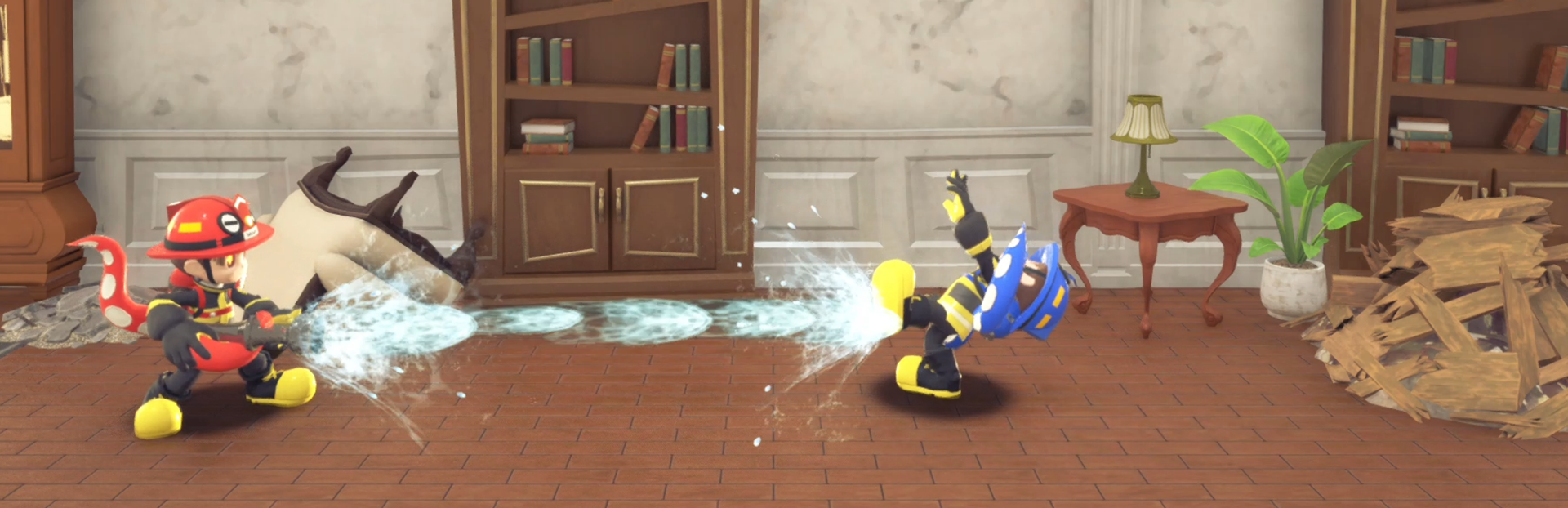
Additionally, the Tornado, a powerful monster that appears periodically, serves as a battle phase that acts as a trigger for deduction. Even players who aren’t comfortable with co-op games can think, “Not cooperating here would be really suspicious…” We especially encourage beginners to pay attention to these moments. Steam post image
Q2. While players don’t need to talk, did you intentionally leave any “limitations” or “uncertainties” to preserve communication and mind games between players?
In OCTOPinbs, we removed the traditional “ meeting” phase found in social deduction games. Meetings existed early in development, but we found they didn’t pair well with fast-paced action gameplay. Instead, we shifted toward a design where every action feeds directly into deduction.
Without meetings, direct verbal communication becomes difficult, but that very limitation creates a unique kind of fun centered on deception through behavior.
Another core element is that, until the very end, you never fully know who your allies are. A teammate extinguishing fires alongside you might actually be an Artist, or a sudden attacker could be an Artist disguised as someone else.
Even among Artists, there’s no room for complacency. To earn points needed for transformation, players sometimes intentionally trap fellow Artists in an Octojar (eliminating them). From this uncertainty, “Can I trust them or not?” comes moments like “I knew I shouldn’t have trusted you!” or “I’m glad I trusted you!” We really want players to experience that emotional swing.
Q3. How did you balance “fairness” as an action game with “comeback potential” as a social deduction game between Firefighters and Artists?
In simple terms, Artists start off stronger. They can extinguish fires, start fires, and disguise themselves as other players. Firefighters counter this initial power through numbers and teamwork.
For example, players can use Color Balls to mark others. Marked players suffer reduced abilities, and the mark is visible to everyone, visually communicating “This player is suspicious.” This system recreates the social-deduction dynamic of “once someone is suspected, they become a shared point of focus” in a systemic, action-driven way.
Artists, on the other hand, are given strong comeback mechanics. By performing Artist-like actions, starting fires, attacking players, and so on—they can accumulate points and then Transform, gaining increased health and attack power. We’ve seen cases where a single transformed Artist defeated multiple Firefighters to secure a dramatic comeback win.
Firefighters also have comeback options. For instance, multiple players coordinating Color Ball marking to weaken an Artist can completely flip the situation. But that requires paying attention during play and identifying suspicious behavior. Simply defeating everyone blindly or relying on luck won’t get you very far.
Q4. There are many rule customization options. From a game design perspective, which combinations do you find the most thrilling?
First, we strongly recommend playing with the default settings, as they offer the most balanced experience.
Once you’re familiar with the game, try these recommended setups:
Increase movement speed during Transformations, Firefighter jump height, and Jet Jump power for high-speed battles
Lower gravity for a light, floaty low-gravity experience
Max out axe attack power and knockback for all-out physical brawls
Start the game with every artists already transformed for pure PvP chaos
Enable “Incapacitated at 0 HP” for a hardcore mode where defeats remove players from the front line instantly
Q5. Some fans may worry that, because this is an action game, identities will be revealed too easily. What would you say about the game’s approach to deception?
This game is packed with forms of deception that are only possible because it’s action-based. Players can disguise themselves before starting fires, mark others from blind spots with Color Balls, cling to walls, or turn invisible. With these tools, it’s not easy to get exposed.
And one of the game’s biggest features is this: even if your identity is revealed, it’s not over.
In the worst-case scenario, Artists can Transform to buy time or act as decoys for their team. Environmental gimmicks like collapsing floors or Tornadoes can also help players escape. Even when characters are incapacitated, they shrink down into their original small octopus or squid forms and can still spray water or start fires—ensuring both sides remain engaged until the very end.
As a side note: when this team first began development, more than half of the members had never played a social deduction game before. Many—including myself—felt that lying with words was difficult. That experience shaped OCTOPinbs into a game where deception is possible through action alone.
We hope you’ll experience this new kind of social deduction for yourself.
Source
Changelog.gg summarizes and formats this update. How we read updates.