
In this update11
Full notes
Full Monolith: Rogue TD update
Read the full published notes in a cleaner layout. The original post stays linked below.
What changed
- Maps
- Gameplay
- Events
- Balance
- Store
Monolith: Rogue TD changes
Gather around, Invaders!
It’s time for the second devlog, and this one is going to be a bit more personal. After the first days of playtests and all the feedback coming in, I thought it would be a good moment to step back and tell you a bit more about where Monolith: Rogue TD actually came from, what inspired it, and how it evolved into what you’re playing today.
“It was never a question of if”
I’ve always known that one day I would make a tower defense game. Growing up, I spent countless hours playing titles like Plants vs. Zombies, Creeper World, Orcs Must Die, and especially custom maps from Warcraft III like Element TD or Gem TD. Those games stuck with me for years. So making a TD game was never really a question of if. It was more about when… and what kind of TD it would be.
The moment everything clicked
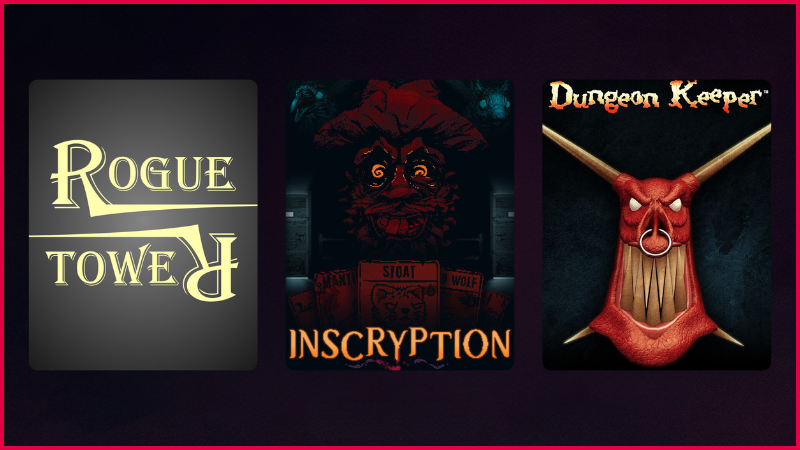
At some point, I discovered Rogue Tower. It immediately felt like something new - a fresh take on the genre that showed how much more potential tower defense still has. At the time I was working on a different project at a studio, so I was curious to see how this idea would evolve in the industry. But… it didn’t. Years passed, and while there were some attempts, nothing really felt like a true evolution of that concept. Most games either changed too much or not enough. And when I reached a point in my career where I started looking for something new, I had a simple thought: Maybe I can try to build that next step myself.
The three pillars
From the beginning, I knew the core of the game would be built around three ideas:
Tower Defense
Roguelike structure
Deckbuilding
The combination of roguelike progression with an expanding battlefield felt instantly right to me. That part came naturally. The system I really wanted to push further was deckbuilding - giving players more meaningful choices, more variety, and more ways to shape their strategy from run to run.
Becoming the villain
Another big question was: how do you make this game stand out?
Tower defense games are often set in fantasy or sci-fi worlds… or involve balloons and monkeys. I wanted something different. While thinking about it, I remembered Dungeon Keeper and started looking into games where the player takes on the role of the villain. Surprisingly, there aren’t that many.
That idea stuck with me - but it created a new design challenge:
How do you make a tower defense game where the player is the villain… without turning it into a reverse TD?
I didn’t want players to control attacking units. That’s a cool idea, but not the game I wanted to make. Instead, I flipped the perspective. You are still defending… but from the point of view of something ancient and terrifying. The “attackers” are actually the defenders - the inhabitants of the world trying to stop an unstoppable force.
That’s how the Monolith was born.
An ancient cosmic entity. A bad omen falling from the sky. A force that corrupts everything it touches.
And no matter what happens…
It always returns.
From cubes to a world
Like most games, Monolith started very simply. At one point… everything was just cubes.
One of the first major challenges was designing the Monolith itself. It had to feel powerful, mysterious, and readable in gameplay. Many early versions looked great in concept art but didn’t quite work in-game.
Enemies also went through big changes. We introduced a system of enemy families, each with its own theme and mechanics. Interestingly, the first playable version of the game used enemies from a completely different family than what you see now.
As the first world evolved visually - into a green, foggy, slightly forgotten land - we shifted towards enemies that fit that atmosphere better: nature- and soul-inspired golem-like creatures.
At the same time, we kept refining the world itself:
more detailed terrain
environmental decorations
moving fog and layered effects
All of this while maintaining a stylized, semi low-poly look, which not only defines the game’s identity but also allows for large numbers of enemies and projectiles on screen.
Inspirations behind the design
Some inspirations are obvious. Rogue Tower opened the door for this subgenre. Others are a bit less direct. Element TD inspired the idea of deeper combat interactions - which led to the creation of different attack types and synergies.
Plants vs. Zombies influenced how the game communicates upcoming threats, helping players prepare instead of react blindly.
Outside the genre:
Dungeon Keeper and Black & White helped shape the tone and personality of the world
Inscryption influenced the atmosphere and worldbuilding in subtle ways
Hearthstone was surprisingly helpful when designing the card system, especially how to communicate mechanics clearly with limited text
Back to the roots of Tower Defense
One thing I wanted to do was actually go a bit back to the roots of the genre.
I wanted clear phases:
preparation
defense
During preparation, you can fully rethink your setup. But once the wave starts - that’s it. No panic-selling. No last-second rebuilding. Your strategy has to hold. This shifts the focus from reflexes to planning and decision-making. At the same time, I didn’t want the game to feel slow, so there are tools to speed things up and keep the flow engaging.
Combined with flexible difficulty settings, my goal is to create something that works both for:
more casual players
hardcore strategy fans
What’s next?
There’s still a lot I want to add to the game. Some of the things I’m most excited about:
expanding enemy families
adding more unique and experimental towers
introducing new cards and synergies
exploring new worlds and environments
potentially adding new modes and systems
A lot of ideas didn’t make it into the current version - not because they weren’t good, but because they didn’t fit yet. And of course, your feedback from the playtests will play a huge role in deciding what comes next.
Thank you
Seeing players jump into the playtest, experiment with builds, and share feedback has been incredible. This is still just the beginning for Monolith: Rogue TD. And I want it to keep evolving for a long time. Thanks for being part of this journey.
Add Monolith: Rogue TD to your Wishlist to join the INVASION!
[dynamiclink href="https://store.steampowered.com/app/3913970/Monolith_Rogue_TD/"]
Source
Changelog.gg summarizes and formats this update. How we read updates.