
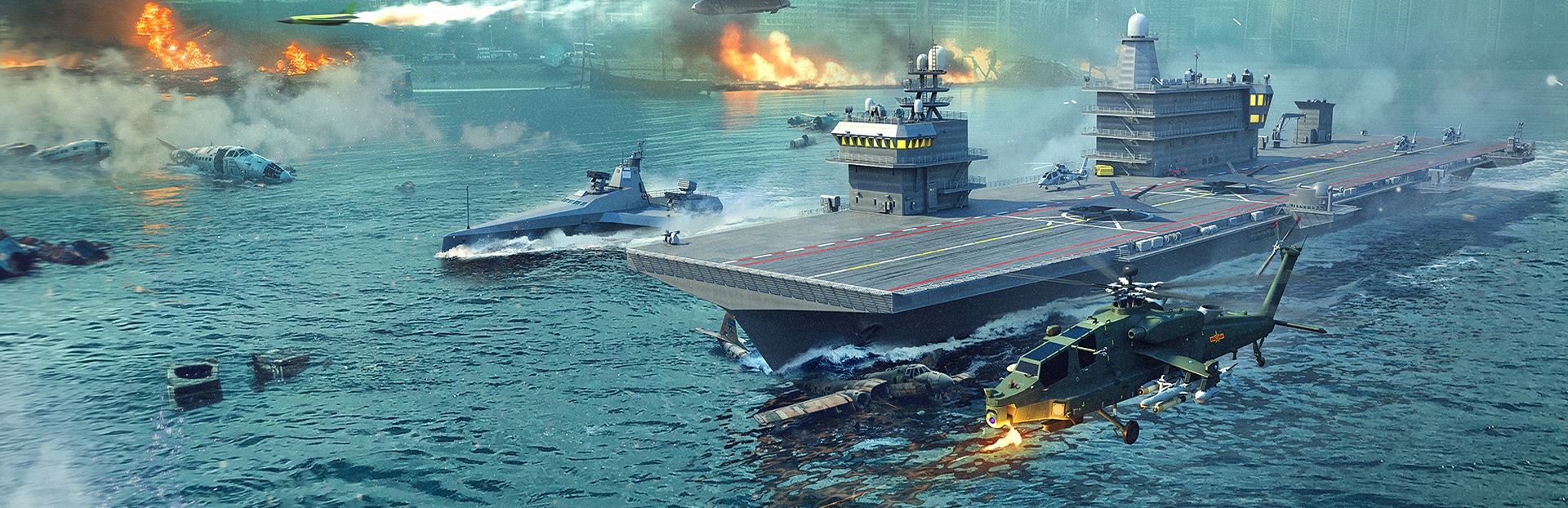
Full notes
Full Modern Warships update
Read the full published notes in a cleaner layout. The original post stays linked below.
What changed
- Gameplay
- Maps
- Balance
- Performance
Modern Warships changes
In Modern Warships, you'll find not only classic ship classes — frigates, destroyers, and battleships — but also more exotic variants such as hovercrafts, ekranoplans, and landing assault ships.
In this article, we'll take a closer look at the last class mentioned. They stand out from the rest not only with their own arsenal of weapons and an expanded helicopter group compared to conventional ships, but also with a unique type of armament for their class — naval unmanned vehicles.
These drones can perform a wide range of tasks, from reconnaissance to full-scale attacks on enemy ships. Moreover, they have unofficial subclasses that differ significantly in gameplay. Next, we'll thoroughly explore the gameplay of landing assault ships, as well as the drones themselves, and explain how to use them most effectively.
Assault Landing Ships
Each ship in this class offers a distinct playstyle with its own character. Their capabilities are shaped by a combination of their arsenal and unique traits. Among them, there are some particularly notable vessels:
HTMS Chang (LPD-792) — a true combat heavyweight. Two grenade launchers and two cannons make it a fearsome force on the front line, while a modern air defense system ensures peace of mind even when the enemy dominates the skies. On top of that, it carries two naval drones in swappable slots and a pair of helicopters, making it a dangerous opponent in any situation.Steam post image
CN 07X — the embodiment of versatility. This ship unlocks enormous tactical potential: in addition to two naval drones, it also deploys two aerial drones, while three helicopters provide massive map control capabilities. In skilled hands, it can confidently take on some aircraft carrier duties! Excellent air defense further enhances its chances of dominating. However, this flexibility comes at a cost — its offensive weaponry is noticeably more modest than others.Steam post image
USS San Antonio (LPD-17) — a true machine of chaos and destruction with a unique twist. Its missile batteries can fire six missiles at once, unleashing a true rain of fire upon the enemy. At the same time, two helicopters and two naval drones allow it to operate effectively at range: scouting, supporting allies, and dealing damage while staying out of the enemy's reach.Steam post image
Unmanned Vehicles
Currently, these elements function as a unified subsystem of the ship, but they can be roughly divided into three subclasses:
Surface Attack Drones
These nimble and fast drones, resembling pleasure boats in size, largely behave like fully-fledged combat ships. They are armed with autocannons, grenade launchers, air defense systems, and other familiar weaponry, but in significantly smaller quantities than their larger counterparts. In terms of characteristics — speed, damage, and overall effectiveness — they are comparable to first and second-tier corvettes, which may initially make them seem underpowered for the third tier. But that's a deceptive impression. At the right moment, such a "little guy" can turn the tide of battle: suddenly appearing from behind cover just when the enemy has let their guard down and is busy repairing, unleashing a hail of fire. High speed and decent damage allow for bold and effective actions without putting the main ship at unnecessary risk.
Unmanned Underwater Vehicles
Compact mini-submarines that perform the same tasks as conventional submarines but do so faster and more aggressively. Yes, their damage is somewhat lower, but that is more than compensated for by excellent speed and maneuverability. Losing such a drone (as with other similar units) does not cause panic: if you have reserves, it will soon be ready for action again. This makes underwater drones a true tool of sabotage — fast, precise, and often unexpectedly painful for the enemy.
Explosive-Laden Drones
These are a true nightmare for any commander who spots them too late. Their appearance almost always spells serious trouble: the damage — up to 200,000 units — speaks for itself. These drones can be used for reconnaissance and attack, but their true purpose lies in delivering a devastating final blow. There's no need to return them to the ship; they are designed as one-way combat units. Sometimes they are fitted with additional weaponry, but the essence remains the same — to dash at full speed toward the target, crash into the enemy ship's hull, and detonate a powerful explosive charge capable of fundamentally deciding the outcome of the engagement.
Conclusion
When choosing any of the available drone types, the playstyle on any assault landing ship can change significantly — it all depends on their subclass, armament, and role in battle. And that's not to mention each ship's own weaponry. Therefore, before every sortie, it's important to carefully study your arsenal as well as the characteristics of your "little ones" to clearly understand their capabilities and unleash their full potential in battle. After all, nothing frightens the enemy more than the flexibility and unpredictability of your actions in combat!
Source
Changelog.gg summarizes and formats this update. How we read updates.