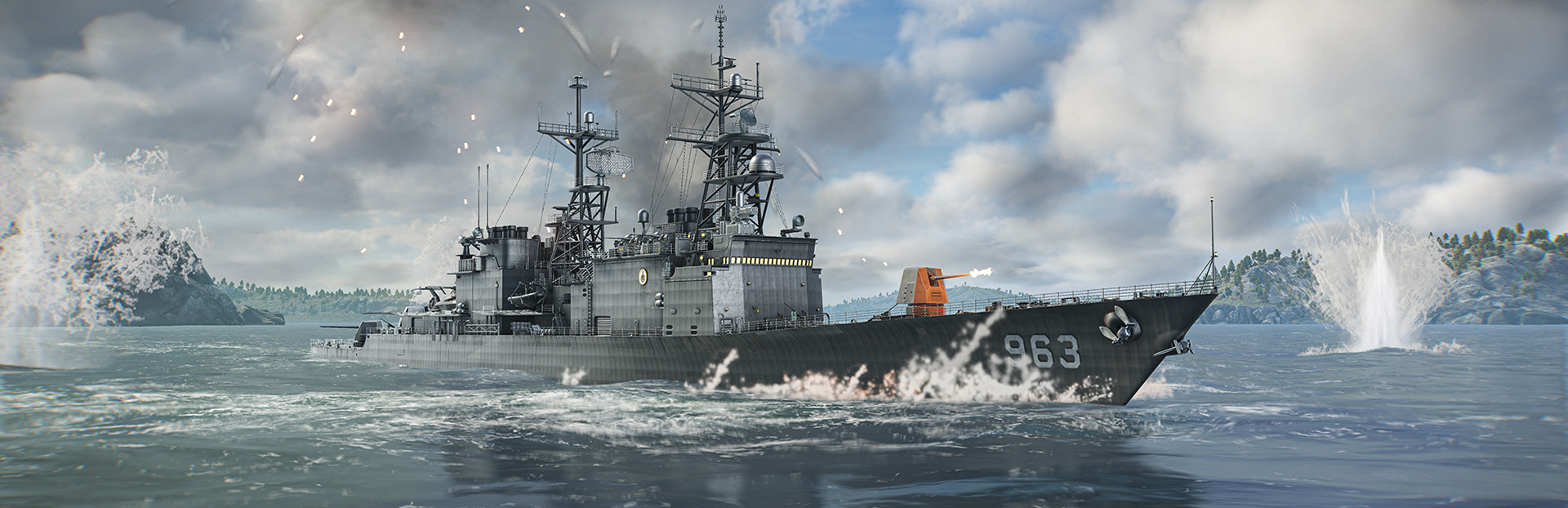
What can be called the main weapon of a modern ship? Some will immediately say missiles, others — crew training or radar capabilities.
In this update4
Full notes
Full Modern Warships update
Read the full published notes in a cleaner layout. The original post stays linked below.
What changed
0 fixes1 addition6 changes0 removals
Balance
Gameplay
Security
Maps
changedWhat can be called the main weapon of a modern ship? Some will immediately say missiles, others — crew training or radar capabilities. And that’s fair: today, battle outcomes are decided beyond visual range thanks to long-range, high-precision anti-ship missiles. But in the past, the kings of the seas were guns: the more main-caliber guns a steel giant carried, the more formidable it was considered. So what happened during the transitional era, when artillery was giving way to the first anti-ship missiles that didn’t yet possess today’s speed and accuracy? The hero of our story today is a vivid embodiment of that era.
changedHistorical BackgroundFrom a technical standpoint, Spruance was one of the most modern destroyers of her time. She became the first American ship of this class with an all-gas-turbine propulsion system based on four General Electric LM2500 turbines, and she featured reduced noise and high effectiveness in anti-submarine warfare. Her armament included 127 mm artillery, the RUR-5 ASROC system, Sea Sparrow SAMs, torpedoes, and after upgrades — Harpoon and Tomahawk missiles and the Mk 41 VLS. The ship also carried up to two anti-submarine helicopters, significantly expanding her combat capabilities.
addedGameplayAs we mentioned earlier, the main feature of the new American destroyer lies in its successful combination of missile and artillery armament. Despite the absence of grenade launchers, which may affect close-range effectiveness, the ship fully unlocks its potential at medium and long distances. Three gun mounts provide high fire density and a significant advantage in quick firefights. The standard Mark 45 Mod 4 (127 mm) guns perform their tasks quite well, but if desired they can be replaced with more powerful analogues. The artillery is complemented by three missile batteries: it’s recommended to fit a powerful anti-ship missile in the dual slot, and use the single slot for a more advanced surface-to-air missile, allowing you to counter aviation more effectively.
changedGameplaySuch a configuration works organically with the existing air defense system, which includes Sea RAM SAMs and Seahawk Sigma B-2B (30 mm) autocannons. This set is sufficient to repel small- and medium-scale attacks, but against massed airstrikes additional support may be required. Employing an anti-aircraft missile in the single slot noticeably strengthens defense and greatly complicates life for enemy aviation, with almost no sacrifice of the ship’s overall strike potential.
changedGameplayThe situation with anti-submarine defense is less clear-cut. The primary means of dealing with underwater threats is the CRAW SV automatic cannon, which operates autonomously. Theoretically, the defense can be reinforced with specialized missiles, but that would require giving up a part of the strike armament, confronting the captain with a choice between offensive capabilities and extra protection.
changedGameplaySpeaking specifically about tactics, the destroyer is most effective at medium and long range, where it can fully exploit the advantages of both powerful artillery and missile armament. It is precisely at such ranges that the ship can exert steady fire pressure on the enemy while maintaining high combat efficiency and flexibility in target selection. Moreover, increasing the distance reduces the likelihood of surprise attacks from submarines and aircraft, allowing the crew to better control the situation and maximize the ship’s potential in battle.
Modern Warships changes
changedWhat can be called the main weapon of a modern ship? Some will immediately say missiles, others — crew training or radar capabilities. And that’s fair: today, battle outcomes are decided beyond visual range thanks to long-range, high-precision anti-ship missiles. But in the past, the kings of the seas were guns: the more main-caliber guns a steel giant carried, the more formidable it was considered. So what happened during the transitional era, when artillery was giving way to the first anti-ship missiles that didn’t yet possess today’s speed and accuracy? The hero of our story today is a vivid embodiment of that era.
changedFrom a technical standpoint, Spruance was one of the most modern destroyers of her time. She became the first American ship of this class with an all-gas-turbine propulsion system based on four General Electric LM2500 turbines, and she featured reduced noise and high effectiveness in anti-submarine warfare. Her armament included 127 mm artillery, the RUR-5 ASROC system, Sea Sparrow SAMs, torpedoes, and after upgrades — Harpoon and Tomahawk missiles and the Mk 41 VLS. The ship also carried up to two anti-submarine helicopters, significantly expanding her combat capabilities.
addedAs we mentioned earlier, the main feature of the new American destroyer lies in its successful combination of missile and artillery armament. Despite the absence of grenade launchers, which may affect close-range effectiveness, the ship fully unlocks its potential at medium and long distances. Three gun mounts provide high fire density and a significant advantage in quick firefights. The standard Mark 45 Mod 4 (127 mm) guns perform their tasks quite well, but if desired they can be replaced with more powerful analogues. The artillery is complemented by three missile batteries: it’s recommended to fit a powerful anti-ship missile in the dual slot, and use the single slot for a more advanced surface-to-air missile, allowing you to counter aviation more effectively.
changedSuch a configuration works organically with the existing air defense system, which includes Sea RAM SAMs and Seahawk Sigma B-2B (30 mm) autocannons. This set is sufficient to repel small- and medium-scale attacks, but against massed airstrikes additional support may be required. Employing an anti-aircraft missile in the single slot noticeably strengthens defense and greatly complicates life for enemy aviation, with almost no sacrifice of the ship’s overall strike potential.
changedThe situation with anti-submarine defense is less clear-cut. The primary means of dealing with underwater threats is the CRAW SV automatic cannon, which operates autonomously. Theoretically, the defense can be reinforced with specialized missiles, but that would require giving up a part of the strike armament, confronting the captain with a choice between offensive capabilities and extra protection.
What can be called the main weapon of a modern ship? Some will immediately say missiles, others — crew training or radar capabilities. And that’s fair: today, battle outcomes are decided beyond visual range thanks to long-range, high-precision anti-ship missiles. But in the past, the kings of the seas were guns: the more main-caliber guns a steel giant carried, the more formidable it was considered. So what happened during the transitional era, when artillery was giving way to the first anti-ship missiles that didn’t yet possess today’s speed and accuracy? The hero of our story today is a vivid embodiment of that era.
Historical Background
USS Spruance (DD-963) is the lead ship of the eponymous class of destroyers that formed the backbone of American surface forces in the 1970s–1980s. These ships were built primarily for anti-submarine defense of carrier strike groups and were meant to replace the aging post-war destroyers. A total of 31 Spruance-class ships were built, and their design subsequently served as the basis for the Ticonderoga-class cruisers and several other major U.S. Navy combatants.
The destroyer is named after American Admiral Raymond Ames Spruance, one of the most renowned naval commanders of World War II. Built at Ingalls Shipbuilding, the ship entered service in 1975 and served for nearly thirty years. During that time, she repeatedly operated in the Mediterranean and the Atlantic, participated in Cold War-era operations, and in 1991, during Operation Desert Storm, launched Tomahawk cruise missiles at targets in Iraq. The destroyer was withdrawn from the fleet in 2005.
From a technical standpoint, Spruance was one of the most modern destroyers of her time. She became the first American ship of this class with an all-gas-turbine propulsion system based on four General Electric LM2500 turbines, and she featured reduced noise and high effectiveness in anti-submarine warfare. Her armament included 127 mm artillery, the RUR-5 ASROC system, Sea Sparrow SAMs, torpedoes, and after upgrades — Harpoon and Tomahawk missiles and the Mk 41 VLS. The ship also carried up to two anti-submarine helicopters, significantly expanding her combat capabilities.
Steam post image
Gameplay
As we mentioned earlier, the main feature of the new American destroyer lies in its successful combination of missile and artillery armament. Despite the absence of grenade launchers, which may affect close-range effectiveness, the ship fully unlocks its potential at medium and long distances. Three gun mounts provide high fire density and a significant advantage in quick firefights. The standard Mark 45 Mod 4 (127 mm) guns perform their tasks quite well, but if desired they can be replaced with more powerful analogues. The artillery is complemented by three missile batteries: it’s recommended to fit a powerful anti-ship missile in the dual slot, and use the single slot for a more advanced surface-to-air missile, allowing you to counter aviation more effectively.
Such a configuration works organically with the existing air defense system, which includes Sea RAM SAMs and Seahawk Sigma B-2B (30 mm) autocannons. This set is sufficient to repel small- and medium-scale attacks, but against massed airstrikes additional support may be required. Employing an anti-aircraft missile in the single slot noticeably strengthens defense and greatly complicates life for enemy aviation, with almost no sacrifice of the ship’s overall strike potential.
The situation with anti-submarine defense is less clear-cut. The primary means of dealing with underwater threats is the CRAW SV automatic cannon, which operates autonomously. Theoretically, the defense can be reinforced with specialized missiles, but that would require giving up a part of the strike armament, confronting the captain with a choice between offensive capabilities and extra protection.
Speaking specifically about tactics, the destroyer is most effective at medium and long range, where it can fully exploit the advantages of both powerful artillery and missile armament. It is precisely at such ranges that the ship can exert steady fire pressure on the enemy while maintaining high combat efficiency and flexibility in target selection. Moreover, increasing the distance reduces the likelihood of surprise attacks from submarines and aircraft, allowing the crew to better control the situation and maximize the ship’s potential in battle.
Armament
Missile Battery (ASM) — RIM-161 (SM-3) [x2]
Missile Battery (ASM) — RIM-161 (SM-3) [x1]
Cannon — Mark 45 Mod 4 (127 mm) [x3]
Torpedo Launcher — Mark 48 (533 mm) [x2]
Helicopter — RAH-66 Comanche [x1]
Autocannon — Seahawk Sigma B-2B (30 mm) [x2]🔒
Autocannon — CRAW SV [x2]🔒
Air Defense — Sea RAM [x2]
Air Defense — Sea RAM [x2]
Steam post image
Summary
USS Spruance (DD-963) is an excellent fit for captains who can coolly assess the battlefield situation, their own position on the map, and the enemy team composition. Once the main threats are identified, all that remains is to promptly take a favorable position away from the main attack vectors and methodically destroy the most dangerous targets, as if on a firing range, leveraging the advantage of safe distance.