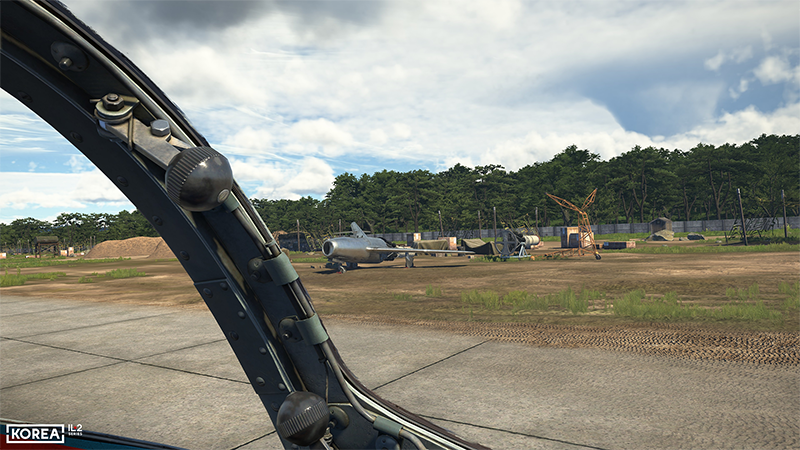
Greetings, comrades! Every time we embark on a combat sortie, we see the airfield in vivid detail - starting the engine, taxiing past the parking stands, heading toward the runway, and climbing to altitude.
Full notes
Full Korea. IL-2 Series update
Read the full published notes in a cleaner layout. The original post stays linked below.
Repeated intro
Greetings, comrades!
What changed
0 fixes2 additions3 changes1 removal
Balance
Maps
Gameplay
Security
changedEvery time we embark on a combat sortie, we see the airfield in vivid detail - starting the engine, taxiing past the parking stands, heading toward the runway, and climbing to altitude. Throughout this entire process, we are slowly making our way across the vast expanse of the airfield. In many games, these areas are often sparsely populated with objects; yet in reality, they feature a vast array of incredibly interesting elements that truly bring an airfield to life. This is especially true during wartime, when airfields are a hive of constant activity - buzzing with repair work, aircraft redeployments, and reequipping operations. With our Korea project, we have strived to eliminate that sense of lifelessness. After all, how you feel while on the ground in the game world - as you prepare for takeoff and combat - directly influences how you will feel once you are airborne and engaged in the fight itself. By noticing various details and scenes of engine maintenance, or observing aircraft undergoing repairs, the perceived significance of every instance of battle damage you sustain in the air is subconsciously heightened. In short, by witnessing the daily life of the airfield, the stakes of every combat engagement feel much higher. You begin to believe in the reality of what is unfolding around you that much more.
changedUntil now — in our Dev Diary #57 dedicated to airfields, in various videos (such as the F-80 footage ), and in other materials — we have focused primarily on the general layout of the airfield: its overall structure, textures, 3D terrain modeling, runway profile characteristics, and our meticulous efforts to ensure historical accuracy. In essence, we have discussed and showcased the broad strokes of these massive installations.
addedTo an outside observer, a military airfield always appears to be in a state of chaos — a multitude of diverse objects seem scattered here and there: aircraft components in one spot, crates in another, and piles of materials elsewhere. Yet, in reality, this environment — which looks like disorder — actually represents a perfectly normal form of military order. Spare parts lie in designated staging areas; partially disassembled aircraft are situated within the tech zone — the technical maintenance and operations section; fuel drums are located in the POL (Petroleum, Oil, and Lubricants) storage area; and so on. Together, all these elements create the distinctive atmosphere of a military airfield — an atmosphere utterly unmistakable. We have approached the task of recreating this atmosphere in our new simulator, "Korea", with meticulous attention to detail.
removedThe first thing that catches the eye at an airfield is, naturally, the aircraft themselves. At a military airfield actively engaged in combat operations, the signs of that involvement are equally conspicuous. Foremost among these signs is the fact that a significant portion of the aircraft fleet is undergoing repairs. Some of these planes will be in a partially disassembled state: one might have its engine removed; another might be hoisted on jacks to facilitate repairs to its landing gear retraction system; while yet another might have its wings detached, as they undergo repairs following combat damage. Still other aircraft, having sustained battle damage, have reached a condition where restoration is either impossible or simply futile; these planes then become donors of spare parts for active combat machines, gradually dissolving away as their components are scavenged. Such is the ruthless logic of operating aviation assets in the crucible of a major war.
changedIt is important to note that a military airfield — especially in wartime—requires protection. Therefore, an airbase hosts not only an aviation unit but also a rifle security company tasked with fulfilling this duty. This auxiliary military unit requires dedicated quarters — a camp equipped with all necessary facilities for service operations. This, too, has now been implemented at the airfields in the "Korea" sim.
addedThus, while working on the airfields, we focused on enhancing their realism and level of detail across all visual ranges — close, medium, and long. We are confident that the result will truly capture your interest and delight you. To ensure you don’t miss out on details regarding other new features in Korea, be sure to subscribe to our channels and social media accounts YouTube , Facebook , Reddit , X , and Discord , and stay tuned for the latest news. We would also like to remind you of our pre-order program. We are incredibly grateful to everyone who has already placed a pre-order , and we wish to remind you that each new pre-order provides us with fresh opportunities to improve the project and further elevate its quality. We can create such wonderful things only thanks to you.
Korea. IL-2 Series changes
changedEvery time we embark on a combat sortie, we see the airfield in vivid detail - starting the engine, taxiing past the parking stands, heading toward the runway, and climbing to altitude. Throughout this entire process, we are slowly making our way across the vast expanse of the airfield. In many games, these areas are often sparsely populated with objects; yet in reality, they feature a vast array of incredibly interesting elements that truly bring an airfield to life. This is especially true during wartime, when airfields are a hive of constant activity - buzzing with repair work, aircraft redeployments, and reequipping operations. With our Korea project, we have strived to eliminate that sense of lifelessness. After all, how you feel while on the ground in the game world - as you prepare for takeoff and combat - directly influences how you will feel once you are airborne and engaged in the fight itself. By noticing various details and scenes of engine maintenance, or observing aircraft undergoing repairs, the perceived significance of every instance of battle damage you sustain in the air is subconsciously heightened. In short, by witnessing the daily life of the airfield, the stakes of every combat engagement feel much higher. You begin to believe in the reality of what is unfolding around you that much more.
changedUntil now — in our Dev Diary #57 dedicated to airfields, in various videos (such as the F-80 footage ), and in other materials — we have focused primarily on the general layout of the airfield: its overall structure, textures, 3D terrain modeling, runway profile characteristics, and our meticulous efforts to ensure historical accuracy. In essence, we have discussed and showcased the broad strokes of these massive installations.
addedTo an outside observer, a military airfield always appears to be in a state of chaos — a multitude of diverse objects seem scattered here and there: aircraft components in one spot, crates in another, and piles of materials elsewhere. Yet, in reality, this environment — which looks like disorder — actually represents a perfectly normal form of military order. Spare parts lie in designated staging areas; partially disassembled aircraft are situated within the tech zone — the technical maintenance and operations section; fuel drums are located in the POL (Petroleum, Oil, and Lubricants) storage area; and so on. Together, all these elements create the distinctive atmosphere of a military airfield — an atmosphere utterly unmistakable. We have approached the task of recreating this atmosphere in our new simulator, "Korea", with meticulous attention to detail.
removedThe first thing that catches the eye at an airfield is, naturally, the aircraft themselves. At a military airfield actively engaged in combat operations, the signs of that involvement are equally conspicuous. Foremost among these signs is the fact that a significant portion of the aircraft fleet is undergoing repairs. Some of these planes will be in a partially disassembled state: one might have its engine removed; another might be hoisted on jacks to facilitate repairs to its landing gear retraction system; while yet another might have its wings detached, as they undergo repairs following combat damage. Still other aircraft, having sustained battle damage, have reached a condition where restoration is either impossible or simply futile; these planes then become donors of spare parts for active combat machines, gradually dissolving away as their components are scavenged. Such is the ruthless logic of operating aviation assets in the crucible of a major war.
changedIt is important to note that a military airfield — especially in wartime—requires protection. Therefore, an airbase hosts not only an aviation unit but also a rifle security company tasked with fulfilling this duty. This auxiliary military unit requires dedicated quarters — a camp equipped with all necessary facilities for service operations. This, too, has now been implemented at the airfields in the "Korea" sim.
Every time we embark on a combat sortie, we see the airfield in vivid detail - starting the engine, taxiing past the parking stands, heading toward the runway, and climbing to altitude. Throughout this entire process, we are slowly making our way across the vast expanse of the airfield. In many games, these areas are often sparsely populated with objects; yet in reality, they feature a vast array of incredibly interesting elements that truly bring an airfield to life. This is especially true during wartime, when airfields are a hive of constant activity - buzzing with repair work, aircraft redeployments, and reequipping operations. With our Korea project, we have strived to eliminate that sense of lifelessness. After all, how you feel while on the ground in the game world - as you prepare for takeoff and combat - directly influences how you will feel once you are airborne and engaged in the fight itself. By noticing various details and scenes of engine maintenance, or observing aircraft undergoing repairs, the perceived significance of every instance of battle damage you sustain in the air is subconsciously heightened. In short, by witnessing the daily life of the airfield, the stakes of every combat engagement feel much higher. You begin to believe in the reality of what is unfolding around you that much more.
Until now — in our Dev Diary #57 dedicated to airfields, in various videos (such as the F-80 footage), and in other materials — we have focused primarily on the general layout of the airfield: its overall structure, textures, 3D terrain modeling, runway profile characteristics, and our meticulous efforts to ensure historical accuracy. In essence, we have discussed and showcased the broad strokes of these massive installations.
Now, however, let’s talk about the details. To ensure our airfields truly feel alive, we have created an extensive library of objects to populate your home bases. And it is precisely these objects that we are going to discuss right now.
To an outside observer, a military airfield always appears to be in a state of chaos — a multitude of diverse objects seem scattered here and there: aircraft components in one spot, crates in another, and piles of materials elsewhere. Yet, in reality, this environment — which looks like disorder — actually represents a perfectly normal form of military order. Spare parts lie in designated staging areas; partially disassembled aircraft are situated within the tech zone — the technical maintenance and operations section; fuel drums are located in the POL (Petroleum, Oil, and Lubricants) storage area; and so on. Together, all these elements create the distinctive atmosphere of a military airfield — an atmosphere utterly unmistakable. We have approached the task of recreating this atmosphere in our new simulator, "Korea", with meticulous attention to detail.
The first thing that catches the eye at an airfield is, naturally, the aircraft themselves. At a military airfield actively engaged in combat operations, the signs of that involvement are equally conspicuous. Foremost among these signs is the fact that a significant portion of the aircraft fleet is undergoing repairs. Some of these planes will be in a partially disassembled state: one might have its engine removed; another might be hoisted on jacks to facilitate repairs to its landing gear retraction system; while yet another might have its wings detached, as they undergo repairs following combat damage. Still other aircraft, having sustained battle damage, have reached a condition where restoration is either impossible or simply futile; these planes then become donors of spare parts for active combat machines, gradually dissolving away as their components are scavenged. Such is the ruthless logic of operating aviation assets in the crucible of a major war.
Beyond the aircraft themselves, a military airfield features a host of smaller objects — various pieces of equipment and materiel directly associated with the operational deployment of combat aircraft. These include small mobile cranes, aircraft engines mounted on maintenance stands, and stacks of aerial ordnance — some piled high, others resting on specialized transport trolleys. A great deal of equipment found at airfields — and indeed within aircraft themselves — relies on compressed air; cylinders containing it are frequently seen in historical footage. Mobile power sources — such as generators and compressors — as well as fuel tankers, are also common sights at an active airfield.
It is important to note that a military airfield — especially in wartime—requires protection. Therefore, an airbase hosts not only an aviation unit but also a rifle security company tasked with fulfilling this duty. This auxiliary military unit requires dedicated quarters — a camp equipped with all necessary facilities for service operations. This, too, has now been implemented at the airfields in the "Korea" sim.
It is also worth mentioning the refined ground textures. Even compared to the Dev Diary published two updates ago, which showcased our work on the environment, we have further enhanced the level of detail in this environmental element. The ground surface now blends much more seamlessly with all the objects situated upon it.
Thus, while working on the airfields, we focused on enhancing their realism and level of detail across all visual ranges — close, medium, and long. We are confident that the result will truly capture your interest and delight you. To ensure you don’t miss out on details regarding other new features in Korea, be sure to subscribe to our channels and social media accounts YouTube, Facebook, Reddit, X, and Discord, and stay tuned for the latest news. We would also like to remind you of our pre-order program. We are incredibly grateful to everyone who has already placed a pre-order, and we wish to remind you that each new pre-order provides us with fresh opportunities to improve the project and further elevate its quality. We can create such wonderful things only thanks to you.