
Full notes
Full Korea. IL-2 Series update
Read the full published notes in a cleaner layout. The original post stays linked below.
What changed
- Gameplay
- UI and audio
- Balance
Korea. IL-2 Series changes
In this new project, we’re significantly raising the bar for authenticity and attention to detail across every aspect, often reaching a level unprecedented for the genre. And the closer we get to release, the more significant insights we’ll be sharing with you in our Dev Blog entries.
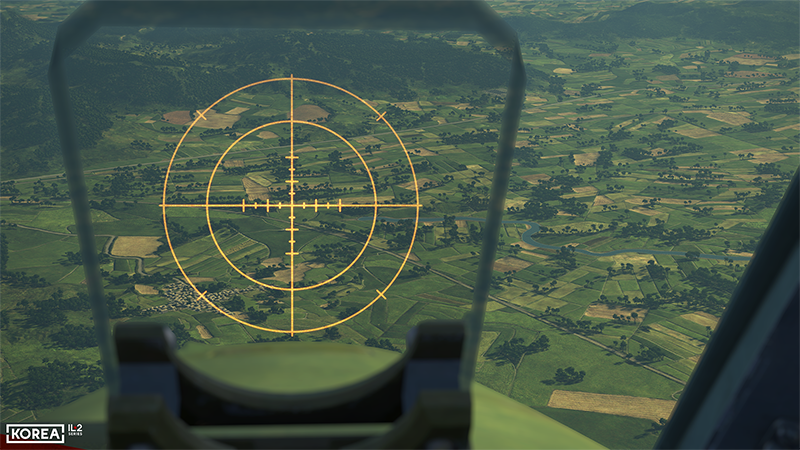
There is one element of an aircraft that every combat pilot spends the most time looking at. An element that commands attention during the most critical moments, those that determine the outcome of a battle. It is what we look through when facing the enemy, when their fate is being decided. That is why the most heated discussions about its accurate reproduction in simulators usually erupt, both on the internet and within the development team — it is the sight.
When developing sights for Korea, we decided to rethink their implementation, primarily the simulation of the optical component. We recently gained access to a working MiG-15 ASP-3 sight, and by working with it, we were able to uncover many subtle details of its operation — for example, things like the appearance of the reticle when the gyro is spinning or the sound of the gyro itself. However, that is not the main point.
The main thing is that this scope is equipped with a genuine 1950s incandescent bulb that still works. We checked its markings against the catalogs we have, and our assumption about its authenticity was fully confirmed. Thus, we ended up with not just a working sight (we're not the first to have one), but a sight whose reticle illumination is completely original. The reticle’s color, brightness, texture, and the details of its fine features — we managed to capture all of this both in photographs and, most importantly, in our memory. After all, an artist and engineer’s direct perception of such an object, rather than just from a photograph, is crucial for the most authentic reproduction in the simulator.
Each reference image was adjusted for color accuracy and brightness to match as closely as possible what a person sees with their own eyes. For example, if you slightly overexpose, the camera will capture highlights that aren’t visible at that reticle brightness.
In addition, these reference images reveal the finest irregularities, slight defects, small reflections, color variations, and many other details that make the scope’s appearance realistic. We have tried to reproduce all of this in our project as faithfully as possible.
That’s not all we’ve developed in terms of new features for the gunsights. We’ve added brightness control, which is crucial for night combat; furthermore, if the aircraft’s electrical system is damaged and the voltage drops, the sight’s backlight will also decrease in brightness. In the Soviet PBP and K8T sights, we’ve implemented a natural reticle illumination mode where the backlight lamp is removed and the reticle’s visibility is provided by sunlight entering the optical system. We’ve made it possible to lock the gyroscopic mechanisms of aircraft sights. The reticle animations have been rendered with much greater precision and detail than in Great Battles.
In addition to the reticles and their functionality, a lot of work has been done to refine the glass itself on which the reticle is displayed, so that it doesn’t look plastic or uniformly transparent.
Thanks to all these small details and nuances, we have been able to achieve maximum realism and a realistic experience when looking through the scope during those blood-pumping moments when you see the enemy in it.
You will see 3D and functional models of no less than ten different sights:
K-14B – installed in the F-51D as the standard variant
K-14C – installed in the F-80C-10 as the standard variant and the F-51 as a modification
Mk.18 – installed in the F-86A as the standard variant
A-1CM – installed in the F-84E and F-86A as a modification
PBP-1a – installed in the Yak-9P as the standard variant
PBP-1b – installed in the pilot's cockpit of the Il-10
K8T – installed in the gunner's cockpit of the Il-10
PKI – installed in the Yak-9P as a modification
ASP-1 – installed in the La-11 as the standard variant
ASP-3n – installed in the MiG-15 as the standard variant and in the La-11 as a modification
Each of these is crafted with meticulous care. We have compiled comprehensive documentation and photographs for every sight. Of course, in reality, there may be other details not described in the documentation, and even within a single sight model, there could be variations due to manufacturing imperfections or other circumstances, leading to some differences. But one thing is certain: a simulation of this element at this level of detail has never been seen before.
The pilot's interaction with their primary combat tool - the gunsight - has been taken to a whole new level, but this is far from the only improvement in aircraft equipment simulation. To make sure you don't miss our coverage of other innovations, please subscribe and follow us on social media: YouTube, Facebook, Reddit, X, and Discord!
Source
Changelog.gg summarizes and formats this update. How we read updates.