
Full notes
Full Kepler Protocol update
Read the full published notes in a cleaner layout. The original post stays linked below.
What changed
- Server
- Gameplay
- Maps
- Events
- Balance
- UI and audio
Kepler Protocol changes
We spent a night playing 540 games against ourselves. What we were looking for, we didn't find. What we found was worse.
Kepler Protocol isn't only tested by hand. We have a second system that plays the game when nobody is watching: two AI sides, the full rulebook, real maps — and a log that records every turn. Every resource level, every march order, every crisis.
On the night of 31 July, that system ran for eleven hours. 27 test series, 540 complete games, 1.1 gigabytes of logs. We wanted to check two new adjustments to the AI. This special issue is about what came back — and why the most interesting answer arrived to a question we never asked.
The test that found nothing
We test in pairs. Every game in the test run starts from exactly the same random seed as its twin in the control run: same map, same deployment, same dice. If one of them plays out differently, the adjustment is the only thing it can be.
The result was sobering. 528 of 540 paired games played out identically. One of the two changes — a filter meant to stop the AI from planning buildings it cannot construct — altered not a single outcome across sixty comparisons. Not one.
And it demonstrably works: with it enabled, the AI rejects 1,076 build proposals instead of 416. Six hundred and sixty additional rejections — and afterwards the same building stands in the same place, stone for stone. The mechanism strikes down proposals that were never going to be built anyway.
A test that finds nothing is still a result. Without that night we would have flipped the switch, ticked the box and moved on.
What we noticed instead
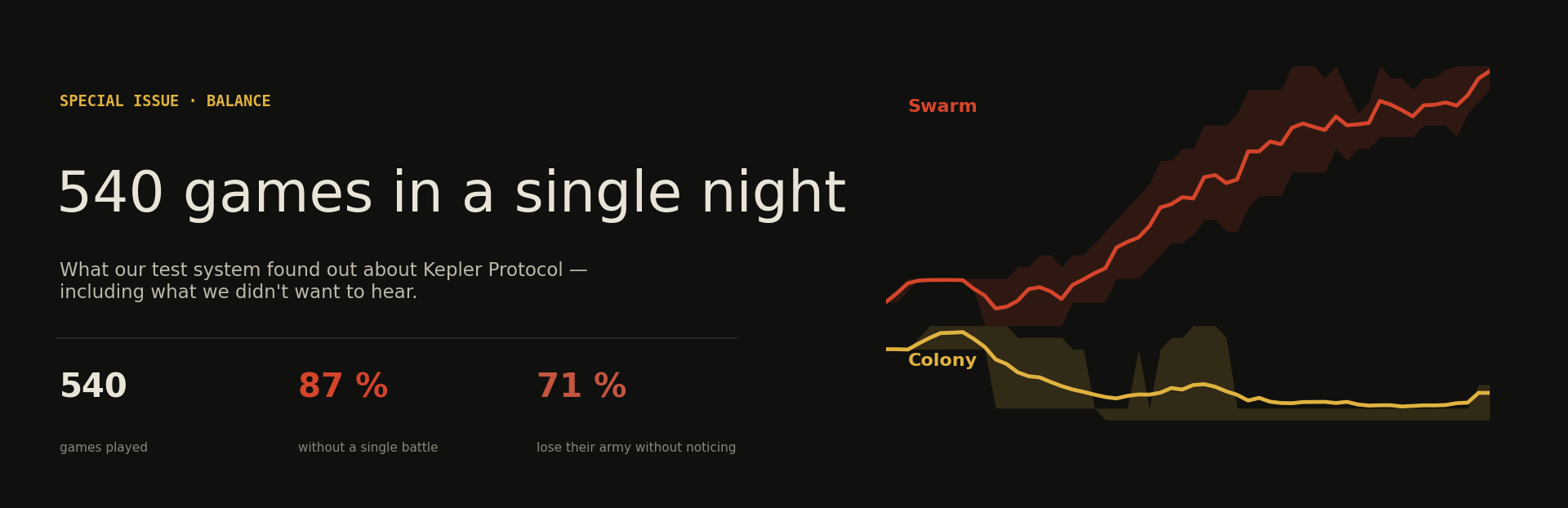
Once 540 games are sitting in front of you, you eventually stop looking only at what you came for. And then a number turned up that we couldn't explain: in 86.9 percent of all games, not one engagement took place. No skirmish, no raid, nothing. Across 540 games there were 104 fights in total.
Our first suspicion was the Swarm — it grows, it patrols, it simply never attacks. Wrong. When fighting does happen, the Swarm starts more than eighty percent of it. It isn't peaceful.
The answer was somewhere else entirely.
In four out of five games the colony loses its last formation — on average by turn 25. It starts with six brigades and is down to one by turn 20; from turn 32, half of all games have none left in the field at all. Over the same span the Swarm grows from ten to thirty. And here is the part that matters: in 386 of 540 games — over seventy percent — that army disappears without a single engagement having taken place, and without the game issuing one single loss report.
It starves. Quietly, over twenty turns. Across all 540 games there are 87 reports of destroyed formations — that's one report per six games.
A player wouldn't even notice when they lost their army. They would simply find, at some point, that there isn't one.
Why this explains everything
We spent months puzzling over why battles never materialise in our test runs. We picked apart the Swarm's aggression values, its alert levels, its target selection. The whole time the question was wrong.
It was
why does nobody attack?
It should have been
who is left to attack?
The Swarm stays at alert level three of six because its escalation is tied to engagements. There are no engagements because from turn 25 nobody is standing on the field. And nobody is standing on the field because hunger is the only effective damage path in the game — the only one nobody is ever told about.
A second finding fits neatly alongside: of seven hardships the colony can report, exactly one has a tangible consequence. Hunger reports itself over a hundred times per game and costs not one colonist. Only thirst kills. Six of seven warnings are noise — and the one that counts drowns in them.
What did work
The second adjustment was a small thing with a large effect. The staff plan — the tree of directives the colony can pursue — holds 27 entries. Until that night, nobody knew how many of them ever show up in play.
The answer was twelve. More than half lay fallow, because the AI always took the highest-scoring entry and that entry was always the same one. Let it draw by weighted lot instead, and coverage rises to twenty. Eight directives appear for the very first time — among them Secure Water Supply, in a game that ends in thirst more than half the time. The number of directives actually completed rises by a quarter.
That isn't a balance win. It's a content win: content that was built and never appeared.
What we're changing
Death by starvation gets a voice. When a formation gives out, the game will report it the same way it reports a loss in battle. Only then do we talk about attrition rates — before that, you're measuring in the dark.
Food shortage gets consequences. Staged: morale first, then production, then losses. For both sides. A warning you can dismiss a hundred times isn't one.
The Swarm gets its will back. Its drives sit on a neutral value for 72 percent of the game — a value that does precisely nothing — and two of its alert levels switch on a clock rather than on the situation. That's one line of configuration and one badly placed threshold. Both fixable.
The lottery stays on. The build filter goes.
A page from the Codex
From the staff's book of losses, entry undated.
The II. Company did not fall. There was no engagement, no withdrawal, no report. It stood in the field for fourteen days, and then it no longer stood. The quartermaster still carries it on the rolls, because no form exists for men nobody killed. Recommendation: such a form is to be created. What we do not count, we have not lost — and what we do not lose, we never learn to prevent.
Next devblog
The drill. Really, this time. That night gave up something about it too: across all 180 games the colony won, the drilling takes exactly 22 turns — not on average, in every single case. And the drill site was never attacked once in 540 games. So far, the Swarm has zero influence on the colony's only victory condition. That's what we're changing next.
Follow along
Wishlist on Steam: Kepler Protocol
Early Access: November 2026
Next devblog: The drill that never fired — and why it does now
Kepler Protocol — 4X strategy on an alien world. Discipline against the Swarm. Codex against pheromone. A red sun over both.
Source
Changelog.gg summarizes and formats this update. How we read updates.