
In this update5
Full notes
Full Kepler Protocol update
Read the full published notes in a cleaner layout. The original post stays linked below.
What changed
- Server
- Balance
- Maps
- UI and audio
Kepler Protocol changes
When the enemy has no mind yet still decides.
In a test round of Kepler Protocol, an Imperial reconnaissance patrol observed a swarm-pack two fields away. The pack was heading north — direction clear, pace steady. Then, mid-movement, it turned west. No visible cause. No order from anywhere.
We searched the log for a directive. There was none. There was a gradient instead: a few fields further west the pheromone concentration had shifted the previous turn — a spore plain had burnt out. The pack did not know about it. It followed an incline in the local field. That is not a decision in the human sense. It is not chance either. It is a third thing, and we are still looking for the word.
Classical game AI builds decision trees: if-X-then-Y. That works for an army with a general staff. It does not work for a swarm. We had to start over.
Where we learned it
**Hölldobler and Wilson, The Superorganism, 2008. Two myrmecologists, one life's work, one thesis: eusocial insect societies — ants, termites, bees — are not aggregations of individuals. They are a single organism whose cells are loosely connected through chemical fields. There are no commanders**. The queen lays eggs; she commands nothing. What the colony does emerges from thousands of local decisions that orient themselves on traces left by others.
Pierre-Paul Grassé coined a word for this in 1959: stigmergy — work that triggers other work, mediated by traces in the world, not by direct communication. A termite placed a clump of mud where one already lay, because the pheromone marker was stronger there. That is how the mound was built. No one planned it. No one had to.
For a swarm AI the productive question shifts: not what is the swarm thinking, but what field lies before it and which gradient is it following.
Built
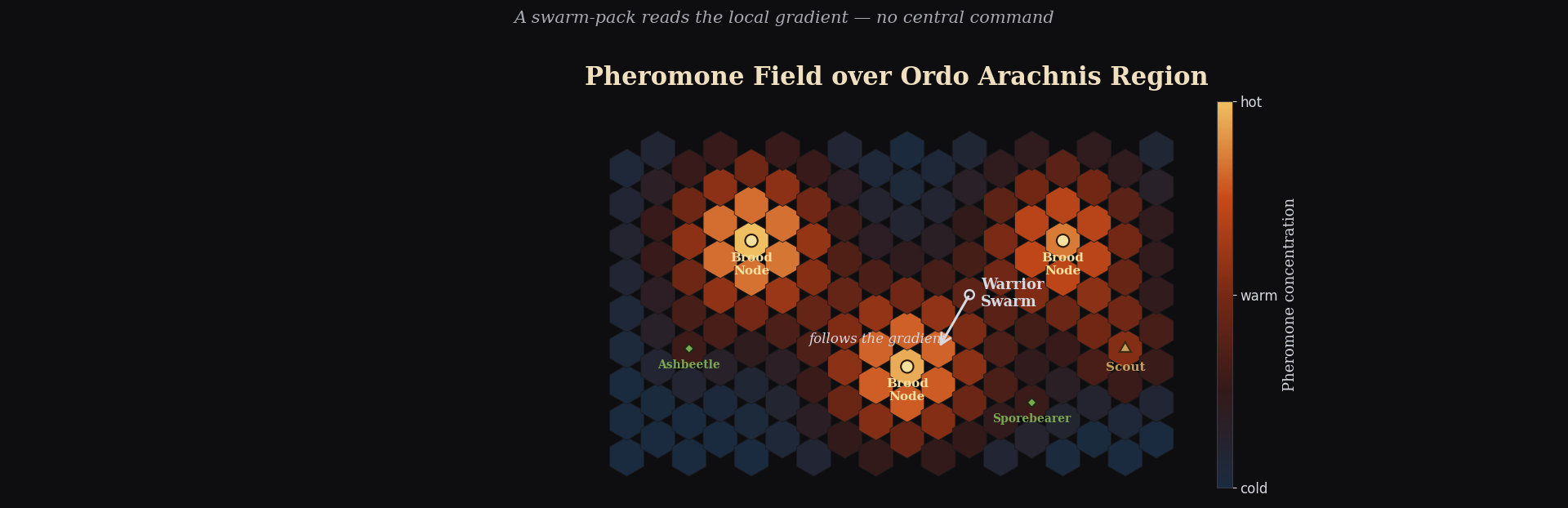
We do not build a decision tree for the Swarm's AI. We build a pheromone field. Steam post image
Across the whole world there is a pheromone field — a chemical grid over every terrain tile, growing through the Swarm's activity and decaying over time. Brood nodes emit passively. Swarm-packs leave traces while marching. When Imperial troops hunt or build, that too shows up in the pheromone field as friction. A pack reads its immediate surroundings and follows the gradient.
Three drives act in parallel, not in hierarchy:
Brood defence — queen nearby? Field pressure rises around her.
Tunnel growth — open expansion available? Outward pressure.
Imperial reaction — pheromone build-up where Kaiserreich troops have been tips the region into higher arousal.
Each drive carries its own weight per region. The dominant drive shapes behaviour locally. No pack knows what the Swarm is planning. It only knows what its field looks like on the ground. That is enough.
On top of this sits a slow phase mood of the swarm as a whole: dormant → curious → alerted → war. That is not an order; more of a register — like microphone hiss changing as a room fills up. Phase shifts happen over rounds, not in a single action.
Three weeks of work. Not a single central decision point in the code.
In play it shows up as an enemy that does not stop moving when you ignore it — and that sometimes goes exactly where you least expected.
Lore vignette
Two hundred thousand years ago a pre-civilisation on Kepler-186e ended abruptly. What it left behind is in the rock walls: smooth-melted boreholes, geometrically precise, nameless. What it did not leave behind directly lives on in the pheromone fields above the spore plains: Ordo Arachnis. By Linnaean count, eight-legged — therefore spider. That is what we call it.
Captain Ehlers writes in Codex 891.3:"We treat the Swarm as an enemy because we have no language for what it is. But enemy* presupposes that both sides recognise the conflict. The Swarm recognises nothing. It is here, the way the highland is here. We are fighting against geography."*
Next devblog
The Core Drill. For seventeen thousand games it stayed silent — not a single activation in our logs. This week we found out why. And it was not the mechanic. It was two voices that were not speaking to each other.
Stay with us
Wishlist on Steam: Kepler Protocol
Early Access: 2 October 2026
Next devblog: The Core Drill — seventeen thousand games of silence
Kepler Protocol — 4X strategy on a foreign planet. Discipline against the Swarm. Codex against pheromone. A red sun over both.
Source
Changelog.gg summarizes and formats this update. How we read updates.