
In this update5
Full notes
Full Kepler Protocol update
Read the full published notes in a cleaner layout. The original post stays linked below.
What changed
- Compatibility
- UI and audio
- Gameplay
- Balance
- Security
- Server
Kepler Protocol changes
In an early playtest of Kepler Protocol, the Kaiserreich's main army stood in front of Hive Beta. Fully manned, in combat, pinned. Back at the home base: a barracks, a reserve pool of soldiers, the material for a second corps. The AI saw all of it. And did nothing.
That was a poor default we'd built ourselves: one brigade per turn when the army had room. If not — standstill. No matter how clear the situation was.
We solved it with an old Prussian principle: Auftragstaktik (mission command).
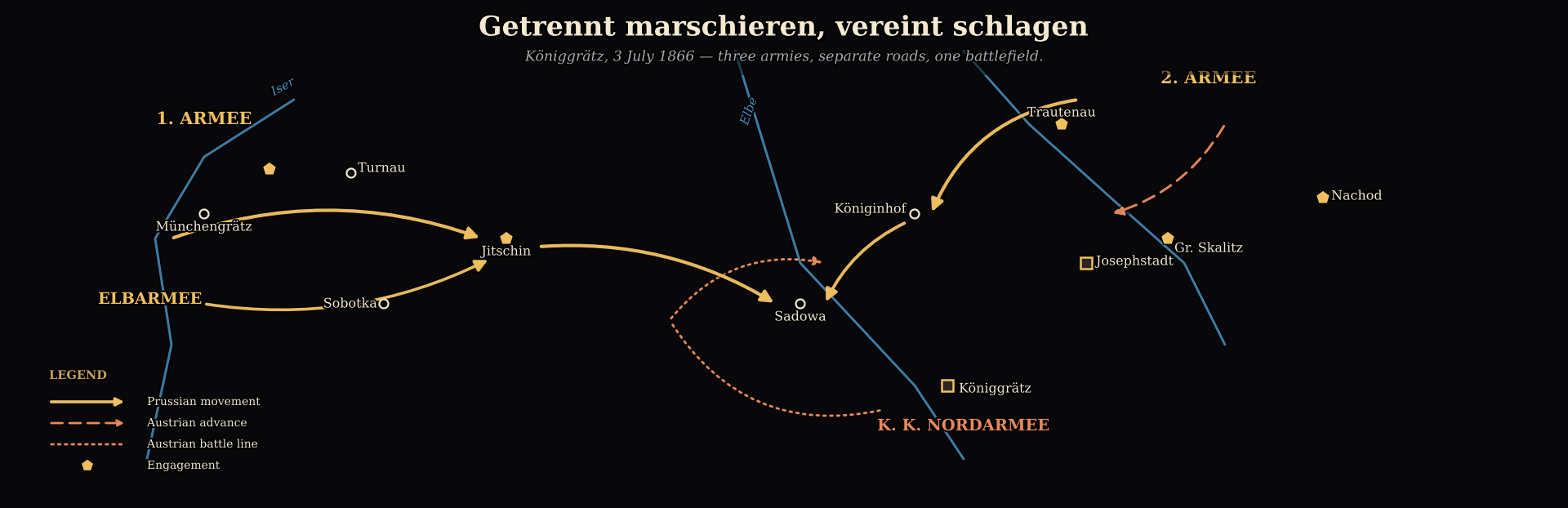
Moltke: March divided, strike united
Helmuth von Moltke the Elder, Chief of the Prussian General Staff 1857–1888, shaped three wars with one principle: the superior gives the intent, not the order. Not "3rd Brigade will march in column to the river, cross at the second bridge, take the heights north of the town." Instead: "3rd Brigade is to secure the river crossing. How — that's for the brigade commander to decide."
Moltke pushed this further than any staff before him: he let his armies march divided and strike united. In the campaign of 1866 he led three armies into enemy territory on separate roads — a risk classical strategists branded as madness. At Königgrätz they converged: the Crown Prince's Second Army appeared on the enemy's flank at the decisive moment — on the staff's directive, yet the officer on the spot chose the hour. No detailed order summoned it; the sound of the guns and the intent were enough.
This only works as an institution. The Prussian War Academy honed generations of officers on one doctrine — so that a delegated intent struck the same spirit in ten different commanders. Trust was not a feeling but a system. "No plan of operations," Moltke wrote, "extends with any certainty beyond the first encounter with the enemy's main force." The plan dies on contact — the intent survives. A game AI is in exactly that position: it is the officer in the fight. From now on, we give it intents rather than orders.
Implemented
Each AI faction receives High Command Missions when the situation calls for them. For example "Raise a new corps":
— Main army at 80%+ capacity
— Population reserve available
— Barracks built or under construction
→ Mission issued. The faction AI decides for itself: the new corps takes the next name in the Prussian line — II. Corps Bismarck, III. Moltke, IV. Roon — and draws its task from the situation: strike, scout, or hold a sector. Where, when, which task — that plays out. The name comes in sequence; the mission comes from the situation.
Before
a random attempt every 30 turns, often in the wrong place, sometimes not at all.
Now
targeted, when conditions are right, with a justification in the log. Two hundred lines of code, a nineteenth-century idea — experienced in-game as an opposing presence that exploits any opening because it spots it itself.
And the Swarm? It has its own form of mission command. Ordo Arachnis spawns new brigades through the Hive Brood when the Queen's pheromone field signals the moment — no general staff, no schedule. The asymmetry is by design. More on that next week.
Lore vignette
In the colony's archives there is a Codex of numbered entries without hierarchy. Codex 47 (Flux), Codex 48 (Salt-Mist Storms), Codex 213 (Arachnis Classification, Linnaean taxonomy). Some entries cite others that no one fully understands any longer. Some cite entries that never existed. To read the Codex is to read the memory of a world that no longer fully knows its own history.
Next week
Ordo Arachnis — Genesis. Who is the Swarm? The honest answer is: nothing, in the human sense. But the pheromone field encodes the probability that the next brigade will move north. That is not thinking. It is also not not-thinking. It is a third thing for which human language has no word.
Follow along
Wishlist on Steam: Kepler Protocol
Early Access: 2 October 2026
Next week: Ordo Arachnis — Genesis
Kepler Protocol — 4X strategy on a foreign planet. Discipline against the Swarm. Codex against pheromone. A red sun over both.
Source
Changelog.gg summarizes and formats this update. How we read updates.