
In this update5
Full notes
Full Kepler Protocol update
Read the full published notes in a cleaner layout. The original post stays linked below.
What changed
- Gameplay
- Maps
- Server
- Balance
Kepler Protocol changes
We have dissected the Swarm once before: how it decides — no commander, only pheromone gradients. Today is about how it grows up.
In one test game the Swarm tipped into a war mood after barely two months — the pheromone field glowing, swarms boiling outward, the brood chambers pulsing. An Imperial patrol pushed in, expecting armoured beetles. It found leaping predators. Small, fast, biting things — and nothing else. The heavy legions the Swarm is feared for were not there. They arrived months later.
Until now our Swarm unlocked its castes by the calendar: from week X, soldiers. That was convenient and biologically wrong. A colony does not count weeks. It counts its size.
Where we learned it
The myrmecologist Walter Tschinkel dissected ant colonies from the first queen to maturity. His finding: a young colony is monomorphic — a single worker size, nothing more. The soldier caste, the big heads, appears only once the colony numbers tens of thousands of workers. And reproductives — the winged breeders — come last of all. George Oster and Edward O. Wilson named this in 1978 as the two phases of an insect state: first the ergonomic (grow, work), then the reproductive (multiply). Never the other way round.
A colony that builds soldiers or wings too early starves. Growth takes priority — so strictly that ants under stress will defer reproduction to keep the body alive.
Generals know the same law: factories first, then tanks. No army ever stood ahead of its production base — the great battles of materiel were won by whoever had built the factory halls years earlier. A force must mature before it shows teeth.
Built — and on the test bench
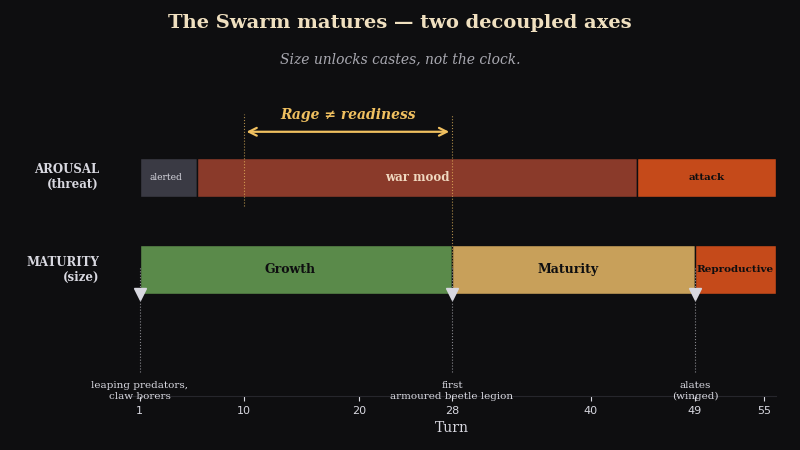
Steam post imageThe Swarm now has two axes.
The first, old, is arousal
dormant → curious → alerted → war, driven by threat.
The second, new, is maturity
founding → growth → maturity → reproductive, driven solely by the size of the colony — buildings plus brood chambers, not by the turn counter.
Each stage unlocks what biology allows.
Growth
leaping predators and claw borers.
Maturity
the majors — armoured beetle legions, bile spitters, brood guards.
Reproductive
the winged alates.
In the maturity axis measurement runs
for months only the small castes, the first armoured beetle legion only after a good half year of colony growth. And the wings? If at all, only toward the end of the first year — by which point most campaigns have long been decided.
Which is exactly right
reproduction is endgame, not routine.
The beauty is the decoupling. The two axes run independently. The Swarm can be in full war mood — and still be stuck in growth. Rage is not readiness. An enemy that has raged for weeks can rage toothless for months. Know that, and you have a window.
Honesty is part of it
the maturity axis currently lives on our test bench — behind a switch, validated against thousands of measured games before it goes live.
That is how we build every system
measure first, then release.
(And the balance? The Swarm's win rate has become above all a question of the map: in tight corridors it wins a good half of the games and more, on open field maps the Empire pushes back with armour and drives it well below that. Exactly the map identity we wanted.)
Lore vignette
A Hive is not a building. It is a body that is not finished yet. The pioneers' recovered Codex records brood chambers that spat out only workers for months and then, almost overnight, something larger. Captain Ehlers noted: "We took the young Hive for harmless. That was no error about its intent. It was an error about its age."
Next devblog
What Falls Does Not Fully Return. Across thousands of games not one soldier died in our battles — the casualty counter read zero. This week we found out why. And what it costs to change it.
Stay with us
Wishlist on Steam: Kepler Protocol
Early Access: 2 October 2026
Next devblog: What Falls Does Not Fully Return — the price of a battle
Kepler Protocol — 4X strategy on a foreign planet. Discipline against the Swarm. Codex against pheromone. A red sun over both.
Source
Changelog.gg summarizes and formats this update. How we read updates.