
In this update10
Full notes
Full HUNGER update
Read the full published notes in a cleaner layout. The original post stays linked below.
Repeated intro
Hello, Living.
What changed
- Balance
- Events
- Gameplay
HUNGER changes
When you first step into the World After The End, it can feel vast - complex, even overwhelming. Every ruin seems to hide a secret, every settlement a story. But as you begin to explore, you’ll find that the world slowly starts to make sense. Patterns emerge. Familiarity grows.
And the first step to understanding Hunger is learning how to take what the world gives you - and sometimes, what it doesn’t want you to have.
The Art of Looting
Looting is your first true dialogue with the world. When you enter one of Hunger’s regions, you’ll find that what you discover often reflects where you are. A logging camp might yield tools, timber, or food. A barracks could offer weapons, armour, or ammunition.
As you explore, you’ll encounter containers of all kinds - crates, chests, cupboards, and barrels - each containing items suited to its environment. Larger containers have a higher chance of holding multiple items, while smaller ones tend to hold fewer.
Every container’s contents are driven by its type, size, and a measure of chance. We want you to develop a sense of what should be inside - without ever being certain. Familiarity breeds efficiency, but mystery keeps you searching.
Even in locations you’ve visited a dozen times, there’s always the chance of finding something unexpected.
Container Variety
Not all containers look like containers. Some take the form of piles of earth, corpses to search, sacks of grain, toolboxes, or even bird’s nests high on rafters. All follow the same logic: the world rewards curiosity.
The more you explore, the more you’ll learn to recognise what might be searchable. A careful eye often finds more than a quick one.
Loose Loot
Not everything worth finding is hidden in a container. Across the regions, you’ll notice loose loot - standalone items left out in the open. Weapons leaning against walls, ampoules on tables, coins resting atop barrels, or provisions tucked beside a campfire.
These items can be picked up directly, and over time you’ll begin to recognise the shapes, colours, and glints that give them away. Learning to spot loose loot quickly is a valuable skill.
Looting the Dead
Any player who perishes during an Expedition can be looted by the Living who remain. Simply approach a corpse and open their inventory to claim what they carried.
Looting the Hunger
Even the Hunger have their uses. Any creature you kill can be searched for loot much like a container. Their twisted forms often yield scraps of armour, ammunition, or materials that hint at what they once were.
Looting a Hunger is risk and reward in its purest form - the reward for ending what was already lost.
Rummaging and Identification
Opening containers takes time. Your character must rummage through and identify what’s inside. This is not instant - and that time spent searching is time spent vulnerable.
Your identification speed can be improved with certain foods, or permanently enhanced through masteries designed for scavengers and explorers. Solo players, or those who value efficiency, would do well to invest in these. The faster you search, the faster you move on.
Locked and Rare Containers
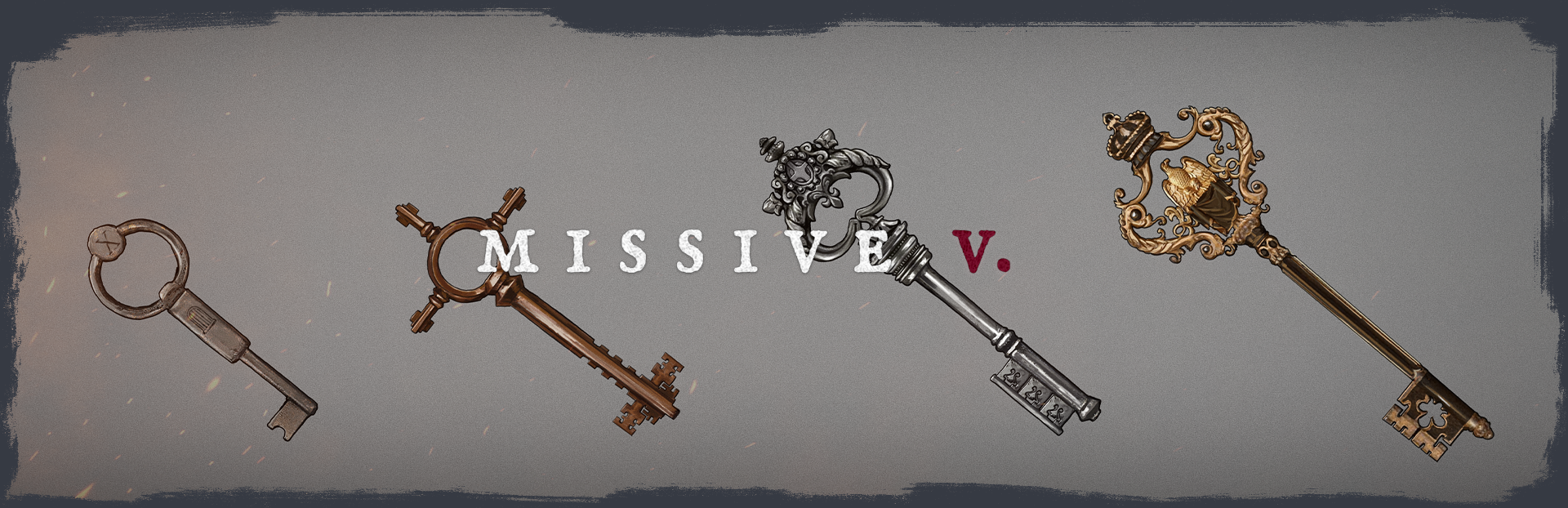
Not all containers yield easily. Some are locked, requiring specific keys to open. These are rare and valuable, and their contents reflect the effort it takes to reach them.
Later, we’ll introduce lockpicking - a slower, riskier alternative to keys. Lockpicks will be inexpensive but will test your patience and precision.
Some rare containers have a very low chance of appearing in a given Expedition. They’re often tied to specific landmarks - so if you learn where one might appear, it’s always worth checking again.
Bags and Capacity
Early in your journey, one of your first goals should be to find a bag. Bags expand your carrying capacity, letting you extract more from each Expedition and build your coin reserves faster.
You’ll often find them where they’d naturally belong: in cupboards, drawers, chests, or barracks. Even the simplest bag can make a significant difference to your survival.
We’ll be sharing more soon in a dedicated Missive, explaining exactly how different bag types work, how they expand your storage, and how they tie into your Stash and Expedition loadouts.
Dropped Bags
If you discard items or choose to leave something behind, they won’t simply vanish - instead, they’ll appear in a small dropped bag on the ground.
Dropped bags can be looted by other players, whether you meant to share or not. It’s a simple system that ensures every decision about what to keep - or abandon - carries consequence.
If you’re dropping items for a teammate, mark your spot well. If you’re dropping them in panic, be sure no one’s watching.
The Philosophy of Loot
Looting in Hunger is not mindless accumulation - it’s how you learn to read the world. Every drawer, every corpse, every creaking chest teaches you something about what remains of civilisation.
The World After The End is generous only to those who observe it. Once you start to understand what belongs where - and what doesn’t - you’ll begin to see the pattern beneath the ruin.
Wishlist Hunger to follow the journey and join our upcoming tests.
Source
Changelog.gg summarizes and formats this update. How we read updates.