
Full notes
Full HUNGER update
Read the full published notes in a cleaner layout. The original post stays linked below.
Repeated intro
Hello, Living.
What changed
- Balance
- Store
- UI and audio
- Gameplay
HUNGER changes
Of all the details revealed in our last trailer, few drew as much attention as the armour - and the tools used to maintain it. We wanted to take you deeper into one of Hunger’s most defining systems: how protection, repair, and survival truly function in the World After The End.
The Role of Armour in Hunger
Armour plays a crucial part in survival. Your chest armour carries its own durability, functioning as a secondary layer of health that absorbs incoming damage. Other pieces, such as helmets and greaves, act as damage modifiers, providing protection but without their own durability to restore.
Our goal is to ensure armour feels impactful and worthwhile without creating an unbridgeable skill gap. A less experienced armoured player should not automatically defeat a highly skilled unarmoured opponent. Armour should provide a clear benefit, yet remain surmountable through ability and strategy.
To keep your protection intact, players can use a range of armour repair tools and consumables, each with its own rhythm and risk. These fall into two categories: repeated-use tools and single or limited-use consumables.
Visual Representation Intent
We made a deliberate decision not to visually represent armour on characters in Hunger. Doing so would have greatly limited our ability to create distinctive, eccentric, and varied character appearances and cosmetics - one of the visual cornerstones of the game.
Because Hunger’s balance keeps the difference in survivability between no armour and top-tier armour within a narrow range, we felt it was less necessary to convey exact armour state visually. There are very few situations in Hunger where you would engage an opponent and later regret it based purely on their apparent gear. This is also because their general appearance works as a great proxy for armour too (and several other factors that may influence an engagement).
A character’s cosmetic rarity, the quality of their bag, and the weapons they carry all serve as strong visual cues to their general level of equipment. Over time, players learn to read these signals naturally. For those seeking more precise information, masteries and tools offer ways to discern exact armour type and condition. In combat, hit markers, sound, and impact feedback further communicate armour status - systems inspired by other titles that have successfully balanced clarity with creative freedom.
The Armour Tongs
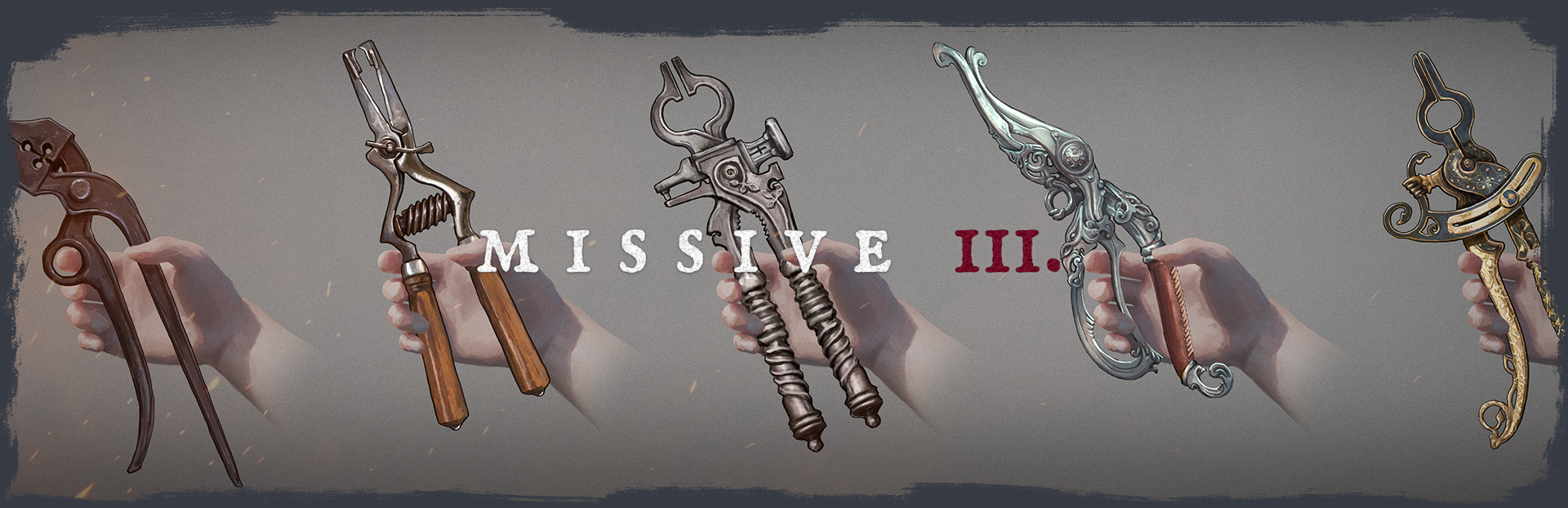
The Armour Tongs represent the repeated-use type. They can be used as often as needed, so long as they remain in your inventory. They’re slow, deliberate, and require dedicated focus, best used between fights rather than during them.
Unlike the faster, single-use Armour Plates that instantly replace damaged plating, the Tongs gradually restore your armour’s integrity over time. They must be equipped to your tool slot and actively used.
Because of their reliability and permanence, the Tongs are invaluable after battle, but risky to use under pressure.
Concept Art: Armour Tongs
Armour Plates
Where the Armour Tongs represent patience and persistence, Armour Plates are immediacy made manifest. They’re single-use, high-impact consumables that restore sections of your chest armour in one decisive action.
Unlike the Tongs, Plates do not mend or repair - they replace. Each Plate is a prefabricated segment of protection, slotted or affixed to your existing armour to restore its defensive capacity. Once used, it’s gone.
Concept Art: Armour Plates
In the field, this makes Armour Plates a tactical choice. They can bring you back from the brink during a fight, quickly restoring integrity that would otherwise take minutes to recover. But that advantage comes at a cost: scarcity, weight, and commitment.
Plates occupy standard inventory space, meaning they compete with the rest of your carried supplies - ammunition, healing, tools, and salvage. Carry too many, and you lose room for other essentials; carry too few, and you may find yourself exposed at the worst possible moment.
Their rarity and potency scale much like the Tongs - from Leather Plates found in ruined caches to the Damascus Plates produced by skilled craftspeople. Each tier restores progressively more of your armour’s bars, reflecting both the quality of the material and the skill of its maker.
In practice, Armour Plates are your rapid response to a bad situation - a means to re-enter the fight, to survive one more engagement, or to buy enough time to use your Tongs in safety.
Armour Repair in Practice
All armour repair items currently sit within the Tool category - Equippable and Usable - meaning they share space with other functional gear such as lanterns, traps, and spyglasses.
For now, every repair action in Hunger is a commitment - something to be done with intention, not haste. The choice between a slow, reusable tool like the Armour Tongs and a faster, consumable Armour Plate is part of the tension that defines the game’s survival loop.
As Hunger evolves beyond Early Access, more tools and gadgets will be introduced to help players maintain, treat, and modify armour in new ways - expanding the tactical choices available in the field and deepening how players prepare between expeditions.
Wishlist Hunger to follow the journey and join our upcoming tests.
Source
Changelog.gg summarizes and formats this update. How we read updates.