
In this update5
Full notes
Full HUNGER update
Read the full published notes in a cleaner layout. The original post stays linked below.
Repeated intro
Hello, Living.
What changed
- Gameplay
- Balance
HUNGER changes
This marks the beginning of our Missives - a series of focused insights into the design of Hunger and its systems. We’ll be releasing new Missives regularly, helping to better acquaint you with the World After The End.
Every wound tells a story. In Hunger, survival is measured not by what you avoid, but by how well you recover. Today’s Missive looks at the systems that govern health, healing, and the fragile space between life and death.
The Nature of Health
Your health represents the Living body’s final measure of endurance. It is the last line of defence beneath your armour, and when it fails, there is no recovery.
Every player begins with a default of 100 health - a finite resource that can only be restored through medical intervention. Damage is taken through combat, environment, or status effects.
To recover health, players rely on Medicine - specialised items that repair what the body cannot. Medicines fall into many categories, but we’ll highlight two today:
Repeated-use items, which can be used indefinitely but restore health slowly.
Single-use consumables, which act quickly but are lost after use.
Both are vital. Both carry risk.
All Medicine items are equipped to your Medicine slot and must be actively used to take effect.
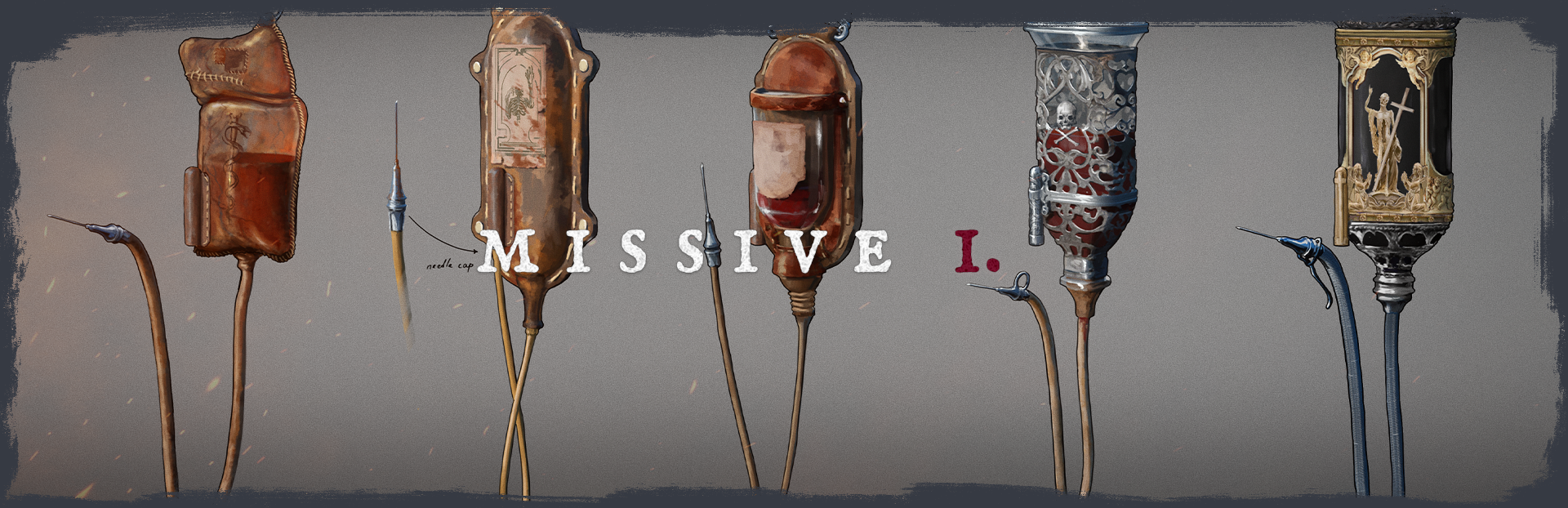
Steam post imageConcept Art: Bloodbags
Design Goals
Our approach to healing in Hunger follows a simple rule: it should be possible, but not perfect.
We want players to be able to heal during combat, but not so immediately that recovery becomes untouchable or leads to endless healing loops.
Medicine is designed to be limited - either in repetition or rate, forcing you to think carefully about when and where to use it. Timing matters - as does position, cover, and the cost of attention. Every choice to heal should carry the risk of being seen, caught, and interrupted.
This balance ensures that survival feels earned, not automated. Healing is not about erasing mistakes - it is about managing consequences.
We’ve designed Health as a standardised resource across all players, rather than something that scales dramatically with progression. A new player should not begin with 50 health while a veteran has 5,000 - that kind of disparity would make genuine competition impossible. By keeping health consistent, we can balance the time-to-kill (TTK) across all weapons and encounters. Better weapons in Hunger may shorten the TTK, but they do not grant invulnerability or guarantee victory - skill, positioning, and decision-making remain the deciding factors.
Bloodbags
The Bloodbags represent the repeated-use type of Medicine. They are slow, methodical instruments of recovery, designed for those who prepare early and heal deliberately.
In the world of Hunger, Bloodbags are a form of self-transfusion - filled with your own siphoned blood before an Expedition. They are heavy, clumsy, and faintly unsettling, but when the fighting ends, they are your best chance of replacing what you’ve lost.
Using a Bloodbag cannot be done from your inventory. It must be equipped, and once used, your character enters a continuous healing state, restoring health gradually over time.
Different rarities of Bloodbag improve both recovery rate and efficiency. The best of them can replenish at a far higher rate, but all share the same demand - exposure. You are vulnerable while healing, and every second you spend recovering is a second the world can punish you for.
Ampoules
The Ampoules represent immediacy - single-use inhalable Medicines that restore health far more quickly than Bloodbags, but at the cost of scarcity.
They can be used in the field to recover from critical damage, providing a rapid boost of vitality over a few seconds. However, the effect can be interrupted by taking damage, cancelling the healing and wasting the resource.
Ampoules can be stacked in the inventory and are often carried as emergency supplies. Each rarity tier improves potency and speed, culminating in the most refined medicines known to the Living.
In short: Bloodbags offer steady recovery, while Ampoules deliver instant reprieve, a split-second lifeline when every moment counts.
Healing in Practice
The tension between slow, repeated-use recovery and fast, consumable healing is deliberate - a mirror to the armour system (which we will be exploring in the near future), and part of Hunger’s rhythm of survival: preparation versus reaction, endurance versus urgency.
After Hunger’s Early Access launch, more and more medicines will be introduced - devices to stabilise allies, stop bleeding, or even share health between players. Cooperation will become a form of medicine in itself.
Steam post imageConcept Art: Ampoules
Wishlist HUNGER to follow the journey and join our upcoming tests.
Source
Changelog.gg summarizes and formats this update. How we read updates.