
Full notes
Full Greenhearth Necromancer update
Read the full published notes in a cleaner layout. The original post stays linked below.
What changed
- Gameplay
- Balance
- Events
- UI and audio
- Maps
Roshelle P. (she/her) is a game designer (UX research, narrative design) and death doula with 4 years of AAA/indie experience. She holds an M.A. in UX Design and founded Playfully Mortal, a two-time award-winning initiative advancing grief literacy through video games.
Her work centers advocacy through interactive storytelling (usually through afrofuturistic and solarpunk lenses) that spans themes of climate change to death justice.
Welcome to the sixth monthly (ish) developer log for Greenhearth Necromancer!
Our monthly devlogs will highlight different aspects of Greenhearth and will share insights into its development. As a semi-idle magical gardening sim, there will be much to share as development continues! This month’s entry is a Q&A with our death doula consultant, Roshelle.
Death is part of the DNA of Greenhearth Necromancer, from resurrecting plants into a transformed state, to processing the grief of your departed greenwitch Grandmother. Every action, spell, and bit of plant care that you do all brush up against the overwhelming permanence of death. It lives in your building in the form of Laurel, a death doula. To ensure we accurately depicted Laurel's role and to get an outside perspective on our story and characters, we turned to a real-life death doula.
Death is not the end, but a transformation…
How did you contribute to Greenhearth Necromancer?
I was a narrative consultant for the game and came in for a bit to review and provide feedback on narrative elements related to the accuracy and realism of how certain deathcare professionals, particularly death doulas, are depicted. I also looked at how general topics about death, like bereavement, coping mechanisms, and grief frameworks, are incorporated into the narrative with care for the player and with a trauma-informed lens foremost.
I also provided a cultural lecture for the narrative design team on a specific deathcare profession, the death doula or end-of-life doula, so they could learn more about the role and how it serves people as they looked to incorporate it into the game.
What exactly is a death doula? What are their responsibilities?
A death doula is someone who works in deathcare, a field that involves working in close proximity to people who are dying and their loved ones. A death doula is there to help the dying and or their families. And as a note: they don't always have to be someone who is clinical. For example, a death doula does not have to be a nurse, doctor, or psychologist. Sometimes those professionals are also death doulas, but the role itself is an informal, non-clinical one in which the person is there to assist as a guide and support.
You are there to help people with transition, whether that is the transition into death, their loved ones' transition into grief, or the transition into life after the person has passed. You are kind of a guide and a helper.
I think the central responsibilities of a death doula are to listen, to hold, and to tread softly.
We are there to listen to the stories, wishes, and concerns of the dying and their families, and to hold their stories, their memories, and who they are as people, bringing themselves into this experience. We tread softly because it's never our role to prescribe what must happen or what someone must do in their journey into death or grief. It's never our role to push someone around or tell them what to do. We are there to assist and to help, and that looks different in every single context with every person that we work with.
Treading softly, to me, is a core responsibility because it means we are aware of the work that we do and of how many complex emotions are involved. It’s a sign of giving dignity and respect to everyone involved and of working within the reverence and sacredness of death.
What makes a good death doula? What sort of approach do you have to take?
Well, what makes a good death doula can be answered in a couple of ways.
I think it starts with a strong foundation of emotional intelligence. Anyone who comes into a field like this is similar to those who go into psychology, therapy, or counselling - where...you don't have to be perfect. You don't have to have never experienced depression, anxiety, or grief yourself. Those are perfectly normal human experiences, and in fact, they can enrich your ability to perform the role because you bring that lived understanding with you… but you do have to have a level of emotional intelligence.
Emotional intelligence is critical because you'll be holding and listening to a lot of pain, trauma, and grief, as well as anger, rage, and sadness. You'll be privy to very personal family moments that may include dramas, feuds, or long-held secrets. Sometimes, death doulas can feel a bit like priests in confession. There are so many intimate moments, and being able to have empathy while also maintaining a healthy emotional distance is important. That requires high emotional intelligence and the ability to navigate complex, difficult conversations with tact and diplomacy, always centred on the dignity of the people you work with and their families. Sometimes you may also need to be an advocate, so having the courage to stand up for the people you support is important.
Overall, being emotionally intelligent, courageous, and empathetic are key hallmarks of a good death doula.
This role involves talking to people and being around them, but you don't have to be an extrovert or a sparkling conversationalist. As long as you can make someone feel seen, heard, and helped in a one-on-one situation, you can be successful.
If you're drawn to this field, it usually means you don't shy away from conversations about death, mortality, and grief. You don't have to be a perfectly put-together person who has never struggled with fear or sadness. That would be unrealistic. However, it's important to be open to candid and transparent conversations about death, as many people seek out a death doula because they need someone who can speak frankly about these topics.
Cultural and folkloric knowledge can also enrich your practice. For example, understanding funereal traditions within Filipino culture could help you better support someone from that background as they navigate their loss. This ability to bridge cultural gaps adds depth to the ritual aspects of deathcare.
My personal approach starts from a place of open-mindedness and curiosity. Being curious allows you to continue learning and to have your perspective expanded.
Adaptability and flexibility are also essential, as every person has different needs. Some individuals may only need a sounding board, while others may require more hands-on guidance or education around end-of-life planning or hospice care. Because no two experiences are the same, being versatile and comfortable with change is tantamount to this work.
What do games, or media in general, often get wrong about death?
I don't necessarily think that games get death wrong, but there's often a missed opportunity.
In many games, death is treated as something reversible. You die, you come back, and you try again. This mechanic has even spawned entire genres, like roguelites, where dying is part of the learning process. In that sense, there's something truthful about learning through failure.
However, what can be problematic is the expendable sense of life that this creates. Death becomes expected, necessary, and sometimes even trivialized as part of the design. This can cheapen its emotional weight and does little to cultivate a meaningful relationship with death or grief for players.
In the real world, many people are afraid to talk about death, yet in games, it becomes normalized in a way that can make it feel disposable. I wouldn't say this portrayal is wrong, but rather that it represents a missed opportunity for games to explore more intentional and considerate relationships with mourning, remembrance, and the emotional impact of loss.
If you had one piece of advice for someone about to deal with a death in their life, what would you offer?
The two things that come to mind immediately are, first, that it's okay to feel the way that you do. It's okay to feel sadness, emptiness, shock, anger, or even conflicting emotions. Especially in the immediate aftermath of losing someone, there's both an internal whirlwind of emotions and the external logistics of funeral planning. Allow yourself to feel and ride the waves of those emotions. Don't try to shut yourself off or bottle them up because you think that's what you're supposed to do.
This is especially important when the relationship with the person who died was complicated. Love can exist alongside anger, shame, or pain, and it's okay to sit with those contradictions without needing to neatly categorize them right away.
The second piece of advice is to get the help that you need. This help can be clinical, non-clinical, or simply the presence of someone willing to listen. Reaching out isn't a sign of weakness. Grief is often a lifelong walk that changes over time, and sometimes you'll need someone to lean on. That someone could even be a pet or, humorously speaking, a sentient compost heap if that's what provides comfort.
How does one become a death doula, both in practice and in spirit?
Well, it's one of those roles where it kind of feels like a calling, especially when you look at more Indigenous and traditional practices around dying, funeral rituals, and mortuary care. There have always been people who stepped into these roles, not necessarily as shamans, witches, or curanderas per se, but as individuals who became who they needed to be for their communities. You're called into it.
The sacredness of this role still exists today, even though we live in a society that approaches death and culture differently. If you find yourself wanting to help people but don't necessarily want to go the clinical route of formal schooling and degrees, this path might resonate with you. Often, people are drawn to this work after navigating their own experiences with grief and death, and feel a desire to pay it forward by supporting others. That's usually a sign that you're being called to the work.
In practice, there's no single or official way to become a death doula. There are certifications and training programs available that can be incredibly valuable, but they aren't mandatory. There isn't one governing body that licenses death doulas in the way that clinicians or counsellors are licensed.
This accessibility can be both a strength and a challenge. On one hand, it removes barriers and allows people from diverse backgrounds to enter the field. On the other hand, it means that individuals and families should carefully vet the doulas they choose to work with by reviewing a collage of their experience, training, and approach.
I often liken the role of a death doula to that of caregivers such as babysitters, nannies, or au pairs, in that, to my knowledge, there's no single credential that defines their worth. Instead, their aptitude is measured through emotional intelligence, compassion, reliability, and their ability to care for and be present with others. Additional education, certifications, or degrees can certainly enhance a practitioner's skill set, but they don't necessarily make or break someone's ability to provide meaningful support.
In spirit, I do believe there's often a spiritual element to this work, though it isn't a requirement. You don't have to be religious or spiritual to be a death doula. You can be agnostic or atheistic and still be deeply effective in this role. The essence of the work is presence.
However, for those who are spiritually inclined (like myself), the role can feel like a sacred practice, involving being in tune with oneself, with life, and with death. Life and death go hand in hand, and supporting someone at that threshold can feel profoundly meaningful.
Ultimately, becoming a death doula is about answering a calling, committing to ongoing learning, and showing up with compassion and respect for the diverse ways people experience death and grief.
How can death affect our perception of time?
Much like a depressive episode or anxiety attack, it depends on the person. Personally, I have felt time slow down, or it feels like time moves quickly around me while I am the single slow-moving point as I grieve. It can make you feel outside of time, distinct from it, in my personal opinion.
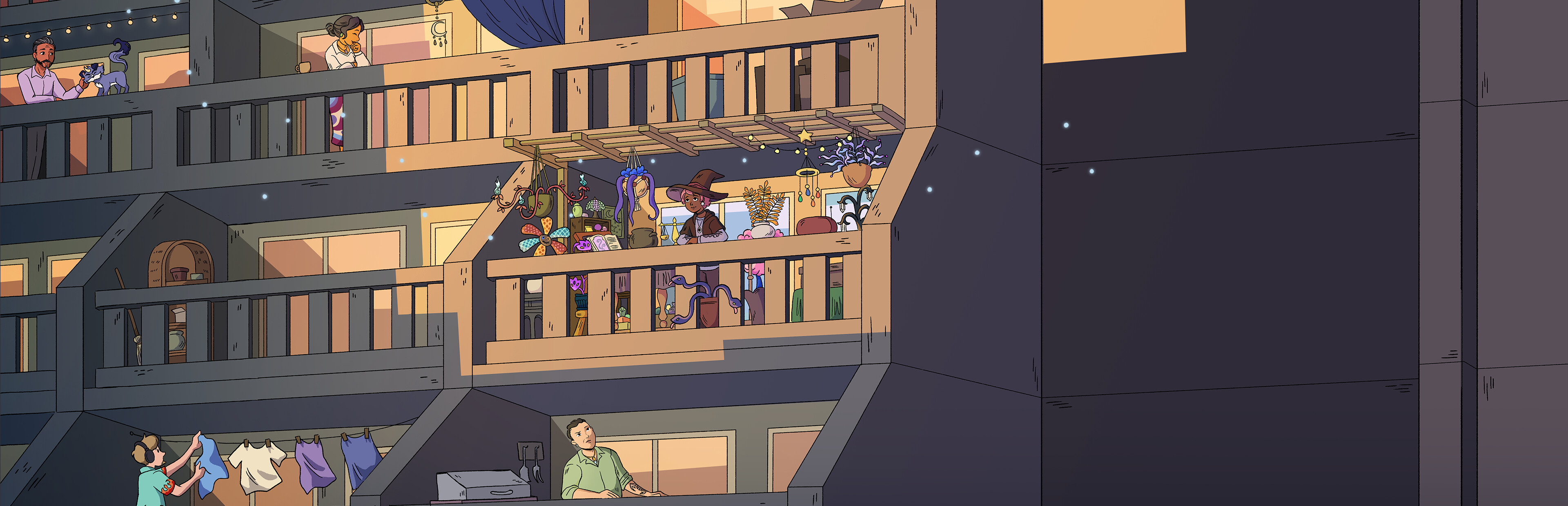
Steam post image[c]A mix of balcony times of day... but also various versions of the game from over the course of development![/c]
How much of you is in Greenhearth’s resident death doula, Laurel?
Haha, well, like Laurel, I really feel like my vibes are a mix of that high school art teacher and career counselor. I like to help people, provide advice, and be a listening ear. I also share some of Laurel's eccentricities and her ability to encourage others.
Like Laurel, I sometimes struggle with giving advice when people are not asking for it, which comes from a very human desire to help and to fix problems. Over time, I have learned to let people tell me what they need and to gently support them until they can articulate it themselves. I never want to be someone's mind reader or prescribe what I think they need, and I am not afraid to admit that I have done that before in an attempt to care. It was misguided care, and I can see that in Laurel as well.
A hallmark of Laurel's character is her accountability and her ability to own her mistakes and confront them. I relate to that deeply. It shows that even professionals in caring fields are human. We care a lot, and we are usually in these professions because of that care. Like Laurel, when I make mistakes, I strive to take accountability, repair any harm, and continue to lead with care and love.
How does one balance remembering someone after they pass, with letting go and moving on?
The beauty of grief is that there is no single right way to experience it. Each grief journey is as unique as the person who was lost.
From a death studies and psychological perspective, frameworks such as continuing bonds suggest that maintaining an ongoing connection with the deceased can be a healthy and meaningful path. Other theories emphasize letting go, but the real balance lies in ensuring that grief does not prevent someone from living their own life.
It's important not to pathologize grief, as many cultures allow for extended or highly expressive mourning practices. Ultimately, the balance involves continuing to live well while carrying the memory of the person with you. Grief does not end; it transforms over time into something more manageable and integrated into daily life.
Does Echo, our protagonist, practice healthy coping mechanisms for the death in their life?
I would say that, for the most part, Echo practices healthy coping mechanisms throughout their experience.
They maintain a connection with their grandmother by keeping memories alive, reading notes and journal entries, carrying on her life's work and research, and embedding themselves in the community that she loved and held dear. They learn to rely on others, open up about their feelings, and allow themselves moments of sadness.
Echo also encourages themselves to try new things, meet new people, and remain open-minded, even when they feel skeptical or uncertain. This openness sets the stage for healthy coping and personal growth.
What are you hoping people take away from the story of Greenhearth Necromancer?
I really hope people can take away two things from the story.
First, that the death of a loved one doesn't have to be the end of the relationship with that person. We carry the people we love with us in memory, in the ways they've shaped us, and in the legacies they leave behind. That continuing bond can be comforting and empowering rather than something that needs to be let go of entirely.
Second, I hope people recognize that they hold within themselves the power to change, evolve, and transform, and that this transformation isn't something to fear but something to embrace. Change is natural. It's how we grow. Just as death is a part of life, transformation is a part of being human, and leaning into that process can be both healing and empowering.
If you could have a bit of magical assistance in your life or line of work, what spells or potions would you like to have at your disposal?
One thing I have really been feeling lately is being short on time. There never seems to be enough time to clean, cook, be with family, be with friends, work, exercise, and everything else, especially when it comes to deep focus work.
I would love a spell that lets me pause time for everyone and everything around me so I can get things done while time is suspended.
Alternatively, a time bubble where time moves more slowly would be wonderful, allowing me to work at my own pace without affecting the outside world. Super speed would also be tempting!
I would also love a potion that grants fluency in every language. This would be invaluable in my work as a death doula and in mental health. Being able to communicate with and understand everyone would help people feel seen and understood, and would allow my natural skills to foster deeper connections and provide meaningful support.
Thank you to Roshelle for all of the insight into your profession and your contribution to the game! If you don’t want to miss updates about the game, subscribe to our newsletter and wishlist the game on Steam!
Source
Changelog.gg summarizes and formats this update. How we read updates.