
In this update4
Full notes
Full Goodbye Seoul update
Read the full published notes in a cleaner layout. The original post stays linked below.
Repeated intro
Hello! This is JINO, the developer of Goodbye Seoul.
What changed
- Gameplay
- Balance
- Events
- Performance
- UI and audio
Goodbye Seoul changes
It feels like it’s been a while since I last posted an update. First of all, I’d like to apologize for the recent lack of development logs. Since the beginning of the year, I’ve been extremely busy working through a series of big and small revisions to improve the overall quality of the game.
In particular, I recently finished the final round of polishing the game’s core element — the story — and have been focusing on implementing changes to the game based on those updates.
Today, I’d like to talk about two topics that involved a lot of consideration during development: the camera system, and an unexpected issue we encountered — motion sickness.
🎥 Choosing the Right Perspective — Even at the Cost of Efficiency
Goodbye Seoul is a 2D platformer played from a side-view perspective. In this genre, it’s very common for the camera to simply follow the player character while keeping them centered on the screen. This approach is not only the easiest to implement, but also the most familiar and comfortable for players.
However, in Goodbye Seoul, I chose not to use that approach. Instead, I manually place cameras throughout different spaces and areas.
To be honest, setting up every camera by hand is a very time-consuming and cumbersome process. Placing them initially is already a lot of work, but whenever the layout of a space changes—such as the structure of the environment, or the position and size of platforms—I have to go back and adjust the camera paths and positions again.
And because this genre often involves frequent changes to level layouts, managing cameras manually like this is actually a very inefficient way to work.
So why did I choose this method anyway?
Effort for Gameplay
The camera has a huge impact on the player’s experience. It shouldn’t simply follow the character—it also needs to consider many other factors: the player’s current position, objects they need to interact with, and the destination they need to move toward.
Especially when solving puzzles or navigating through the environment, if the camera fails to provide the right visual information, players can easily feel lost or frustrated.
By carefully framing certain objects at specific moments, the camera can also give subtle hints about puzzles, helping guide the player without explicitly telling them what to do.
Effort for Art
Another reason is the visual presentation.
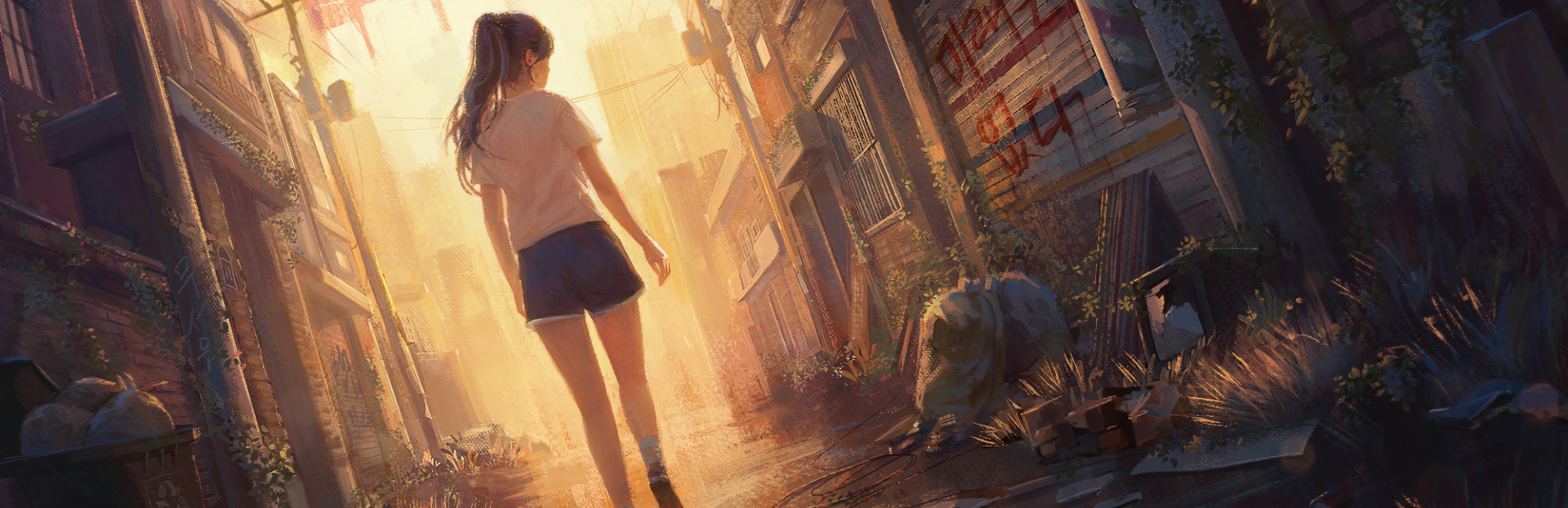
I wanted to show the ruined landscapes of Seoul in the most compelling way possible. To do that, I carefully think about which viewpoint best captures the atmosphere of each scene, and place the cameras by hand accordingly.
To balance both playability and visual appreciation, I manually set the framing and movement of every camera to match each scene and situation.
At first, I was overly ambitious and tried to showcase every visually impressive location during gameplay. But now I’m adjusting the balance more carefully—separating sections where players should focus on the gameplay from moments where they can take in the scenery.
My goal is to achieve both visual enjoyment and smooth gameplay at the same time.
🎞️ The Limitations of Animation
While many variables must be considered when designing camera work for gameplay, a different set of constraints appears when the cameras are used for cutscene animation.
Steam post imageSteam post image
The biggest limitation is that the range of camera angles we can use is extremely restricted.
Goodbye Seoul is a game that is played entirely from a side-view perspective. Most of the resources used in the game are 2D images, and the placement of objects and the composition of the screen are also built around a 2D structure.
Because of this, unlike 3D games where you can freely switch between top views, close-ups, and dynamic camera angles to create dramatic scenes, our available camera angles are inherently limited.
Even within these constraints, I spend a lot of time thinking about how to convey the characters’ emotions and the situation in a way that doesn’t feel dull or repetitive.
🌀 An Unexpected Challenge: 2.5D and Motion Sickness
One of the most surprising pieces of feedback during development was players saying that the game made them feel motion sickness.
Normally, motion sickness is something people associate with 3D FPS games, so it felt strange to hear that players experienced it in Goodbye Seoul.
To be honest, I’m not someone who is particularly resistant to motion sickness either. I previously worked at a company that developed VR content, and back then I often had to take breaks while working because wearing a VR headset for long periods would make me feel dizzy.
Because of that, it was quite surprising to hear that some players experienced motion sickness in Goodbye Seoul, even though I personally never felt it while developing the game.
What surprised me even more was feedback from players who said they had never experienced motion sickness in 3D games before, yet felt it while playing Goodbye Seoul.
After running various tests and analyzing the issue, I realized the problem came from my desire to emphasize the sense of depth in the game’s 2.5D presentation.
Although Goodbye Seoul is played like a 2D game, its rendering uses many 3D techniques. Object placement, scene composition, and lighting are closer to what you would see in a 3D game. At the same time, the gameplay itself remains mostly 2D, and many of the assets used are also 2D resources.
In games like this, when the camera simply moves left and right without any motion, the depth of a 2.5D space can feel somewhat flat. To compensate for that, I experimented with exaggerated camera movement and shake while the character was moving, hoping it would enhance the sense of depth.
However, this attempt ended up causing visual fatigue and motion sickness for some players.
To address this, I implemented a new “Motion Sickness Reduction” option, allowing players to disable elements such as screen shake or more intense camera effects.
My goal is to provide options so that players who enjoy the stronger sense of depth can keep it, while those who prefer a more comfortable experience can play without discomfort.
✍️ Closing Thoughts
For the past four years, I’ve been developing this game mostly on my own. During that time, I became very used to quietly working in isolation, with little interaction or connection with the outside world.
Over the past year, however, many things have changed. Through this game, I’ve finally begun to connect with the world little by little.
Because this shift happened relatively recently for me, I’m still not completely used to communicating in this way. As a result, there may have been times when updates arrived later than expected or when my communication felt a bit awkward.
But I truly want to say that the encouragement you’ve been sending has been a tremendous source of support during development.
As I once mentioned in an interview, I originally started this project simply because I enjoyed the act of developing a game itself. But now, the greatest joy for me is seeing players enjoy and experience the game I’ve created.
Goodbye Seoul began as a project made by just one person. But thanks to your support, it has been able to come this far.
Thank you sincerely for waiting for me and for this game.
— JINO
※ All contents of this developer note are subject to change depending on development progress.
Source
Changelog.gg summarizes and formats this update. How we read updates.