
Full notes
Full Global Conflagration update
Read the full published notes in a cleaner layout. The original post stays linked below.
What changed
- Gameplay
- Maps
- Store
- Balance
Global Conflagration changes
Let’s start with the good
We’ve completed our list of tasks based on the biggest complaints from our last PvP test. Everything on that front is now done. But does that mean Global Conflagration is finally ready for release?
In one sense, yes.
We now have a smooth, fully playable indie RTS experience, featuring three distinct factions, a solid map pool that stands well alongside recent RTS releases, and fully functional skirmish and PvP modes. On top of that, the campaign is already underway, with four missions completed and a strong foundation for the world and its conflicts.
Most importantly, the game works, and it’s fun.
The Bad
What we have would have easily satisfied RTS players 20 years ago. Today, however, expectations have shifted, especially around replayability and long-term engagement. The game performs best in short, action-focused sessions, but that style does not naturally align with a traditional skirmish-only structure. Because of that, an Early Access release, already a challenging step for most games, becomes an even bigger risk for us if we stay on the same path.
We are a very small team working with limited resources. Four years ago, part of the team stepped away from stable jobs to pursue this project full-time, and those resources have now largely been spent. We are proud of what we have built so far, but it has come at a significant cost in time and effort.
Developing an RTS campaign as a small indie team is an enormous undertaking. To give some perspective, it took us seven months to produce just two campaign missions, roughly 1.5 to 2 hours of gameplay. That is a substantial amount of work for a relatively small amount of content, with limited replayability. Because of this, scaling a traditional campaign to a meaningful length becomes extremely difficult under our current structure and funding outlook, especially if Early Access does not perform strongly.
Beyond the campaign, RTS development brings a high level of systemic complexity. Even in our recent task cycle, much of the time was spent testing, debugging, and reworking existing systems. At this point, even small changes can have wide-reaching effects across multiple systems, particularly unit AI and core gameplay logic.
This is also where the broader reality of the RTS genre comes into play. RTS games tend to have smaller player bases compared to many other genres, and they come with a high barrier to entry and modest commercial returns.
As a result, simply meeting baseline expectations already consumes a large portion of development resources, leaving limited space for experimentation or risk. This is one of the key reasons why it is rare to see small indie RTS projects break through in a major way.
The Road Ahead
The current campaign is serviceable and provides a solid introduction to our mechanics and universe. It is a strong foundation that we can build upon later, should we secure the resources needed to fully realize it.
Until then, we are shifting focus toward a mode that better reflects the strengths of the game. Since the early days of development, there have been ideas we always wanted to explore but never had the opportunity to fully pursue:
Army customization- allowing players to build their own battlegroup by selecting from a wide roster of real and fictional units.
Wave defense and insect invasion scenarios- players face overwhelming, evolving enemy forces. This also gives us creative freedom in designing opponents without the constraints of real-world warfare rules.
We are now bringing these ideas together through a roguelite-inspired game mode. This approach aligns closely with our strengths: short, intense sessions, high replayability, and scalable content. Just as importantly, it fits the reality of our team size, allowing us to expand the game at a sustainable pace while continuously delivering new experiences.
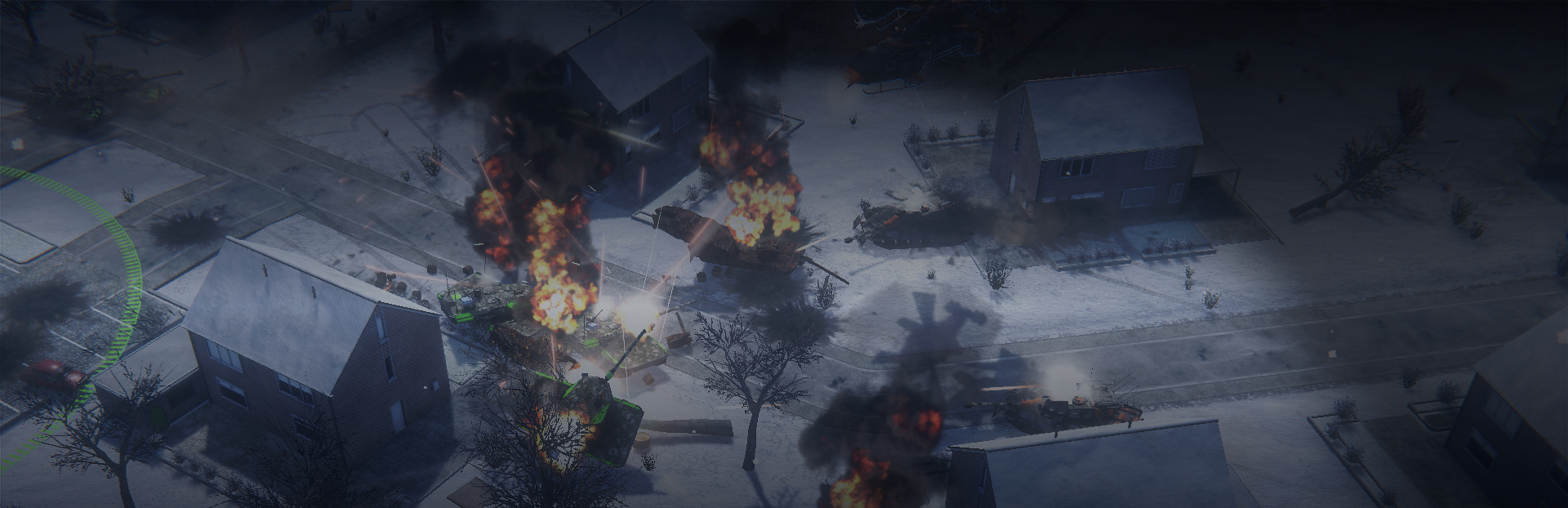
The first step in this direction will be the addition of the much-requested Harvester mode to Skirmish, serving as an initial test of our modular roguelite system. This is a relatively simple implementation, but it integrates cleanly with our existing mechanics. View store page Steam post image
It will serve as an alternative to the current more dynamic frontline resource system, replacing the scrap, refunds, checkpoints, and bounties, with a more traditional harvester-based economy. This should better support players who prefer a slower pace focused on base building and expansion.
What's a good plan without the resources to execute it?
On that front, we are pivoting away from a high-risk Early Access release and toward Kickstarter crowdfunding and following that with a full release.
Please sign here to receive a notice when it starts: Kickstarter page
Over the course of development, we have consistently delivered on our promises, with community feedback directly shaping the game after each public demo. This is a project with a long development history, built in close collaboration with its players from the very beginning.
We believe this track record demonstrates a level of reliability and transparency that we want to continue building on through crowdfunding.
With sufficient funding, we will be able to focus on delivering a complete release, rather than gradually fragmenting development through Early Access.
Source
Changelog.gg summarizes and formats this update. How we read updates.