
In this update9
Full notes
Full Gilded Destiny update
Read the full published notes in a cleaner layout. The original post stays linked below.
What changed
- UI and audio
- Gameplay
- Events
- Balance
- Maps
Gilded Destiny changes
Salutations industrialists!
I'm Marc, a Producer on Gilded Destiny. In today's dev diary, we're going to update you on the progress we've been making with Leaders, focusing on art style, animations, modding, and the importance of Leaders in the game. We also have a video version of this Dev Diary, which includes detailed examples of our portraits, animations, and implementation workflow.
If you haven’t already, please wishlist Gilded Destiny on Steam, subscribe on YouTube. You can additionally join our Discord, or Reddit community to stay up to date.
For more information about the Leader System itself, be sure to check out our previous Dev Diary on Leaders from last year, where we discussed the Leader UI, Leader traits, positions, and skills, and general mechanics of the Leader system.
In Gilded Destiny, Leaders represent the famous men and women of the nineteenth century who feature in our game as recruitable characters, that can fill governmental, military, and researcher roles. The game is also able to autogenerate generic Leaders who can be used to supplement (or even replace) the unique, historical Leaders, in order to cover both historical and alt-historical scenarios.
Without further ado, let's dive in.
Creating Portraits
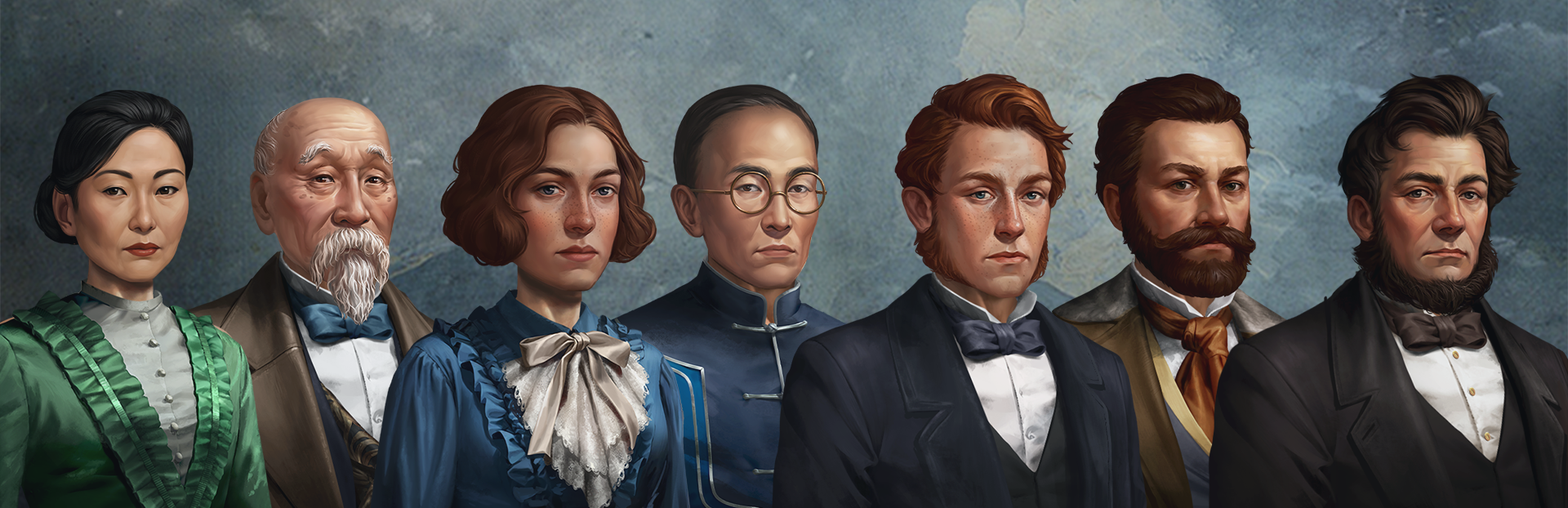
Given the number of countries and the overall time-span of the game, Gilded Destiny will have a significant number of historical Leaders. We've therefore had to be somewhat selective about which Leaders get unique portraits, and which get generic portraits that are just representative of their class and nationality. This means that we can still include plenty of Leaders with the appropriate traits and stats, but without being too constrained by the number of unique portraits we can reasonably produce (while still making sure that some famous faces are making an appearance).
Leader portraits use a realist painterly style that allows us to represent a wide range of historical personas with a fitting degree of detail and personality. We collaborate closely with an outsourcing studio, which allows us to scale the production of portraits while still maintaining a high level of artistic quality and historical authenticity.
We aim to preserve some degree of personal and cultural variation as well, within a manageable scope. While most 19th century military uniforms of the era tended to imitate the French style, we include some variations, such as red coats for British generals and white coats for Austrians. We also include some special clothing, such as the yellow dragon robes of the Qing Emperors.
Summary:
Historical Leaders will be given unique portraits where possible, although some will have generic portraits so that we can include a much wider range of real people.
Leader portraits use a painterly style that mimics nineteenth-century portraiture.
Leaders will have some degree of personal and cultural variation in their uniforms and clothing.
Leader Animations
After a portrait is finalized, polished, and approved by our artists and designers, we move to the animation phase. The portrait is separated into core components: head, clothing, body, and background. Each piece is exported as a high-quality PNG for animation using Spine (our rigging tool), in which our artists create meshes and skeletal rigs. Then we animate subtle, natural movements, such as breathing or posture shifting, to evoke a sitting-for-a-portrait feel.
We'd like to think that if animated portraits existed in the nineteenth century, this is how they would have looked.
Currently, animations are randomly selected from a pool of eight animation clips, creating an ongoing loop of non-repetitive motion that the Spine Unity plug-in blends automatically. This setup creates an ongoing loop that gives every portrait a quiet presence without requiring custom animations.
Summary:
Animations are subtle and non-obtrusive—as if the Leader were sitting for a portrait.
A pool of 8 animations will be randomly selected and blended smoothly via the Spine Unity plug-in.
Choosing Historical Leaders
For unique portraits, we focus on the heavy-hitters of the 19th century—people whose names (and sometimes faces) are instantly recognizable, and whose actions defined an era or changed the course of history. However, we've also included a few historical Leaders who could've made a big difference in alt-history scenarios (e.g., Ernest Augustus).
In game, historical Leaders will usually be added to a country's Leader pool when they started to make their mark on world history. When or if a Leader appears is sometimes dependent on certain conditions—for example, a Leader of a certain religion will only appear if that religion is allowed to hold office. Leaders might also appear after being unlocked via an event chain.
Leaders have stats that will indicate the roles for which they are best suited. In addition, they'll have individual traits—both good and bad—and might gain new traits with experience. Of course, Leaders will also have a lifespan that will run out, meaning that they will need to be replaced during the game.
Summary:
Unique portraits will mostly be reserved for significant historical figures, but with a few alt-history figures
Whether a historical Leader appears could be determined by specific conditions.
Leaders have stats and traits that indicate the roles for which they might be best suited.
Inputting Leaders and their portraits into the game
Once a Leader portrait has been completed, it is packaged for Unity and integrated into the current build via the game Editor.
Within the Editor, we first add Leader info (name, nationality, age, gender, etc.) and then assign the portrait head and clothing—for example, Otto von Bismarck.
Summary:
A completed Leader portrait is packaged for Unity and integrated via the game Editor
Leader info is first added to create a new Leader in the game itself
Then the portrait head and clothing are assigned to the Leader info.
Modding portraits and Leaders into the game
Finally, you can upload your own Leader portraits into the game via the game Editor! We are designing the Editor primarily with modders in mind.
Modding portraits into the game involves uploading a PNG file to the game Editor into game resources. The closer the dimensions are to our Leader's heads, the better it will render in the game. For instance, our office manager's portrait, as seen in the example, does not line up perfectly. We will then link the PNG file to a specific Leader component (a head or clothing) and then choose basic descriptors for age, body type, etc., for the new portrait.
We can then assign a new head to a new Leader or swap the head of an existing Leader. By this same process, you can edit any existing Leader in the game—you can switch heads, body types, clothing, and even portrait backgrounds.
Any changes can then be exported from the game editor and copied into the game files—a process which we aim to streamline before release.
When complete, you can see your changes in the game. Here's one we made earlier: the United Kingdom has a new, very regal Leader, ready to steer his country to greatness, food, and comfy boxes! If you like the idea of an official Gilded Cats of Destiny mod, let us know!
Summary:
Modders will be able to use the game Editor to easily switch portraits or create new Leaders
Modders can also edit existing Leaders, changing stats, body type, age, etc.
The process involves uploading a PNG file to the editor and linking the portrait to a Leader.
Alpha Update
Completed at the End of August
Research for military unit initialization is completed, implementation still needs to be done
Forest placement has been pushed back to September
Continued creating Portraits for Historical Leaders and Generic Portraits—mostly generics in August, with a focus on East Asian and European portraits
Input Political Parties UI
Completed implementation of Political Parties
Partially completed Pop distributions for Asia and Africa—initial Job balance complete, culture and religion setup under refinement
Completed 2D Army unit icons
Completed the redesign of the Regiment UI
Finished the main terrain illustrations
Targets for the End of September
Create Culture and Religion traits that fulfill a mechanical necessity, e.g., a trait that discourages pops from converting to animism
Continue balancing and refining the economy
Begin work on forests
Refine the size and population densities of certain provinces for the sake of balance
Continue creating Portraits for Historical Leaders and Generic Portraits, including African and more European and East Asian portraits
Complete 2D Navy unit icon
Postamble
We hope you've enjoyed this Dev Diary, and as always, if you have any questions or comments, let us know. You can find us on Discord, YouTube, X, Facebook, and Reddit for discussions, updates, and feedback.
Until our paths converge once more, we bid thee farewell!
May your destiny be a gilded one.
Source
Changelog.gg summarizes and formats this update. How we read updates.