In this devlog I’m going to talk about one my favorite parts of game design, both as a player and a developer: Artwork! I’ve been interested in computer graphics (CG) for about 30 years.
Full notes
Full Gearplexed update
Read the full published notes in a cleaner layout. The original post stays linked below.
What changed
0 fixes0 additions5 changes0 removals
Performance
Gameplay
Maps
changedIn this devlog I’m going to talk about one my favorite parts of game design, both as a player and a developer: Artwork! I’ve been interested in computer graphics (CG) for about 30 years. For a time, I actually considered, and trained for a career in movie special effects, but ultimately decided on a different path for career stability. However, keeping CG a hobby purely on its own was somewhat difficult. It is difficult for me to just sit down and make a piece of artwork without some inspiration or purpose. Incidentally, making my own video games turned out to be a perfect outlet. It’s a way of giving myself small, bite sized assignments. Often of things I wouldn’t otherwise do that push me out of my comfort zone.
changedAt the risk of stating the obvious, video games need a lot of artwork (a lot!). For Gearplexed, I settled on a no-outline 2D toon style because it best reinforced the game’s casual personality, and wouldn’t require a lot of time-consuming detail work. I originally considered a hybrid approach, where I would obtain 3rd party assets for the one-off pieces such as animals, vehicles, and buildings that would build the one-note stories (discussed in Periodic Devlog #2 ). Then I would match the assets’ art style for the gears, racks, and wheels, which I would do myself. I spent a few weeks browsing through 3rd party assets for the artwork I needed, but no one creator made everything I needed, and trying to get a consistent art style across multiple creators wasn’t happening. I also considered AI renderings, briefly, but the results tend to be less than inspired.* In the end I decided to cut the one-note stories and do 100% of the artwork myself.
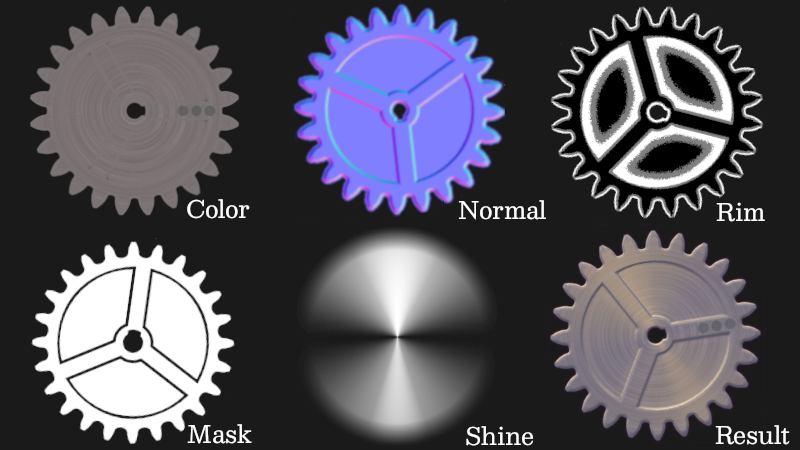
changedAll this for one gear… There’s about 300 original pieces of artwork tailor-made for Gearplexed, each with several maps and layers for dynamic effects.
changedGearplexed was an opportunity to try out Unity’s dynamic 2D lighting. Early experiments with it looked great, and I immediately decided that was the way to go. Although dynamic 2D lighting requires every sprite to have two secondary maps, fewer sprites are needed overall because there is no need to make sprites for different lighting scenarios (i.e. rotations). For example, there is only 3 sprites for the pipes – straight, bend, and tee, but I could combine them in different ways and even made an entire level environment exclusively out of these 3 pipe sprites. To get even more mileage out of each sprite, I used a bland, grayish color palette, and then tinted them different colors in-game to achieve different looks. When combined with different lighting angles and styles in each level, the possible combinations grew exponentially. The result is 72 levels that each look distinct from one-another with just 74 unique pieces of artwork.
changedThe most expensive decision was to have three different themes. Originally I wanted to do five themes, but after spending four months on the first two, I cut the total down to three distinct themes that could each be roughly associated with the different puzzle styles (i.e. movement, speed, torque). I feel like the effort was well placed, because it is a game about gears after all, so there should be a lot of gears to look at. The overall aesthetic naturally settled into a type of steampunk (though not as intricate as typical steampunk). I leaned into the steampunk style for chests and crafting machines, where I incorporated other mechanisms such as reversing gears and Geneva drives that serve as diegetic progress indicators.
Gearplexed changes
changedIn this devlog I’m going to talk about one my favorite parts of game design, both as a player and a developer: Artwork! I’ve been interested in computer graphics (CG) for about 30 years. For a time, I actually considered, and trained for a career in movie special effects, but ultimately decided on a different path for career stability. However, keeping CG a hobby purely on its own was somewhat difficult. It is difficult for me to just sit down and make a piece of artwork without some inspiration or purpose. Incidentally, making my own video games turned out to be a perfect outlet. It’s a way of giving myself small, bite sized assignments. Often of things I wouldn’t otherwise do that push me out of my comfort zone.
changedAt the risk of stating the obvious, video games need a lot of artwork (a lot!). For Gearplexed, I settled on a no-outline 2D toon style because it best reinforced the game’s casual personality, and wouldn’t require a lot of time-consuming detail work. I originally considered a hybrid approach, where I would obtain 3rd party assets for the one-off pieces such as animals, vehicles, and buildings that would build the one-note stories (discussed in Periodic Devlog #2 ). Then I would match the assets’ art style for the gears, racks, and wheels, which I would do myself. I spent a few weeks browsing through 3rd party assets for the artwork I needed, but no one creator made everything I needed, and trying to get a consistent art style across multiple creators wasn’t happening. I also considered AI renderings, briefly, but the results tend to be less than inspired.* In the end I decided to cut the one-note stories and do 100% of the artwork myself.
changedAll this for one gear… There’s about 300 original pieces of artwork tailor-made for Gearplexed, each with several maps and layers for dynamic effects.
changedGearplexed was an opportunity to try out Unity’s dynamic 2D lighting. Early experiments with it looked great, and I immediately decided that was the way to go. Although dynamic 2D lighting requires every sprite to have two secondary maps, fewer sprites are needed overall because there is no need to make sprites for different lighting scenarios (i.e. rotations). For example, there is only 3 sprites for the pipes – straight, bend, and tee, but I could combine them in different ways and even made an entire level environment exclusively out of these 3 pipe sprites. To get even more mileage out of each sprite, I used a bland, grayish color palette, and then tinted them different colors in-game to achieve different looks. When combined with different lighting angles and styles in each level, the possible combinations grew exponentially. The result is 72 levels that each look distinct from one-another with just 74 unique pieces of artwork.
changedThe most expensive decision was to have three different themes. Originally I wanted to do five themes, but after spending four months on the first two, I cut the total down to three distinct themes that could each be roughly associated with the different puzzle styles (i.e. movement, speed, torque). I feel like the effort was well placed, because it is a game about gears after all, so there should be a lot of gears to look at. The overall aesthetic naturally settled into a type of steampunk (though not as intricate as typical steampunk). I leaned into the steampunk style for chests and crafting machines, where I incorporated other mechanisms such as reversing gears and Geneva drives that serve as diegetic progress indicators.
In this devlog I’m going to talk about one my favorite parts of game design, both as a player and a developer: Artwork! I’ve been interested in computer graphics (CG) for about 30 years. For a time, I actually considered, and trained for a career in movie special effects, but ultimately decided on a different path for career stability. However, keeping CG a hobby purely on its own was somewhat difficult. It is difficult for me to just sit down and make a piece of artwork without some inspiration or purpose. Incidentally, making my own video games turned out to be a perfect outlet. It’s a way of giving myself small, bite sized assignments. Often of things I wouldn’t otherwise do that push me out of my comfort zone.
At the risk of stating the obvious, video games need a lot of artwork (a lot!). For Gearplexed, I settled on a no-outline 2D toon style because it best reinforced the game’s casual personality, and wouldn’t require a lot of time-consuming detail work. I originally considered a hybrid approach, where I would obtain 3rd party assets for the one-off pieces such as animals, vehicles, and buildings that would build the one-note stories (discussed in Periodic Devlog #2). Then I would match the assets’ art style for the gears, racks, and wheels, which I would do myself. I spent a few weeks browsing through 3rd party assets for the artwork I needed, but no one creator made everything I needed, and trying to get a consistent art style across multiple creators wasn’t happening. I also considered AI renderings, briefly, but the results tend to be less than inspired.* In the end I decided to cut the one-note stories and do 100% of the artwork myself.
All this for one gear… There’s about 300 original pieces of artwork tailor-made for Gearplexed, each with several maps and layers for dynamic effects.
Gearplexed was an opportunity to try out Unity’s dynamic 2D lighting. Early experiments with it looked great, and I immediately decided that was the way to go. Although dynamic 2D lighting requires every sprite to have two secondary maps, fewer sprites are needed overall because there is no need to make sprites for different lighting scenarios (i.e. rotations). For example, there is only 3 sprites for the pipes – straight, bend, and tee, but I could combine them in different ways and even made an entire level environment exclusively out of these 3 pipe sprites. To get even more mileage out of each sprite, I used a bland, grayish color palette, and then tinted them different colors in-game to achieve different looks. When combined with different lighting angles and styles in each level, the possible combinations grew exponentially. The result is 72 levels that each look distinct from one-another with just 74 unique pieces of artwork.
The most expensive decision was to have three different themes. Originally I wanted to do five themes, but after spending four months on the first two, I cut the total down to three distinct themes that could each be roughly associated with the different puzzle styles (i.e. movement, speed, torque). I feel like the effort was well placed, because it is a game about gears after all, so there should be a lot of gears to look at. The overall aesthetic naturally settled into a type of steampunk (though not as intricate as typical steampunk). I leaned into the steampunk style for chests and crafting machines, where I incorporated other mechanisms such as reversing gears and Geneva drives that serve as diegetic progress indicators.
What is conspicuously absent is stylized backgrounds. This isn’t because I got lazy, it is because Gearplexed is already a visually busy game with two layers to think about. Any pattern at all in the background turns it into a visual cacophony. As such, that puts more pressure on the foreground and middle ground to create visual interest. I feel I could have done better on the environments, but Gearplexed is not a game about exploring an environment, it is a game about gears. As developers we have finite resources and as such must prioritize our efforts where they have the most impact, which in this case was the gears, wheels, and belts.
Gearplexed was my first attempt at making intentionally non-realistic artwork. I think it turned out pretty well, and I learned a lot in the process. That’s all for this devlog, next time I'll cover part 2 of the game design. Thanks for reading!
*Edit: That decision was made well over a year ago. Now I'm really glad I didn't use any Gen AI, because this year has seen a huge swell in abhorrence towards those tools.