
Full notes
Full FSX SpacePort update
Read the full published notes in a cleaner layout. The original post stays linked below.
What changed
- Gameplay
FSX SpacePort changes
As many of you may know by now, Microsoft has announced the successor to the highly acclaimed FSX, along with the series of legacy Flight Simulators derived from FSX. The new simulator will be titled (appropriately) FS2020, (or, FS dos equis, for FSXX, as some simmers have started calling it ːsteamhappyː). We have been following with great interest the progress of the development, and we tried to scoop technical details that might pertain to what hopefully will be a follow up to FSX SpacePort - a version compatible with FS2020.
While the visuals are undeniably stunning, what MS has shown off so far was within atmosphere, where spaceflight dwells for mere minutes. On October 24th, MS has posted the latest development video, where they describe the weather system in FS2020. In it, there are a few quick video sequences of weather from a very high altitude, and, to our delight, a sequence from orbital altitude! Let's take a look at what they reveal:
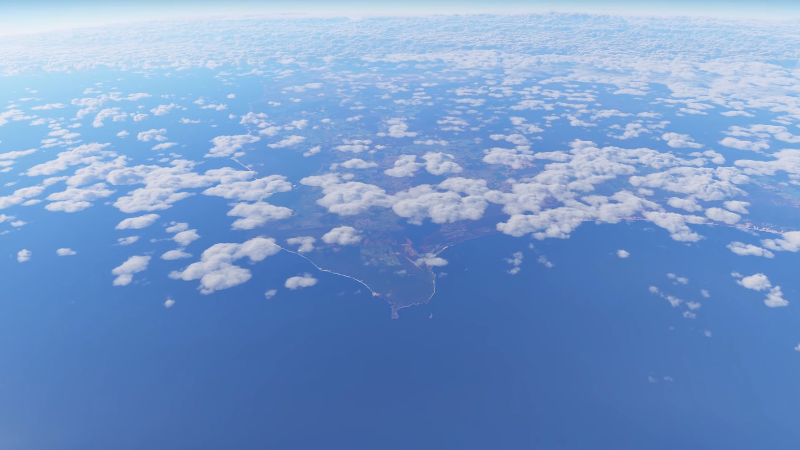
This first shot is taken from a very high altitude, perhaps 20 to 30 km (judging by the curvature of the Earth), and it shows a visual acuity far into the horizon. This is great from the aspect that the weather seems to have a lot bigger coverage than it had in FSX, where above 30 or so km, you can clearly see a "box" of weather (clouds) under the spacecraft. At orbital heights, The weather has to be turned off because it is just a small patch close to the ground that follows spacecraft, and the rest of the planet has no weather at all. We were always unhappy with how this looked and were searching for alternate solutions.
The next shot is pretty spectacular: It clearly shows the landmass of Western Australia from orbital height. There are a few things that are truly exciting about this shot: First, the land mass is rendered with a much better and natural looking land coverage. It is looking far less generic (as it is in FSX's case) and far more random and natural. Moreover, there is (finally) cloud coverage from orbital heights!!! And not just random cloud coverage - this is REAL TIME WEATHER data, and the clouds are then procedurally generated to depict the correct cloud type, coverage, altitude, etc.
The next image is truly impressive - it is a zoomed-in region of the area inside a blue circle in the above image:
These are 3-D cloud puffs as seen from orbit! All rendered with shadows casting on the ground, AND onto the clouds themselves. If this is the sign of what is being developed, the vista from the orbit will be truly spectacular! We cannot wait to enjoy a spacewalk in LEO, with this kind of imagery zipping below us - the experience will be breathtaking!
Mitch Lead Developer
Source
Changelog.gg summarizes and formats this update. How we read updates.